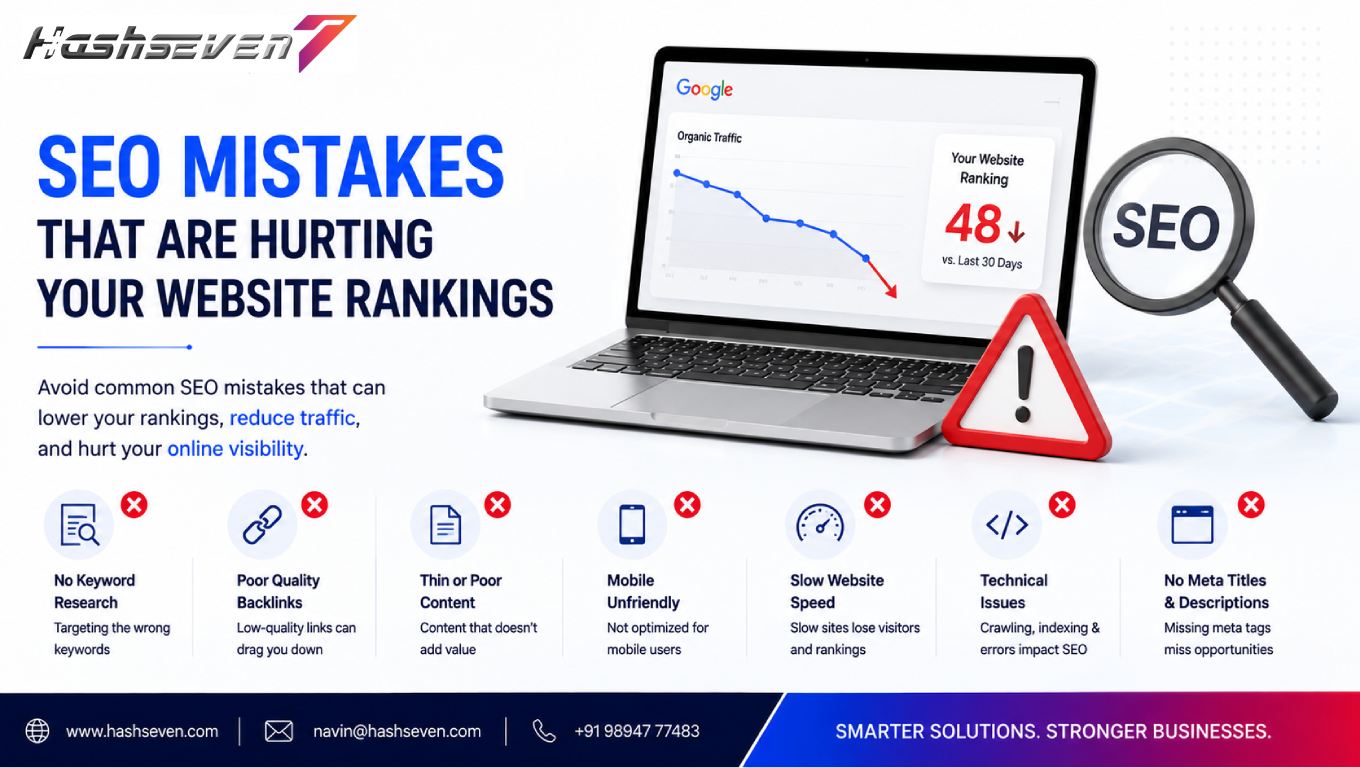

Avoiding common SEO mistakes is essential for businesses that want to improve website visibility, attract organic traffic, and reach potential customers through search engines. Even a well-designed website can struggle to rank when technical problems, poor content, weak keyword targeting, or ineffective optimization practices are holding it back.
SEO is not just about adding keywords to a webpage. Search engines evaluate many aspects of a website, including content quality, technical accessibility, page experience, links, mobile usability, and how well a page satisfies search intent.
Some SEO problems are easy to identify, while others can remain unnoticed for months. A broken internal link, poorly optimized title, slow page, duplicate content, or missing indexability setting can prevent important pages from performing as expected.
In this guide, we’ll explore the most common SEO mistakes, explain why they can hurt your website, and provide practical ways to fix them.
What Are SEO Mistakes?
SEO mistakes are errors or ineffective practices that can prevent a website from reaching its full potential in organic search.
They can occur in different areas, including:
- Keyword research
- Content creation
- On-page SEO
- Technical SEO
- Link building
- Local SEO
- Website performance
- Mobile optimization
- Analytics
- Search engine indexing
Some mistakes may directly affect how search engines crawl, index, or understand your website. Others can reduce the usefulness of your content or make it harder for visitors to accomplish their goals.
Understanding and correcting common SEO mistakes can help create a stronger foundation for sustainable organic growth.
Build a Website That Grows Your Business
A professionally developed website is the foundation of your online success. If you’re planning to create a responsive, fast, and SEO-friendly business website, explore our Website Development Services to see how Hashseven can help transform your ideas into a powerful digital presence.
Why Do SEO Mistakes Matter?
Search engines aim to provide users with useful and relevant results.
If your website has technical problems or content that doesn’t satisfy the user’s needs, it may struggle to compete with better-optimized pages.
SEO mistakes can contribute to:
- Lower organic visibility
- Reduced website traffic
- Poor user experience
- Lost leads
- Lower conversions
- Indexing problems
- Wasted marketing resources
SEO is a long-term process, so identifying problems early can prevent them from becoming larger issues.
1. Keyword Stuffing
One of the most common SEO mistakes is keyword stuffing.
Keyword stuffing happens when a website repeatedly uses a keyword in an unnatural attempt to influence search rankings.
For example, writing:
“Our SEO services provide SEO services for businesses looking for SEO services because our SEO services are the best SEO services.”
This creates an unpleasant reading experience and provides little value.
How to Fix It
Use your focus keyword naturally and focus on the topic as a whole.
Include related terms, synonyms, and relevant concepts where appropriate.
Instead of repeating one phrase, explain the subject comprehensively.
2. Targeting the Wrong Keywords
Choosing keywords simply because they have high search volume can be a mistake.
A keyword may attract many searches but have little relevance to your products or services.
For example, a local web development company may benefit more from a targeted phrase such as:
“website development company in Chennai”
than a highly competitive general term such as:
“website.”
How to Fix It
Consider:
- Search intent
- Relevance
- Competition
- Location
- Business goals
- Conversion potential
The best keywords are not always those with the highest search volume.
3. Ignoring Search Intent
Search intent refers to what users are actually trying to accomplish when they search.
A person searching:
“what is SEO?”
is probably looking for educational information.
Someone searching:
“SEO services for small business”
may be researching service providers.
If your content doesn’t match the intent behind the query, it may fail to satisfy visitors.
How to Fix It
Before creating content, analyze the search results and determine whether the dominant intent is:
- Informational
- Navigational
- Commercial
- Transactional
- Local
Then create content that directly addresses that intent.
4. Creating Thin Content
Thin content provides little useful information to the visitor.
Examples include:
- Very short articles with no meaningful explanation
- Pages with little original value
- Automatically generated pages
- Duplicate location pages
- Product pages with minimal information
Longer content isn’t automatically better.
The goal should be useful, relevant, original content that addresses the user’s needs.
How to Fix It
Improve content by adding:
- Practical examples
- Expert insights
- Relevant data
- FAQs
- Step-by-step instructions
- Helpful images
- Comparisons
- Original explanations
Focus on usefulness rather than word count alone.
5. Publishing Duplicate Content
Duplicate content occurs when substantially similar content appears across multiple URLs.
This can make it difficult for search engines to determine which page should be shown in search results.
Common causes include:
- Duplicate product pages
- Multiple URL versions
- Copied blog posts
- Printer-friendly pages
- Similar location pages
How to Fix It
Use:
- Canonical URLs
- Proper redirects
- Unique content
- Consistent URL structures
Review duplicate pages during regular technical SEO audits.
6. Writing Poor Page Titles and Meta Descriptions
Your title and meta description help users understand what a webpage is about before clicking.
A poor title may be:
Home
A better title could be:
Professional Web Development Services | Hashseven Inc
How to Fix It
Create titles that are:
- Relevant
- Specific
- Concise
- Descriptive
- Aligned with search intent
Meta descriptions should accurately summarize the page and encourage qualified users to click.
Avoid stuffing multiple keywords into titles and descriptions.
7. Ignoring Technical SEO
Technical SEO helps search engines crawl, understand, and index your website.
Ignoring technical SEO is one of the common SEO mistakes that can affect otherwise good content.
Important technical areas include:
- Crawlability
- Indexability
- XML sitemap
- Robots.txt
- Canonical tags
- Redirects
- Structured data
- HTTPS
- Website architecture
- Core Web Vitals
How to Fix It
Regularly perform a technical SEO audit and use tools such as Google Search Console to identify indexing and technical problems.
Google Search Console can help website owners monitor search performance and identify certain technical issues.
8. Having a Slow Website
Website performance can influence user experience.
A slow page may cause visitors to leave before interacting with your content.
Common causes of poor performance include:
- Large images
- Unnecessary scripts
- Poor hosting
- Excessive plugins
- Unoptimized code
- Browser caching problems
How to Fix It
Consider:
- Compressing images
- Using modern image formats
- Removing unnecessary scripts
- Optimizing code
- Using caching
- Improving hosting infrastructure
- Monitoring Core Web Vitals
You can use Google PageSpeed Insights to evaluate page performance.
9. Ignoring Mobile Optimization
A website that looks good on desktop but performs poorly on smartphones can lose potential visitors.
Mobile users expect:
- Fast loading
- Easy navigation
- Readable text
- Touch-friendly buttons
- Responsive layouts
- Simple forms
How to Fix It
Test your website across different screen sizes and ensure that important content and functionality remain accessible.
Responsive design should be part of your website development strategy from the beginning.
10. Poor Internal Linking
Internal links connect pages within your own website.
They can help users discover relevant information and help search engines understand the relationship between pages.
For example, a blog about website speed could link naturally to a relevant website development service page.
How to Fix It
Create internal links when they genuinely help the reader.
Use descriptive anchor text rather than generic phrases such as:
- Click here
- Read more
- Learn more
Build logical connections between related pages.
11. Broken Links and Incorrect Redirects
Broken links can create poor user experiences.
Common problems include:
- 404 errors
- Broken internal links
- Incorrect redirects
- Redirect chains
- Links pointing to deleted pages
How to Fix It
Regularly crawl your website and identify broken URLs.
Then:
- Update broken links
- Redirect permanently moved pages
- Remove unnecessary links
- Fix redirect chains
A healthy website should make navigation straightforward for both users and search engines.
12. Ignoring Image SEO
Images can improve content, but poorly optimized images can create performance and accessibility issues.
Common problems include:
- Huge image files
- Missing ALT text
- Descriptive information missing
- Poor filenames
- Unnecessary images
How to Fix It
Use:
- Descriptive filenames
- Appropriate ALT text
- Compressed images
- Modern image formats
- Responsive images
For example:
Bad filename:
IMG12345.jpg
Better filename:
local-seo-services-guide.webp
ALT text should describe the image accurately rather than simply stuffing keywords.
13. Neglecting Local SEO
Local businesses often overlook local search optimization.
If your company serves specific locations, local SEO can help potential customers discover your business.
Local SEO may include:
- Google Business Profile
- Local landing pages
- Customer reviews
- Local citations
- Location-specific content
- Consistent business information
A complete local strategy can complement broader SEO efforts.
14. Buying Low-Quality Backlinks
Backlinks can help establish authority, but not all links are valuable.
Purchasing large numbers of low-quality or manipulative links can create SEO risks.
Avoid:
- Link farms
- Spam directories
- Automated link schemes
- Irrelevant paid links
- Private blog networks designed solely for rankings
How to Fix It
Focus on earning relevant links through:
- Original research
- Useful resources
- Expert content
- Digital PR
- Partnerships
- Industry publications
Quality and relevance are more important than simply collecting large numbers of backlinks.
15. Not Updating Old Content
SEO doesn’t end after publishing an article.
Information can become outdated.
Examples include:
- Old statistics
- Outdated software information
- Expired products
- Old screenshots
- Incorrect links
- Previous-year references
How to Fix It
Conduct periodic content audits.
Update pages when needed by:
- Refreshing information
- Replacing outdated statistics
- Improving explanations
- Adding relevant sections
- Fixing broken links
- Updating screenshots
Don’t change content simply for the sake of changing it. Update pages when there is a meaningful reason to do so.
16. Ignoring Search Console Data
Another common SEO mistake is publishing content without monitoring its performance.
Search Console can help businesses understand:
- Search queries
- Impressions
- Clicks
- Click-through rate
- Search positions
- Indexing information
This information can reveal opportunities for improvement.
For example, a page receiving many impressions but relatively few clicks may benefit from a stronger title or more relevant search-result presentation.
17. Overlooking Website Security
Security is essential for modern websites.
An unsecured or compromised website can damage:
- Customer trust
- Business reputation
- Website availability
- Search visibility
Use HTTPS and keep your CMS, plugins, themes, and dependencies updated.
Regular backups and security monitoring can also reduce risks.
18. Not Measuring Conversions
Traffic alone doesn’t guarantee business growth.
A website may receive thousands of visitors without generating meaningful leads or sales.
Track valuable actions such as:
- Contact form submissions
- Phone calls
- Purchases
- Quote requests
- Appointment bookings
- Newsletter signups
Your SEO strategy should ultimately support business objectives.
How to Fix Common SEO Mistakes
A systematic approach makes SEO improvements easier.
Step 1: Perform a Website Audit
Review technical SEO, content, links, performance, mobile usability, and indexing.
Step 2: Identify Priority Issues
Don’t try to fix everything simultaneously.
Prioritize problems that affect:
- Security
- Indexing
- Important pages
- User experience
- Conversions
Step 3: Improve Existing Content
Update pages that already have search visibility but need better content or optimization.
Step 4: Fix Technical Problems
Address broken links, redirects, crawl issues, speed problems, and indexing errors.
Step 5: Improve Internal Linking
Connect related pages using useful, descriptive anchor text.
Step 6: Monitor Results
Track rankings, organic traffic, conversions, impressions, and clicks over time.
SEO Audit Checklist
Use this checklist to identify common SEO mistakes on your website:
- ☐ Research relevant keywords
- ☐ Match search intent
- ☐ Avoid keyword stuffing
- ☐ Create useful original content
- ☐ Optimize page titles
- ☐ Write relevant meta descriptions
- ☐ Use logical headings
- ☐ Improve website speed
- ☐ Optimize for mobile
- ☐ Fix broken links
- ☐ Review redirects
- ☐ Optimize images
- ☐ Add relevant internal links
- ☐ Monitor backlinks
- ☐ Update outdated content
- ☐ Check indexing
- ☐ Maintain an XML sitemap
- ☐ Review robots.txt
- ☐ Use HTTPS
- ☐ Monitor Search Console
- ☐ Track conversions
Why Professional SEO Services Can Help
SEO involves multiple disciplines, including content, technical optimization, website development, analytics, and digital marketing.
Professional SEO services can help businesses:
- Identify technical problems
- Perform keyword research
- Optimize website content
- Improve website architecture
- Build internal links
- Monitor search performance
- Improve local SEO
- Track conversions
- Develop long-term SEO strategies
This can be especially useful for businesses that don’t have dedicated SEO professionals internally.
Why Choose Hashseven Inc?
Hashseven Inc can help businesses build and improve their search visibility through a comprehensive SEO strategy.
Our approach can include:
- Technical SEO
- On-page SEO
- Local SEO
- Keyword research
- Content optimization
- Website optimization
- SEO audits
- Performance optimization
- Conversion-focused SEO
Instead of focusing only on rankings, the goal should be to create a website that attracts relevant visitors and turns them into customers.
Frequently Asked Questions
1. What are the most common SEO mistakes?
Some of the most common SEO mistakes include keyword stuffing, targeting irrelevant keywords, ignoring search intent, creating thin content, publishing duplicate content, neglecting technical SEO, having a slow website, and failing to optimize for mobile devices.
2. Can SEO mistakes lower website rankings?
Yes. Technical problems, poor-quality content, indexing issues, bad user experiences, and other ineffective practices can prevent pages from performing well in organic search.
3. How can I find SEO mistakes on my website?
Start with a technical and content audit. Tools such as Google Search Console, PageSpeed Insights, and website crawling software can help identify technical and performance issues.
4. Is keyword stuffing still effective for SEO?
No. Keyword stuffing creates unnatural content and is not a good SEO strategy. Keywords should be used naturally while focusing on satisfying the user’s search intent.
5. How often should I perform an SEO audit?
A basic SEO review can be performed regularly, while a more comprehensive audit can be scheduled quarterly or whenever significant website changes are made.
Conclusion
Avoiding common SEO mistakes is essential for businesses that want to build sustainable organic visibility.
SEO isn’t simply about adding keywords to webpages. Successful optimization requires a combination of useful content, technical health, strong internal linking, mobile usability, website performance, relevant backlinks, and continuous monitoring.
Problems such as keyword stuffing, poor search intent alignment, thin content, slow pages, broken links, weak internal linking, outdated content, and technical SEO issues can all limit a website’s potential.
The good news is that most SEO problems can be identified and improved with a structured audit and consistent optimization process.
Rather than chasing quick ranking improvements, focus on creating a technically sound website that provides useful information and a positive experience for visitors.
Ready to Build a Professional Website for Your Business?
Turn your business into a powerful online brand with Hashseven.
Since 2017, we’ve helped businesses grow through professional website development, mobile apps, custom software, SEO, digital marketing, CRM, POS solutions, and Meta-approved WhatsApp automation. Let’s create a fast, secure, and conversion-focused website that attracts more customers and drives real business growth.