

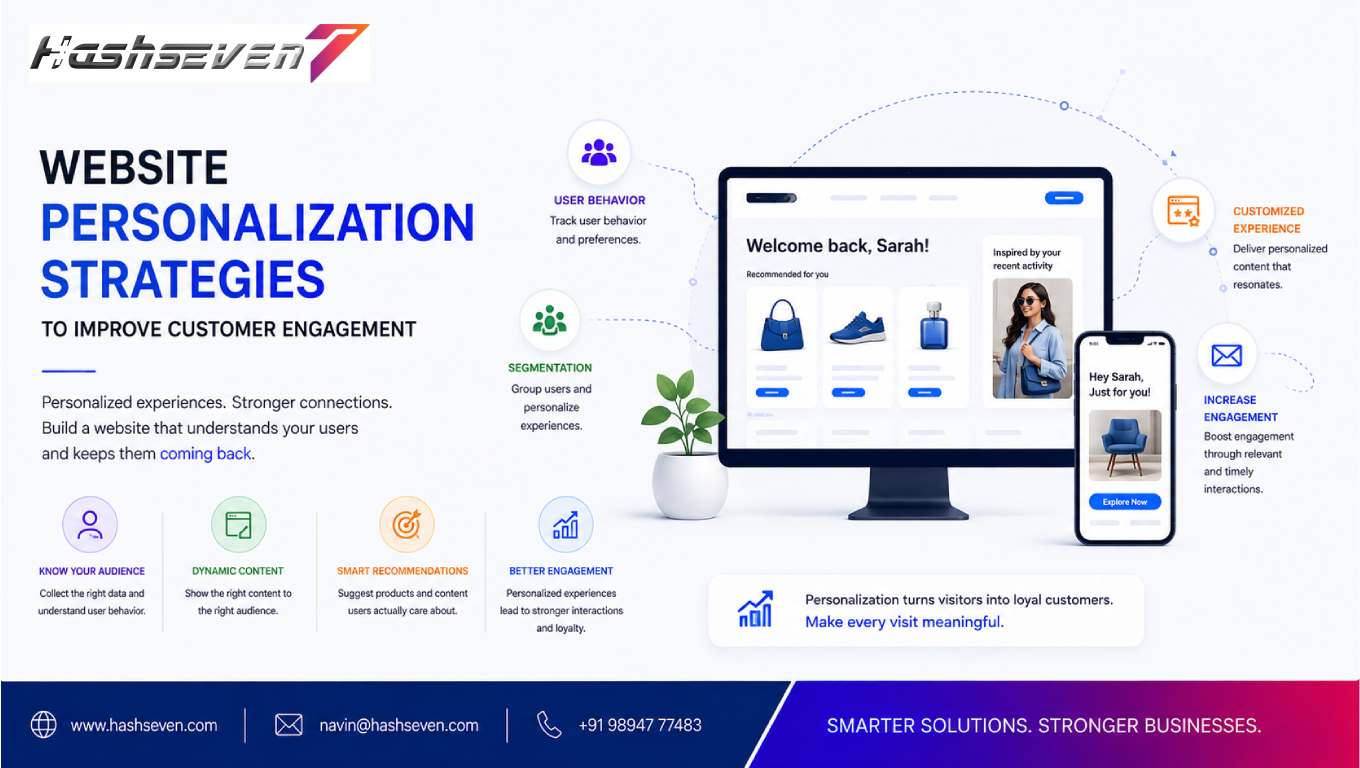
Website Personalization Strategies to Improve Customer Engagement

Customer expectations have changed significantly. Visitors no longer want generic online experiences that show the same content to everyone. They expect websites to understand their needs, provide relevant information, and make it easier to find what they are looking for.
This is where website personalization becomes valuable.
Website personalization allows businesses to tailor website content, recommendations, offers, calls to action, and user experiences based on visitor behavior, preferences, location, device, customer stage, or other relevant signals.
For example, a returning visitor might see content related to products they previously explored, while a first-time visitor could receive introductory information. A visitor from a specific location may see locally relevant services or contact information.
When implemented correctly, website personalization can create more relevant customer experiences, improve engagement, support conversions, and strengthen relationships with visitors.
In this guide, we will explore effective website personalization strategies, their benefits, implementation methods, and best practices businesses can use to improve customer engagement.
What Is Website Personalization?
Website personalization is the process of customizing a website experience according to the characteristics, interests, behavior, or needs of individual visitors or audience segments.
Instead of presenting exactly the same website experience to every visitor, businesses can dynamically adjust certain elements.
These elements can include:
- Website content
- Product recommendations
- Calls to action
- Offers and promotions
- Landing pages
- Images
- Navigation
- Forms
- Service recommendations
- Location-based information
- Email capture messages
For example, an eCommerce website could recommend products based on previous browsing activity. A B2B website could display different content for first-time visitors and returning prospects.
The goal is not simply to make a website look different. The goal of website personalization is to make the experience more useful and relevant.
Build a Website That Grows Your Business
A professionally developed website is the foundation of your online success. If you’re planning to create a responsive, fast, and SEO-friendly business website, explore our Website Development Services to see how Hashseven can help transform your ideas into a powerful digital presence.
Why Is Website Personalization Important?
Visitors interact with websites with different goals and expectations.
A new visitor may want to understand what a company offers, while an existing customer may want support or access to a specific service.
Showing identical content to both visitors may create unnecessary friction.
Effective website personalization helps businesses deliver more relevant experiences by considering visitor context.
Improve Customer Engagement
Relevant content gives visitors more reasons to interact with a website.
When users quickly find information that matches their interests, they are more likely to explore additional pages, interact with calls to action, and spend more time engaging with the website.
Improve Conversion Opportunities
Personalized calls to action can guide visitors toward actions that match their stage in the buying journey.
For example:
- New visitor → “Explore Our Services”
- Returning visitor → “Request a Consultation”
- Existing customer → “Access Your Account”
This can make the customer journey more relevant.
Create Better Customer Experiences
Website personalization reduces the need for visitors to search through irrelevant information.
A well-personalized website can guide users toward products, services, resources, or information that is more relevant to them.
Website Personalization Strategies Every Business Can Use
Businesses can use different personalization techniques depending on their audience, website technology, and marketing objectives.
1. Personalize Website Content
Content is one of the easiest areas to personalize.
Instead of displaying generic messaging to everyone, businesses can adapt headlines, supporting text, recommendations, or resources according to visitor segments.
For example, a software company could show different content to:
- Small businesses
- Enterprise companies
- Developers
- Marketing teams
The underlying service remains the same, but the messaging focuses on each audience’s specific needs.
This approach makes website personalization more useful without requiring completely separate websites.
2. Use Location-Based Website Personalization
Location can provide valuable context.
A business serving multiple cities or regions can display locally relevant content based on a visitor’s location.
For example, a service company could present:
“Professional Construction Services in Dallas”
to visitors from the relevant service area.
Location-based personalization can also be used for:
- Store information
- Local service availability
- Regional offers
- Local contact details
- Delivery information
- Currency
- Language
However, businesses should avoid excessive location-based targeting that feels intrusive or inaccurate.
3. Personalize Recommendations
Recommendation systems can help visitors discover relevant products, services, or content.
An eCommerce website might recommend products based on browsing behavior.
A content-driven website could recommend:
- Related articles
- Relevant guides
- Case studies
- Services
- Resources
Recommendations are particularly useful when a website contains a large amount of content.
4. Personalize Calls to Action
Calls to action play an important role in conversion.
Instead of using the same CTA everywhere, businesses can adapt calls to action according to visitor intent.
For example:
First-time visitor:
“Learn More”
Returning visitor:
“Book a Consultation”
High-intent visitor:
“Request a Quote”
This type of website personalization can make conversion paths more relevant to different audiences.
5. Personalize Landing Pages
Landing pages can be customized according to advertising campaigns, audience segments, or search intent.
For example, a digital marketing company could create different landing page experiences for:
- SEO services
- Google Ads
- Social media marketing
- Local SEO
Visitors then arrive at a page that directly reflects the reason they clicked.
This reduces the gap between the visitor’s expectations and the website experience.
6. Personalize Experiences for Returning Visitors
Returning visitors already have some familiarity with your business.
Instead of showing exactly the same introductory content, businesses can provide more advanced information.
For example, a returning visitor might see:
- Recently viewed products
- New resources
- Recommended services
- Saved items
- Relevant offers
- Next-step content
Returning visitor personalization can help move users further through the customer journey.
7. Use Behavioral Personalization
Visitor behavior provides useful signals.
Businesses can analyze actions such as:
- Pages viewed
- Products explored
- Search queries
- Content downloads
- Previous interactions
- Referral source
- Session activity
These signals can help businesses understand visitor intent and provide more relevant experiences.
For example, someone who repeatedly visits a pricing page may be closer to making a purchasing decision than someone who only reads a blog post.
8. Personalize Content by Customer Journey Stage
Not every visitor is ready to buy.
A strong website personalization strategy considers the customer’s stage in the buying journey.
Awareness Stage
Visitors may need educational resources, guides, and explanations.
Consideration Stage
Visitors may benefit from:
- Comparisons
- Case studies
- Product demonstrations
- Detailed service information
Decision Stage
Visitors may need:
- Pricing information
- Testimonials
- Consultation options
- Contact forms
- Free trials
Matching content with customer intent can create a smoother journey.
How Website Personalization Improves Customer Engagement
Personalization can influence engagement in several ways.
More Relevant Experiences
When visitors see information that matches their needs, they are more likely to interact with it.
Easier Navigation
Personalized recommendations can reduce the amount of searching required to find relevant information.
Stronger Customer Relationships
Relevant communication can make customers feel that a business understands their needs.
Better Content Discovery
Personalized recommendations can expose visitors to resources they may otherwise overlook.
More Meaningful Interactions
Instead of treating every visitor identically, businesses can create experiences based on context and intent.
Website Personalization and AI
Artificial intelligence is making website personalization more sophisticated.
AI-powered systems can analyze large amounts of behavioral and contextual information to identify patterns and generate recommendations.
For example, AI can help businesses:
- Recommend relevant products
- Predict customer interests
- Segment visitors
- Personalize content
- Identify high-intent visitors
- Optimize calls to action
- Analyze customer behavior
AI should support personalization rather than replace strategic decision-making.
Businesses should still define clear objectives, customer segments, privacy standards, and measurement criteria.
Website Personalization and AI
Artificial intelligence is making website personalization more sophisticated.
AI-powered systems can analyze large amounts of behavioral and contextual information to identify patterns and generate recommendations.
For example, AI can help businesses:
- Recommend relevant products
- Predict customer interests
- Segment visitors
- Personalize content
- Identify high-intent visitors
- Optimize calls to action
- Analyze customer behavior
AI should support personalization rather than replace strategic decision-making.
Businesses should still define clear objectives, customer segments, privacy standards, and measurement criteria.
How to Implement Website Personalization
A successful personalization strategy requires more than installing a personalization tool.
Step 1: Define Your Objective
Start by determining what you want personalization to achieve.
Possible objectives include:
- Increasing engagement
- Improving conversions
- Increasing average order value
- Reducing bounce rates
- Improving lead quality
- Increasing returning visitors
Step 2: Understand Your Audience
Identify important customer segments based on factors such as:
- Customer type
- Location
- Industry
- Behavior
- Purchase history
- Website activity
- Marketing source
Step 3: Identify Personalization Opportunities
Choose website elements where personalization can create meaningful value.
Start with high-impact areas such as:
- Homepage messaging
- Product recommendations
- CTAs
- Landing pages
- Content recommendations
Step 4: Test Your Personalization
Use A/B testing to compare personalized experiences with standard experiences.
Measure whether personalization actually improves the desired outcome.
Step 5: Monitor Results
Track metrics such as:
- Conversion rate
- Engagement rate
- Pages per session
- Average session duration
- Lead generation
- Revenue
- Returning visitor rate
Personalization should be continuously optimized based on performance.
Best Practices for Website Personalization
Effective website personalization should provide value without becoming intrusive.
Keep Personalization Relevant
Only personalize elements when there is a clear benefit to the visitor.
Avoid Over-Personalization
Too much personalization can make users uncomfortable.
Businesses should avoid displaying information that feels unnecessarily specific or invasive.
Protect Customer Data
Personalization often involves customer or behavioral data. Businesses should handle this information responsibly and follow applicable privacy requirements.
Start Small
You do not need to personalize every part of your website.
Start with one or two high-value areas and expand based on results.
Keep the Experience Consistent
Personalized content should still align with your brand voice, visual identity, and overall customer experience.
Measure Everything
Never assume personalization is working simply because it looks sophisticated. Use data to evaluate its actual impact.
Common Website Personalization Mistakes
Personalizing Without a Strategy
Adding personalization simply because it is a trend can create unnecessary complexity.
Using Poor-Quality Data
Incorrect or outdated data can produce irrelevant recommendations.
Ignoring Privacy
Businesses should clearly understand how visitor information is collected and used.
Creating Too Many Segments
Excessive segmentation can make campaigns difficult to manage and maintain.
Not Testing Personalization
A personalized experience is not automatically better. Testing is essential.
Is Website Personalization Right for Your Business?
Website personalization can benefit businesses of many sizes, but the appropriate strategy depends on your goals and audience.
It can be particularly valuable for:
- eCommerce businesses
- SaaS companies
- B2B companies
- Travel websites
- Financial services
- Media websites
- Educational platforms
- Large service businesses
- Multi-location businesses
Smaller businesses can also use simple personalization techniques such as location-based content, relevant CTAs, returning visitor messaging, and personalized recommendations.
The key is to focus on meaningful improvements rather than complexity.
Frequently Asked Questions
1. What is website personalization?
Website personalization is the process of customizing website content, recommendations, offers, or experiences according to visitor characteristics, behavior, preferences, or context.
2. How does website personalization improve customer engagement?
It provides visitors with more relevant content and experiences, helping them find useful information faster and encouraging deeper interaction with the website.
3. Is website personalization useful for small businesses?
Yes. Small businesses can use simple strategies such as location-based content, personalized CTAs, relevant recommendations, and returning visitor experiences.
4. Does website personalization improve conversions?
It can improve conversion opportunities by presenting more relevant content and calls to action. Results depend on implementation, audience, testing, and the quality of the personalization strategy.
5. Can AI be used for website personalization?
Yes. AI can analyze behavioral and contextual data to support content recommendations, customer segmentation, product recommendations, and other personalization activities.
Conclusion
Website personalization helps businesses move beyond generic digital experiences and create more relevant interactions for their customers.
From personalized content and location-based experiences to behavioral recommendations and customized calls to action, businesses have many ways to make their websites more useful and engaging.
The most effective strategy is not to personalize everything. Instead, identify the moments where personalization can genuinely help visitors and improve the customer journey.
When supported by reliable data, thoughtful UX design, testing, privacy practices, and clear business objectives, website personalization can become an important part of a modern digital marketing and customer engagement strategy.
Ready to create a more engaging website experience? Hashseven can help you develop a personalized, user-focused website designed around your customers and business goals.
Ready to Build a Professional Website for Your Business?
Turn your business into a powerful online brand with Hashseven.
Since 2017, we’ve helped businesses grow through professional website development, mobile apps, custom software, SEO, digital marketing, CRM, POS solutions, and Meta-approved WhatsApp automation. Let’s create a fast, secure, and conversion-focused website that attracts more customers and drives real business growth.
