
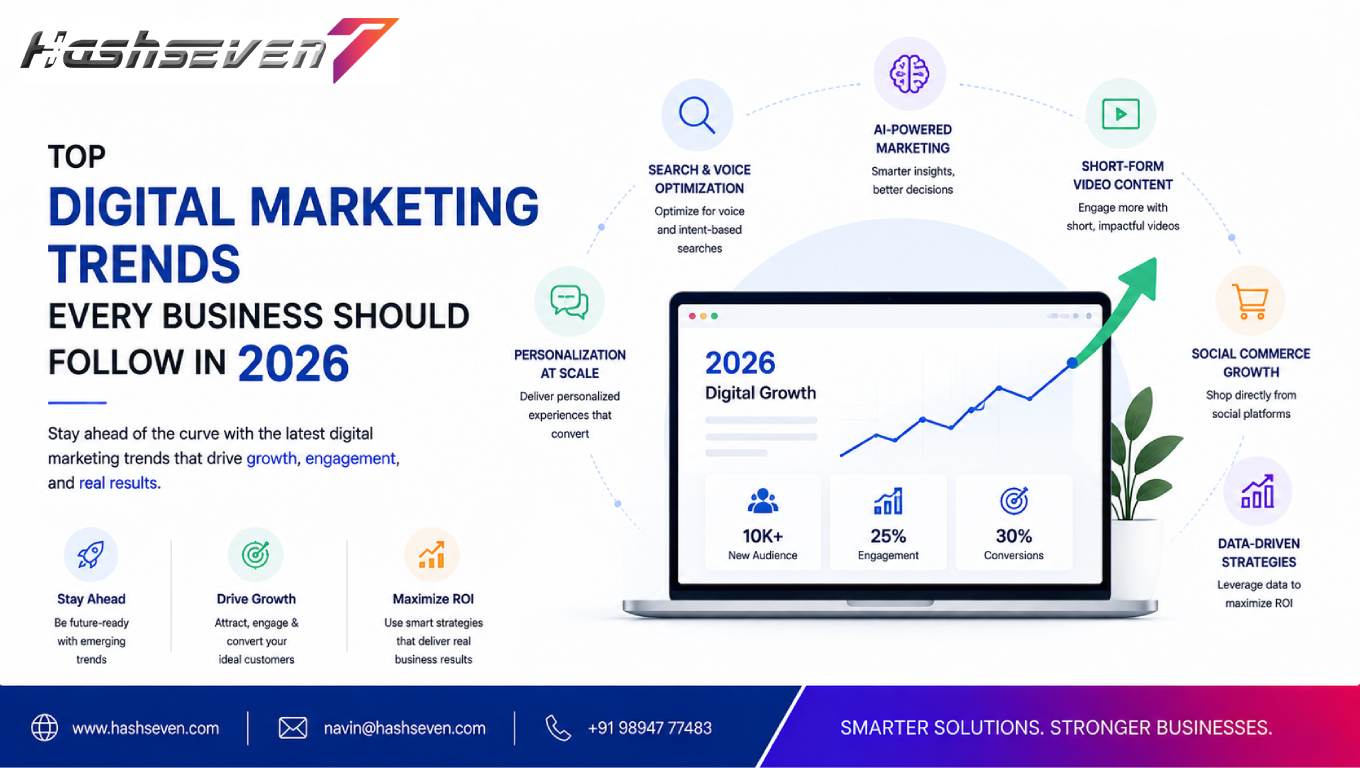

Digital marketing continues to evolve rapidly as businesses adapt to changing customer expectations, search behavior, artificial intelligence, social media platforms, and new technologies. In 2026, businesses cannot rely only on traditional digital strategies. They need to understand emerging trends and determine which ones can create meaningful business results.
The latest digital marketing trends 2026 are focused on smarter automation, AI-assisted content, personalized customer experiences, search visibility across multiple platforms, short-form video, first-party data, conversational marketing, and measurable customer journeys.
For small businesses and large companies alike, following every trend is not necessary. The goal is to identify the trends that match your audience, industry, budget, and business objectives.
In this guide, we explore the most important digital marketing trends businesses should consider in 2026, how they work, and how companies can use them to improve visibility, engagement, leads, and sales.
What Are Digital Marketing Trends in 2026?
Digital marketing trends are emerging strategies, technologies, platforms, and customer behaviors that influence how businesses attract, engage, and convert audiences online.
The most important digital marketing trends 2026 include:
- Artificial intelligence in marketing
- AI-powered personalization
- Search optimization beyond traditional search engines
- Short-form video marketing
- Social commerce
- First-party data
- Conversational marketing
- Marketing automation
- Influencer marketing
- Local and hyperlocal marketing
- Interactive content
- Voice and visual search
- Customer experience optimization
- Data-driven marketing
- Privacy-focused marketing
Businesses that understand these changes can adapt their marketing strategies before competitors.
Build a Website That Grows Your Business
A professionally developed website is the foundation of your online success. If you’re planning to create a responsive, fast, and SEO-friendly business website, explore our Website Development Services to see how Hashseven can help transform your ideas into a powerful digital presence.
Why Businesses Should Follow Digital Marketing Trends in 2026
Customer behavior changes continuously.
People now use:
- Search engines
- Social media
- AI tools
- Video platforms
- Online communities
- Messaging applications
- Business websites
- Mobile applications
to research products and services.
This means businesses need to be present across the digital channels their customers actually use.
However, following trends does not mean blindly adopting every new technology.
Businesses should ask:
Does this trend help us reach the right audience, solve a customer problem, improve efficiency, or generate measurable business value?
If the answer is yes, the trend deserves consideration.
1. Artificial Intelligence Is Transforming Digital Marketing
Artificial intelligence has become one of the biggest developments in digital marketing.
Businesses can use AI to support:
- Content research
- Customer segmentation
- Data analysis
- Campaign optimization
- Personalization
- Chatbots
- Marketing automation
- Predictive analysis
AI can help marketers work more efficiently, but human oversight remains essential.
Businesses should use AI as a productivity and decision-support tool rather than publishing unverified or low-quality AI-generated content.
2. AI-Powered Content Creation
AI tools can help marketers generate ideas, outlines, drafts, summaries, and variations of marketing content.
Businesses can use AI to support:
- Blog planning
- Social media captions
- Email ideas
- Ad copy variations
- Content briefs
- FAQ generation
- Keyword research
However, high-quality marketing content still requires:
- Original insights
- Expertise
- Fact checking
- Brand consistency
- Human editing
- Customer understanding
The strongest strategy is often AI-assisted marketing rather than AI-only marketing.
3. Search Is Expanding Beyond Traditional Google Results
Search behavior is becoming more diverse.
Consumers may discover information through:
- Traditional search engines
- AI assistants
- YouTube
- Social platforms
- Online communities
- Maps
- Product marketplaces
This means businesses should think beyond ranking for individual keywords.
They should create useful content that clearly answers customer questions and demonstrates expertise.
A strong search strategy should focus on:
- Helpful content
- Clear answers
- Structured information
- Strong website architecture
- Brand authority
- User experience
4. Answer Engine Optimization Is Becoming More Important
People increasingly use AI-powered systems to ask questions and receive direct answers.
This creates an opportunity for businesses to optimize their content for answer-driven experiences.
AEO strategies can include:
- Answering questions directly
- Using clear headings
- Creating FAQ sections
- Providing definitions
- Supporting claims with trustworthy information
- Organizing information logically
Businesses should continue following search engine guidelines while making their content useful for both people and modern search experiences.
5. Generative Engine Optimization Is Gaining Attention
Generative Engine Optimization, often called GEO, focuses on improving a brand’s visibility in AI-generated search experiences.
While the field continues to evolve, businesses can prepare by building a strong digital presence.
Important foundations include:
- Accurate business information
- Authoritative content
- Consistent brand information
- Quality external references
- Strong website structure
- Demonstrated expertise
The goal should not be manipulating AI systems.
Instead, businesses should create information that is genuinely useful, trustworthy, and easy for digital systems to understand.
6. Short-Form Video Marketing Continues to Grow
Short-form video remains an important way for businesses to capture attention.
Platforms such as:
- YouTube
- TikTok
provide opportunities to reach audiences through short videos.
Businesses can create videos around:
- Product demonstrations
- Customer questions
- Tutorials
- Behind-the-scenes content
- Industry tips
- Testimonials
- Company stories
Short-form video can be especially effective because it communicates information quickly.
7. Video SEO Is Becoming Essential
Creating videos is not enough.
Businesses should also optimize their videos so audiences can discover them.
Video SEO can involve:
- Descriptive titles
- Relevant descriptions
- Appropriate keywords
- Captions
- Transcripts
- Strong thumbnails
- Clear calls to action
Businesses should also publish videos on relevant platforms rather than creating content without a distribution strategy.
8. Social Commerce Is Changing Online Shopping
Social media platforms are increasingly becoming part of the buying journey.
Customers can discover products through:
- Short videos
- Influencer recommendations
- Product posts
- Live streams
- Social advertisements
Businesses selling physical products should evaluate whether social commerce fits their audience.
A successful social commerce strategy should combine:
Discovery → Trust → Product Information → Purchase
9. First-Party Data Is Becoming More Valuable
Privacy changes and evolving advertising technologies have made first-party data increasingly important.
First-party data is information collected directly from customers or website visitors through appropriate interactions.
Examples include:
- Email subscriptions
- Customer accounts
- Purchase history
- Website interactions
- Form submissions
- Customer preferences
Businesses should collect and use this information responsibly and transparently.
10. Personalization Is Improving Customer Experiences
Customers increasingly expect relevant experiences.
Businesses can personalize marketing based on:
- Customer interests
- Previous purchases
- Website behavior
- Location
- Customer lifecycle stage
- Product preferences
Examples include:
- Personalized email campaigns
- Product recommendations
- Customized offers
- Relevant website content
Personalization should provide value rather than becoming intrusive.
11. Conversational Marketing Is Growing
Customers often want immediate answers.
Conversational marketing uses tools such as:
- Live chat
- AI chatbots
- Messaging applications
- Automated responses
to help customers interact with businesses.
Businesses can use conversational marketing to:
- Answer common questions
- Qualify leads
- Recommend services
- Schedule appointments
- Provide basic support
For complex situations, businesses should make it easy for customers to reach a human representative.
12. AI Chatbots Are Becoming Business Tools
AI chatbots can help businesses provide support outside traditional working hours.
They can assist with:
- Frequently asked questions
- Product information
- Lead qualification
- Appointment requests
- Basic customer support
- Navigation
However, chatbots should be trained and monitored carefully.
Incorrect answers can damage customer trust.
Businesses should regularly review chatbot performance and provide escalation options when necessary.
13. Marketing Automation Is Increasing Efficiency
Marketing automation allows businesses to automate repetitive marketing tasks.
Examples include:
- Welcome emails
- Lead nurturing
- Customer reminders
- Abandoned-cart emails
- Follow-up messages
- Campaign segmentation
Automation allows marketers to spend more time on strategy and creative work.
The best automation strategies combine efficiency with personalization.
14. Customer Journey Marketing Is More Important
Customers rarely move directly from seeing an advertisement to making a purchase.
A typical journey may look like:
Awareness → Research → Consideration → Decision → Purchase → Retention
Businesses should create content and campaigns for each stage.
Awareness
Educational social posts and videos.
Research
Blog articles and guides.
Consideration
Case studies and comparisons.
Decision
Product pages, demos, and consultations.
Retention
Email marketing and customer support.
Understanding the entire customer journey can improve campaign performance.
15. Influencer Marketing Is Becoming More Specialized
Influencer marketing is shifting from simply choosing accounts with large follower counts to finding creators with relevant audiences.
Micro and niche influencers can provide:
- Targeted reach
- Community trust
- Higher relevance
- Authentic product demonstrations
Businesses should evaluate influencers based on:
- Audience relevance
- Engagement quality
- Content quality
- Brand alignment
- Campaign objectives
Follower count should not be the only consideration.
16. User-Generated Content Builds Authenticity
User-generated content, or UGC, is created by customers rather than the brand itself.
Examples include:
- Customer reviews
- Product photos
- Testimonials
- Social posts
- Unboxing videos
- Customer stories
UGC can provide social proof and help potential customers understand how real people use a product or service.
Businesses should obtain appropriate permission before using customer-created content in marketing campaigns.
17. Local SEO Remains Important
Local businesses should continue investing in local search visibility.
Local SEO strategies can include:
- Accurate business information
- Google Business Profile optimization
- Customer reviews
- Local content
- Location pages
- Local citations
- Relevant backlinks
Businesses should keep their information consistent across important online platforms.
18. Google Business Profile Optimization
For businesses that serve local customers, Google Business Profile remains an important digital marketing asset.
Businesses should maintain:
- Accurate business name
- Correct address
- Phone number
- Business hours
- Website
- Categories
- Photos
- Services
- Customer reviews
Regularly updating business information can help customers find accurate information when researching the company.
19. Voice Search and Conversational Queries
People increasingly use natural language when searching through voice-enabled devices and conversational interfaces.
Instead of searching:
“digital marketing agency Chennai”
a user might ask:
“Which digital marketing agency can help my small business?”
Businesses can prepare by creating content that answers natural-language questions.
Useful formats include:
- FAQs
- How-to guides
- Definitions
- Comparison articles
- Conversational headings
20. Visual Search Is Expanding
Visual search allows users to discover information using images rather than traditional text queries.
This can be particularly relevant for:
- Fashion
- Home products
- Food
- Travel
- Retail
- E-commerce
Businesses should optimize images with:
- Descriptive filenames
- Useful alt text
- Relevant surrounding content
- High-quality visuals
- Structured product information where appropriate
21. Interactive Content Improves Engagement
Interactive content can encourage users to actively participate rather than simply read.
Examples include:
- Calculators
- Quizzes
- Surveys
- Product configurators
- Assessments
- Interactive comparisons
Interactive content can also help businesses understand customer preferences and generate leads.
22. Email Marketing Remains Powerful
Despite the emergence of new channels, email remains useful for customer communication.
Businesses can use email for:
- Newsletters
- Product updates
- Promotions
- Educational content
- Lead nurturing
- Customer retention
Successful email marketing depends on delivering useful content to appropriately segmented audiences.
23. WhatsApp Marketing for Business
Messaging platforms provide businesses with direct communication opportunities.
Businesses can use WhatsApp for:
- Customer support
- Order updates
- Appointment reminders
- Product inquiries
- Lead follow-up
Businesses should obtain appropriate consent and follow platform rules when sending marketing messages.
Messaging should provide value rather than becoming unwanted communication.
24. Data-Driven Marketing Decisions
Modern marketing generates large amounts of data.
Businesses can analyze:
- Website traffic
- Conversion rates
- Customer acquisition cost
- Engagement
- Email performance
- Advertising results
- Sales data
Data should guide decisions, but businesses should also consider qualitative customer feedback.
The goal is not to collect as much data as possible.
The goal is to collect useful data and turn it into better decisions.
25. Conversion Rate Optimization Is Becoming More Important
Generating website traffic is only part of digital marketing.
Businesses also need to turn visitors into:
- Leads
- Subscribers
- Customers
- Bookings
- Sales
Conversion rate optimization can involve testing:
- Headlines
- CTAs
- Forms
- Landing pages
- Pricing presentation
- Navigation
- Trust signals
Small improvements in conversion rates can make existing marketing traffic more valuable.
26. Customer Experience Is a Marketing Strategy
Marketing does not stop when a customer clicks an advertisement.
The entire experience matters.
Customers evaluate:
- Website speed
- Navigation
- Content
- Support
- Checkout
- Communication
- Delivery
- After-sales service
A poor customer experience can waste the money spent on advertising.
Businesses should therefore connect marketing, website design, sales, and customer service.
27. Privacy-Focused Marketing Is Essential
Consumers are increasingly concerned about how companies collect and use personal information.
Businesses should prioritize:
- Transparent privacy policies
- Appropriate consent
- Secure data handling
- Responsible tracking
- Data minimization
Marketing strategies should comply with applicable privacy and data protection requirements.
Trust can become a competitive advantage when businesses handle customer information responsibly.
28. Content Quality Matters More Than Content Quantity
Publishing dozens of low-quality articles is not a sustainable marketing strategy.
Businesses should focus on creating content that:
- Answers real questions
- Demonstrates expertise
- Provides original value
- Matches search intent
- Is easy to understand
- Is factually accurate
A smaller collection of high-quality resources can be more valuable than a large collection of repetitive pages.
29. Topic Clusters and Content Hubs
Businesses can organize content around major topics.
For example, a digital marketing company could create a central page about digital marketing and supporting articles covering:
- SEO
- Social media marketing
- Email marketing
- Google Ads
- Content marketing
- Local SEO
Internal links can connect these resources and create a clearer content structure.
30. Omnichannel Marketing Is Becoming the Standard
Customers may interact with a business across multiple channels.
For example:
Google Search → Website → Instagram → WhatsApp → Email → Purchase
Businesses should aim for a consistent brand experience across these touchpoints.
This includes:
- Messaging
- Visual identity
- Offers
- Customer information
- Support
An omnichannel strategy helps reduce friction throughout the customer journey.
How Businesses Should Use Digital Marketing Trends in 2026
Businesses do not need to implement every trend.
Instead, follow this process:
Step 1: Understand Your Audience
Identify who your customers are and how they discover businesses.
Step 2: Define Your Goals
Choose measurable objectives such as:
- Leads
- Sales
- Website traffic
- Brand awareness
- Customer retention
Step 3: Select Relevant Trends
Choose trends that support your goals.
Step 4: Test Small Campaigns
Start with manageable experiments.
Step 5: Measure Results
Track meaningful metrics.
Step 6: Improve
Keep strategies that work and adjust those that do not.
Digital Marketing Metrics Businesses Should Track
Businesses should measure performance using meaningful metrics.
Important metrics include:
- Website traffic
- Organic clicks
- Conversion rate
- Leads generated
- Cost per lead
- Customer acquisition cost
- Return on ad spend
- Email engagement
- Social engagement
- Customer retention
- Revenue
The most important metric depends on the campaign’s objective.
Common Digital Marketing Mistakes in 2026
Following Every Trend
Not every trend is relevant to every business.
Using AI Without Human Review
AI-generated content can contain inaccurate or generic information.
Focusing Only on Traffic
Traffic without conversions does not necessarily create business growth.
Ignoring Existing Customers
Acquiring new customers is important, but retaining existing customers can also create significant value.
Neglecting Website Experience
A strong campaign cannot compensate for a poor website.
Ignoring Data Privacy
Poor data practices can damage trust and create compliance risks.
Creating Content Without Strategy
Content should serve a clear audience and business objective.
Digital Marketing Strategy Checklist for 2026
Use this checklist when planning your strategy:
- Define target audience
- Set measurable marketing goals
- Audit your website
- Review SEO performance
- Optimize Google Business Profile
- Create high-quality content
- Explore AI-assisted marketing
- Develop short-form video content
- Improve conversion rates
- Build email campaigns
- Use marketing automation
- Explore conversational marketing
- Collect first-party data responsibly
- Test social commerce where relevant
- Monitor customer journey
- Track campaign performance
- Review privacy practices
- Improve customer experience
- Test new channels carefully
- Measure ROI
The Future of Digital Marketing
The future of digital marketing will likely become increasingly connected, automated, personalized, and data-driven.
AI will continue to influence how businesses create content, analyze data, communicate with customers, and optimize campaigns.
At the same time, human expertise will remain important.
Customers still value:
- Trust
- Authenticity
- Expertise
- Helpful information
- Fast support
- Good experiences
The businesses most likely to succeed will be those that combine technology with genuine customer understanding.
Frequently Asked Questions
1. What are the biggest digital marketing trends in 2026?
Major trends include AI-assisted marketing, personalized experiences, short-form video, conversational marketing, first-party data, search optimization across multiple platforms, marketing automation, and conversion rate optimization.
2. How can small businesses use digital marketing trends in 2026?
Small businesses should focus on trends that match their customers and budget. Local SEO, short-form video, email marketing, AI-assisted content, social media, WhatsApp communication, and conversion optimization can be useful starting points.
3. Is AI replacing digital marketers?
AI can automate and assist with many marketing tasks, but it does not eliminate the need for strategy, creativity, customer understanding, fact checking, and human decision-making.
4. Is SEO still important in 2026?
Yes. Search remains an important way customers discover businesses. However, businesses should optimize for useful content and broader search experiences rather than focusing only on individual keywords.
5. Which digital marketing trend should a business prioritize first?
Businesses should prioritize the trend that directly supports their primary goal. For many businesses, improving their website, SEO, customer experience, content strategy, and conversion rate provides a stronger foundation before adopting more advanced technologies.
Conclusion
The most important digital marketing trends 2026 are not simply about adopting the newest technologies. They are about understanding how customers discover, evaluate, and interact with businesses in an increasingly digital environment.
AI, short-form video, personalization, conversational marketing, first-party data, social commerce, local SEO, automation, and conversion optimization all provide opportunities for businesses to improve their marketing strategies.
However, businesses should avoid chasing every new trend.
A successful digital marketing strategy starts with a strong foundation:
- A professional website
- Useful content
- Technical SEO
- Strong customer experience
- Clear branding
- Reliable analytics
- Consistent communication
From there, businesses can test emerging technologies and channels based on measurable goals.
The businesses that combine innovation with customer-focused marketing will be better positioned to build visibility, generate leads, increase conversions, and maintain long-term growth.
Ready to Build a Professional Website for Your Business?
Turn your business into a powerful online brand with Hashseven.
Since 2017, we’ve helped businesses grow through professional website development, mobile apps, custom software, SEO, digital marketing, CRM, POS solutions, and Meta-approved WhatsApp automation. Let’s create a fast, secure, and conversion-focused website that attracts more customers and drives real business growth.


