
Businesses are under constant pressure to attract customers, generate qualified leads, improve conversions, and build stronger relationships while controlling marketing costs. Traditional marketing processes often require teams to spend significant time on repetitive tasks such as lead follow-ups, email campaigns, customer segmentation, reporting, and campaign optimization.
This is where AI marketing automation can make a significant difference.
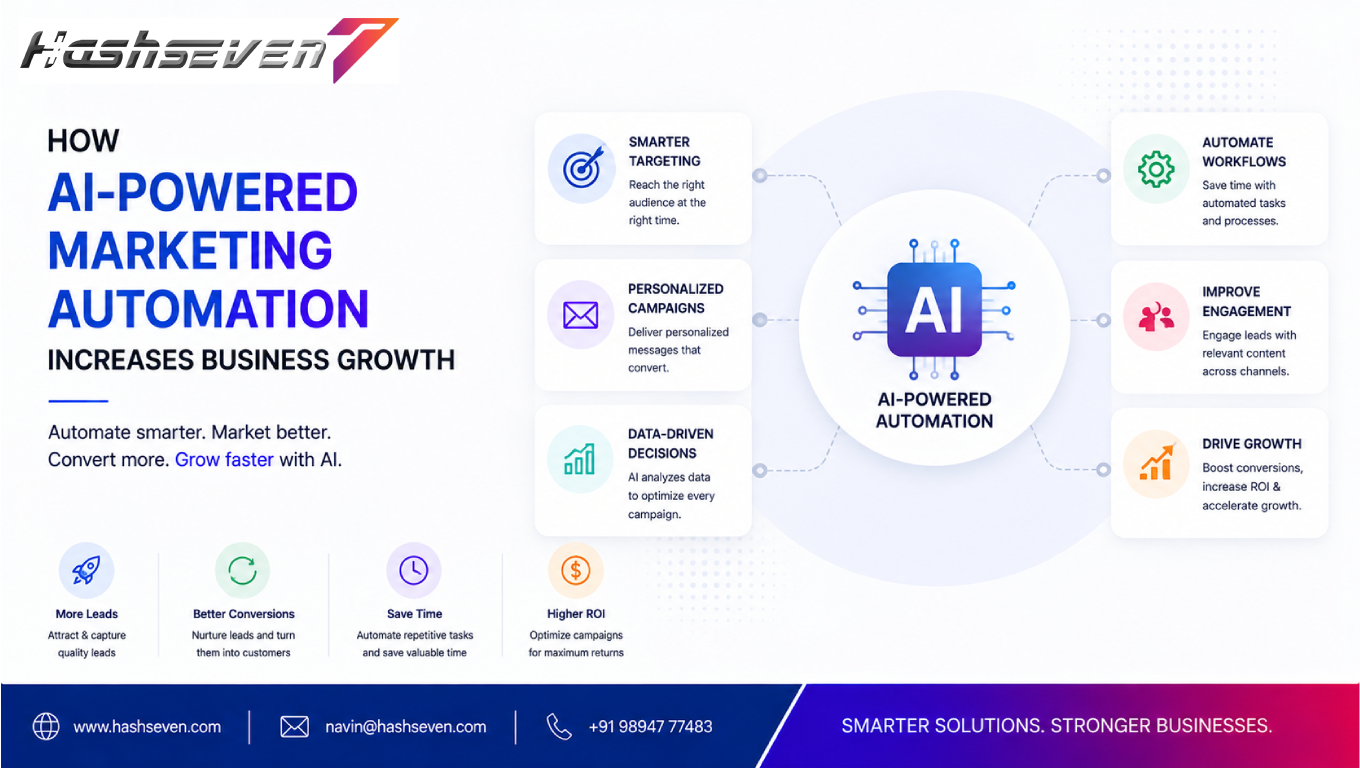
AI-powered marketing automation combines artificial intelligence with automated marketing workflows to help businesses understand customer behavior, personalize communication, identify opportunities, and execute repetitive tasks more efficiently. Instead of replacing marketers, these technologies can help marketing teams spend more time on strategy, creativity, and customer relationships.
From automated email campaigns and intelligent chatbots to predictive analytics and personalized recommendations, AI is changing how businesses approach digital marketing.
In this guide, we will explain how AI-powered marketing automation works, its major benefits, practical applications, implementation steps, common mistakes, and how businesses can use it to support sustainable growth.
What Is AI Marketing Automation?
AI marketing automation is the use of artificial intelligence and automated workflows to plan, execute, personalize, and analyze marketing activities with less manual intervention.
Traditional marketing automation follows predefined rules.
For example:
If a customer downloads an eBook → send a follow-up email.
AI-powered automation can go further by analyzing customer data and identifying patterns.
For example:
A customer repeatedly visits a pricing page → the system identifies buying intent → assigns a higher lead score → triggers a personalized follow-up.
AI can help marketing systems make data-driven decisions while automation carries out the appropriate actions.
Build a Website That Grows Your Business
A professionally developed website is the foundation of your online success. If you’re planning to create a responsive, fast, and SEO-friendly business website, explore our Website Development Services to see how Hashseven can help transform your ideas into a powerful digital presence.
How AI Marketing Automation Works
AI-powered marketing automation generally involves several connected components:
1. Data Collection
The system collects information from customer interactions.
2. Data Analysis
AI analyzes behavior and identifies patterns.
3. Customer Segmentation
Customers can be grouped according to behavior, interests, or characteristics.
4. Prediction
AI can identify potential customer intent or likely future actions.
5. Automated Action
The system triggers an appropriate marketing activity.
6. Continuous Optimization
Campaign results can be analyzed and used to improve future actions.
This creates a continuous marketing cycle:
Collect → Analyze → Predict → Personalize → Automate → Measure → Improve
Why Businesses Are Adopting AI Marketing Automation
Modern customers expect relevant and timely communication.
They may interact with businesses through:
- Websites
- Search engines
- Social media
- Messaging platforms
- Mobile applications
- Online advertisements
Managing all these interactions manually can become difficult as a business grows.
AI automation helps businesses manage large volumes of interactions while maintaining greater consistency.
The biggest advantages can include:
- Improved efficiency
- Faster lead response
- Better personalization
- More effective customer segmentation
- Improved campaign optimization
- Reduced repetitive work
- Better customer experiences
- More scalable marketing
1. AI Saves Marketing Teams Time
Marketing teams often spend hours performing repetitive tasks.
Examples include:
- Sending routine emails
- Sorting leads
- Creating reports
- Updating customer segments
- Monitoring campaign activity
- Scheduling content
- Following up with prospects
Automation can perform many of these repetitive activities automatically.
AI can add intelligence by helping determine what should happen next based on customer behavior.
This allows marketing teams to focus more on:
- Strategy
- Creative development
- Customer research
- Brand building
- Campaign planning
2. AI Improves Lead Generation
Generating leads is one of the most important goals of business marketing.
AI-powered systems can analyze customer interactions to identify potential prospects.
Lead generation automation can use signals such as:
- Website visits
- Form submissions
- Content downloads
- Product page visits
- Email interactions
- Chatbot conversations
For example, if a visitor repeatedly views a service page and downloads a pricing guide, the system may identify stronger purchase intent.
This information can help businesses prioritize promising prospects.
3. AI-Powered Lead Scoring
Lead scoring helps businesses identify which prospects are more likely to convert.
Traditional lead scoring may use fixed rules.
For example:
- Website visit = 5 points
- Email click = 10 points
- Demo request = 30 points
AI-based lead scoring can analyze multiple behavioral signals and patterns to identify higher-intent prospects.
This can help sales teams focus their attention where it is most valuable.
4. Faster Lead Follow-Up
Speed matters when a prospect shows interest.
A delayed response can cause potential customers to move toward competitors.
AI automation can trigger immediate responses after actions such as:
- Form submissions
- Demo requests
- Product inquiries
- Chat conversations
- Quote requests
For example:
Lead submits a form → automated confirmation → personalized email → sales notification → follow-up workflow
This creates a smoother lead management process.
5. Personalized Marketing at Scale
Personalization can make marketing messages more relevant.
Instead of sending the same message to every customer, AI can help businesses personalize communication based on:
- Previous purchases
- Browsing behavior
- Customer interests
- Location
- Engagement
- Lifecycle stage
For example, an e-commerce business could recommend products based on previous customer activity.
Personalization becomes particularly valuable when a business has thousands of customers.
6. AI Improves Customer Segmentation
Customer segmentation involves dividing audiences into meaningful groups.
Businesses can segment customers based on:
- Demographics
- Interests
- Purchase history
- Website behavior
- Engagement
- Customer value
- Buying stage
AI can identify patterns that may be difficult to discover manually.
This allows businesses to create more relevant campaigns for different audience segments.
7. AI-Powered Email Marketing
Email marketing remains an important channel for customer communication.
AI automation can support:
- Subject-line suggestions
- Content personalization
- Audience segmentation
- Send-time optimization
- Automated follow-ups
- Re-engagement campaigns
- Product recommendations
For example, a customer who abandons a shopping cart can automatically receive a relevant reminder.
A customer who completes a purchase can enter a post-purchase email sequence.
8. Automated Customer Journeys
Customers move through different stages before and after making a purchase.
A typical journey may look like:
Awareness → Interest → Consideration → Purchase → Retention
AI-powered automation can create different workflows for each stage.
Awareness
Send educational content.
Interest
Provide relevant resources.
Consideration
Share case studies or product information.
Purchase
Provide onboarding or order information.
Retention
Send helpful follow-ups and personalized recommendations.
This creates a more connected customer experience.
9. AI Chatbots Improve Customer Engagement
AI-powered chatbots can provide immediate responses to common customer questions.
Businesses can use chatbots for:
- FAQs
- Product information
- Lead qualification
- Appointment scheduling
- Basic support
- Service recommendations
For example:
Visitor: “What website development services do you provide?”
AI chatbot: Provides relevant information and offers a consultation option.
This can help businesses engage potential customers outside normal working hours.
10. AI Helps Improve Customer Support
Marketing and customer support are increasingly connected.
AI automation can help answer routine questions and direct customers toward useful resources.
This can reduce the workload on support teams.
However, businesses should provide an easy way for customers to reach a human when an issue is complex or sensitive.
The goal should be faster support without losing the human element.
11. AI-Powered Content Recommendations
AI can analyze customer interests and recommend relevant content.
For example, a website visitor reading an article about SEO could receive recommendations for:
- Technical SEO guides
- Keyword research articles
- SEO services
- Case studies
Relevant recommendations can increase engagement and help customers discover useful information.
12. AI Helps Optimize Advertising Campaigns
Paid advertising generates large amounts of performance data.
AI can analyze factors such as:
- Audience behavior
- Ad engagement
- Conversion patterns
- Device usage
- Campaign performance
This information can support campaign optimization.
Marketers can use AI to identify:
- Strong-performing audiences
- Weak campaigns
- High-value keywords
- Effective creative variations
- Potential budget adjustments
Human oversight remains important when making significant advertising decisions.
13. Predictive Analytics Supports Better Decisions
Predictive analytics uses historical and current data to identify potential future outcomes.
Businesses can use predictive models to estimate:
- Customer churn
- Purchase likelihood
- Lead conversion probability
- Customer value
- Campaign performance
For example, a business may identify customers who appear likely to stop engaging and create a retention campaign.
14. AI Helps Reduce Customer Churn
Customer retention is often more efficient than constantly acquiring new customers.
AI can identify warning signs such as:
- Reduced engagement
- Fewer purchases
- Lower email activity
- Increased support issues
- Subscription changes
The business can then trigger a retention workflow.
For example:
Reduced engagement → personalized email → special offer → customer support option
This gives businesses an opportunity to reconnect with customers before they leave.
15. AI Improves Marketing Personalization
Personalization can extend beyond emails.
Businesses can personalize:
- Website experiences
- Product recommendations
- Advertisements
- Landing pages
- Offers
- Messaging
For example, returning visitors can be shown content based on previous interactions.
The key is to make personalization useful rather than intrusive.
16. AI Helps Businesses Understand Customer Intent
Customer intent refers to what a customer is likely trying to accomplish.
For example:
“What is CRM software?”
indicates informational intent.
While:
“CRM software pricing for small businesses”
may indicate stronger commercial intent.
AI can analyze customer interactions and help businesses distinguish between different stages of the buying journey.
This can improve marketing personalization and lead qualification.
17. AI Improves Marketing Reporting
Marketing teams often need to analyze multiple platforms.
These may include:
- Website analytics
- Email platforms
- CRM systems
- Advertising platforms
- Social media
- E-commerce systems
AI can help summarize large datasets and identify important patterns.
Instead of simply asking:
“How many visitors did we receive?”
marketers can investigate:
“Which channels are generating the highest-quality leads?”
This shifts marketing reporting from basic numbers toward actionable insights.
18. AI Helps Optimize Marketing Budgets
Businesses have limited marketing budgets.
AI-assisted analysis can help identify which campaigns, audiences, or channels are producing stronger results.
Businesses can compare:
- Cost per lead
- Conversion rate
- Customer acquisition cost
- Revenue
- Return on advertising spend
This can help marketers allocate resources more effectively.
19. AI and CRM Integration
A CRM system contains valuable customer information.
When AI marketing automation is integrated with CRM software, businesses can create more connected customer journeys.
For example:
Website visit → Lead created → AI lead scoring → Automated email → Sales notification → CRM update
This reduces manual data entry and improves coordination between marketing and sales.
20. AI Supports Omnichannel Marketing
Customers may interact with a business through several channels.
For example:
Google → Website → Instagram → WhatsApp → Email → Purchase
AI automation can help coordinate these interactions.
Businesses can create consistent experiences across:
- Websites
- Social media
- Messaging
- Advertisements
- CRM systems
This creates a more connected customer journey.
21. AI Helps Scale Marketing Operations
A small marketing team may struggle to manually manage thousands of customer interactions.
Automation provides scalability.
For example:
A team can create one lead-nurturing workflow and allow the system to manage it for thousands of leads.
This does not mean every customer receives identical communication.
AI can help introduce personalization while automation manages the workflow.
22. AI Can Improve Conversion Rates
The ultimate goal of many marketing activities is conversion.
AI can support conversion optimization by analyzing:
- Landing page behavior
- User engagement
- CTA performance
- Customer segments
- Traffic sources
- Conversion paths
Businesses can then test different approaches.
Potential improvements include:
- Better messaging
- Personalized offers
- Improved CTAs
- Faster responses
- Better lead qualification
23. AI Marketing Automation for E-Commerce
E-commerce businesses can use AI automation across the customer lifecycle.
Applications include:
- Product recommendations
- Abandoned-cart reminders
- Personalized offers
- Customer segmentation
- Purchase follow-ups
- Re-engagement campaigns
- Customer support chatbots
For example:
Customer views product → leaves website → automated reminder → personalized recommendation → purchase
This can create additional opportunities to convert existing traffic.
24. AI Marketing Automation for B2B Businesses
B2B businesses often have longer sales cycles.
AI automation can help manage leads throughout the buying journey.
It can support:
- Lead scoring
- Email nurturing
- Content recommendations
- Meeting scheduling
- Sales notifications
- CRM updates
A B2B prospect may receive different content depending on their stage in the buying process.
25. AI Marketing Automation for Small Businesses
Small businesses can also benefit from automation.
They can start with simple workflows such as:
- Welcome emails
- Lead follow-ups
- Appointment reminders
- Customer review requests
- FAQ chatbots
- Re-engagement campaigns
Businesses do not need to implement complex AI systems immediately.
Starting with one repetitive process can demonstrate value before expanding automation.
How to Implement AI Marketing Automation
Businesses can follow a structured implementation process.
Step 1: Define Your Business Goal
Determine what you want to improve.
Examples:
- Generate more leads
- Improve conversions
- Reduce response time
- Increase retention
- Reduce repetitive work
Step 2: Map Your Customer Journey
Identify how customers move from first interaction to purchase.
Document:
- Discovery
- Engagement
- Consideration
- Conversion
- Retention
Step 3: Identify Repetitive Tasks
Find tasks that consume significant time.
Examples:
- Lead follow-up
- Email segmentation
- Reporting
- Customer reminders
- Data entry
These are good candidates for automation.
Step 4: Select the Right Tools
Choose tools based on your requirements.
Potential categories include:
- CRM platforms
- Marketing automation platforms
- Email marketing tools
- Chatbots
- Analytics systems
- Customer data platforms
Do not choose tools simply because they contain AI.
Choose technology that solves a real business problem.
Step 5: Integrate Your Systems
Connect relevant platforms where appropriate.
For example:
Website + CRM + Email + Analytics + Chatbot
This allows information to move between systems more efficiently.
Step 6: Start With a Small Workflow
Do not automate everything immediately.
Start with one process.
For example:
Website lead → Automated email → CRM notification
Measure the results before expanding.
Step 7: Monitor Results
Track metrics such as:
- Leads generated
- Conversion rate
- Response time
- Customer engagement
- Revenue
- Customer retention
- Cost per acquisition
Step 8: Continuously Improve
AI automation should not be a set-and-forget system.
Review:
- Workflow performance
- Customer feedback
- AI accuracy
- Conversion rates
- Automation errors
Then improve the system.
Best Practices for AI Marketing Automation
Keep Humans in the Loop
AI should support people rather than remove human judgment from important decisions.
Protect Customer Data
Use appropriate security and privacy practices.
Verify AI-Generated Information
AI systems can produce incorrect or misleading information.
Avoid Over-Automation
Customers do not want every interaction to feel robotic.
Personalize Responsibly
Use customer information appropriately and transparently.
Measure Business Outcomes
Do not judge automation only by the number of automated tasks.
Measure actual business results.
Common AI Marketing Automation Mistakes
1. Automating Without a Strategy
Automation cannot fix a poorly designed marketing strategy.
2. Using AI Everywhere
Not every process needs artificial intelligence.
3. Ignoring Data Quality
Poor data can produce poor recommendations.
4. Removing Human Support
Customers should always have a path to human assistance when needed.
5. Sending Too Many Automated Messages
Excessive communication can frustrate customers.
6. Failing to Test Workflows
Automation errors can affect large numbers of customers.
7. Ignoring Privacy
Customer data should be handled responsibly.
AI Marketing Automation vs Traditional Marketing Automation
| Feature | Traditional Automation | AI-Powered Automation |
|---|---|---|
| Workflow | Rule-based | Data-driven |
| Segmentation | Predefined rules | Behavioral analysis |
| Personalization | Basic | More dynamic |
| Lead scoring | Fixed points | Predictive possibilities |
| Content | Predefined | AI-assisted |
| Optimization | Manual | AI-assisted |
| Reporting | Descriptive | Pattern-focused |
| Scalability | High | High with intelligent decision support |
AI does not necessarily replace traditional automation.
Instead, it can make existing automation more adaptive and intelligent.
How to Measure AI Marketing Automation Success
Businesses should track meaningful KPIs.
Lead Generation
Measure the number and quality of leads generated.
Conversion Rate
Measure how many prospects become customers.
Customer Acquisition Cost
Understand how much it costs to acquire customers.
Customer Lifetime Value
Estimate the value generated by customers over time.
Engagement
Track meaningful interactions with campaigns.
Response Time
Measure how quickly prospects receive assistance.
Revenue
Ultimately, determine whether automation contributes to business growth.
The Future of AI Marketing Automation
AI marketing automation is likely to become increasingly integrated into everyday business operations.
Future systems may become better at:
- Predicting customer behavior
- Personalizing experiences
- Coordinating campaigns
- Analyzing large datasets
- Automating routine decisions
- Connecting marketing and sales
- Supporting customer service
However, businesses should continue prioritizing transparency, privacy, accuracy, and customer experience.
Technology should support the relationship between a business and its customers rather than replace it.
Frequently Asked Questions
1. What is AI marketing automation?
AI marketing automation combines artificial intelligence with automated marketing workflows to analyze customer behavior, personalize communication, automate repetitive tasks, and support marketing decisions.
2. How does AI marketing automation help business growth?
It can help businesses improve lead generation, personalize customer experiences, accelerate follow-ups, optimize campaigns, reduce repetitive work, and improve conversion opportunities.
3. Can small businesses use AI marketing automation?
Yes. Small businesses can begin with simple applications such as automated lead follow-ups, email campaigns, appointment reminders, chatbots, and customer re-engagement.
4. Does AI marketing automation replace marketers?
No. AI can automate repetitive tasks and provide insights, but marketers are still needed for strategy, creativity, brand decisions, customer understanding, and human judgment.
5. How should a business start using AI marketing automation?
Start by identifying one repetitive marketing process that affects an important business goal. Automate that workflow, measure its results, and expand gradually based on performance.
Conclusion
AI marketing automation is changing the way businesses approach customer acquisition, engagement, conversion, and retention.
By combining artificial intelligence with automated workflows, businesses can analyze customer behavior, personalize communication, improve lead qualification, automate repetitive tasks, and make faster data-driven decisions.
The biggest opportunity is not simply automating more activities. It is creating smarter and more relevant customer experiences.
Businesses should start with clear objectives, reliable customer data, carefully selected tools, and measurable workflows. Human oversight should remain part of the process, especially when AI is communicating directly with customers or influencing important decisions.
When implemented responsibly, AI-powered marketing automation can help businesses improve efficiency, scale their marketing efforts, strengthen customer relationships, and create sustainable opportunities for growth.
Ready to Build a Professional Website for Your Business?
Turn your business into a powerful online brand with Hashseven.
Since 2017, we’ve helped businesses grow through professional website development, mobile apps, custom software, SEO, digital marketing, CRM, POS solutions, and Meta-approved WhatsApp automation. Let’s create a fast, secure, and conversion-focused website that attracts more customers and drives real business growth.