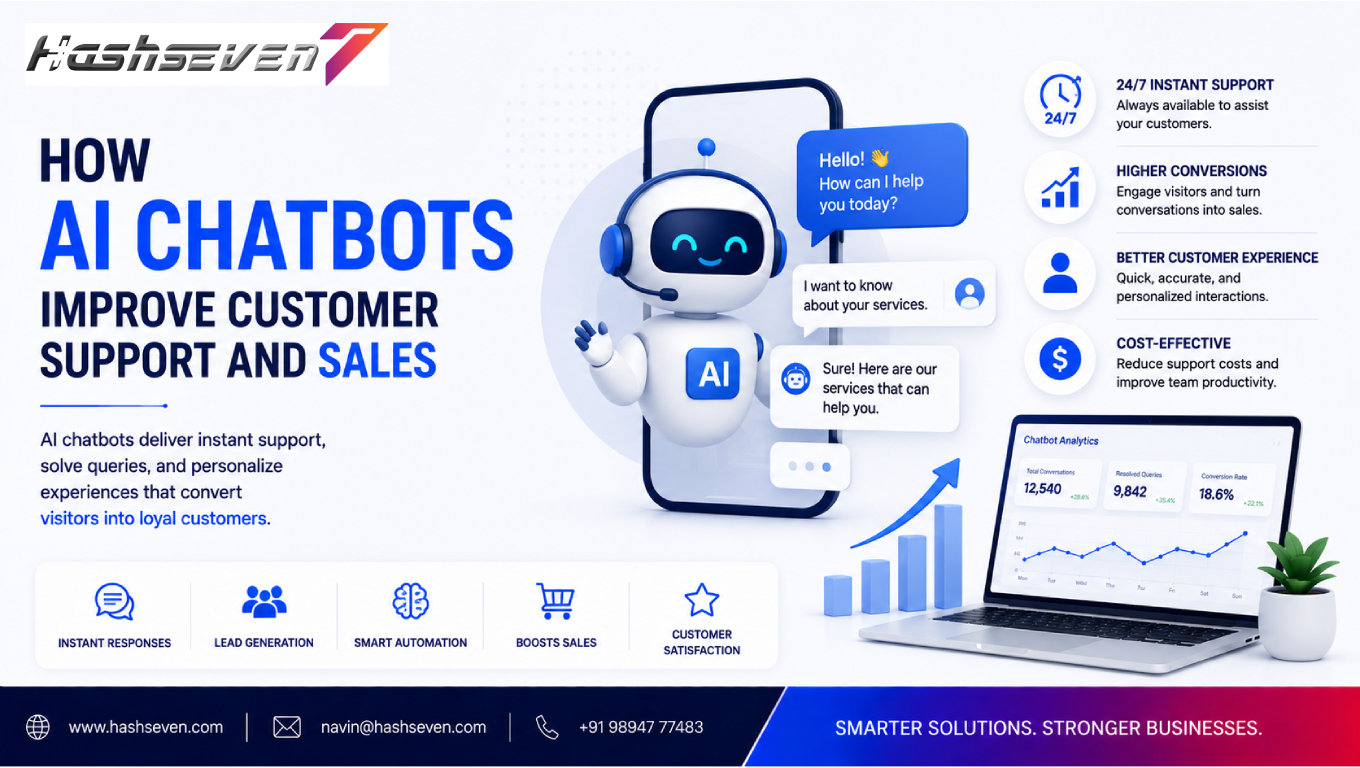

An AI chatbot for business can transform the way companies communicate with customers, answer questions, generate leads, and support sales. Customers today expect quick responses, convenient communication, and access to information whenever they need it. Businesses that depend entirely on manual support may struggle to respond quickly when enquiry volumes increase.
AI chatbots provide a practical solution by using artificial intelligence to understand customer questions and provide automated responses. They can work across websites, messaging platforms, and other digital channels while allowing human teams to handle conversations that require personal attention.
From answering frequently asked questions to qualifying prospects and helping customers find products, AI chatbots can support multiple stages of the customer journey.
In this guide, we’ll explain how AI chatbots work, how they improve customer support and sales, their key benefits, implementation strategies, common mistakes, and how businesses can use them effectively in 2026.
What Is an AI Chatbot for Business?
An AI chatbot for business is an automated conversational tool that uses artificial intelligence to communicate with customers and prospects.
Unlike traditional rule-based chatbots that depend heavily on fixed commands, modern AI chatbots can understand natural language and respond to a wider variety of questions.
Depending on how they are configured, AI chatbots can:
- Answer customer questions
- Recommend products
- Collect contact details
- Qualify leads
- Schedule appointments
- Provide basic customer support
- Direct visitors to relevant pages
- Assist with sales enquiries
- Share product information
- Transfer conversations to human agents
The goal isn’t necessarily to replace customer service employees. Instead, chatbots can handle repetitive conversations and allow employees to focus on more complex customer needs.
How AI Chatbots Work
AI chatbots typically combine conversational AI, natural language processing, business information, and predefined workflows.
A simple customer interaction might look like this:
Customer asks a question → AI understands the request → Chatbot finds relevant information → Response is provided → Customer takes the next action
For example, a website visitor might ask:
“Do you provide digital marketing services for small businesses?”
The chatbot can identify the customer’s intent and provide relevant information about available services.
If the customer wants to continue, the chatbot can collect contact details or connect them with a sales representative.
Build a Website That Grows Your Business
A professionally developed website is the foundation of your online success. If you’re planning to create a responsive, fast, and SEO-friendly business website, explore our Website Development Services to see how Hashseven can help transform your ideas into a powerful digital presence.
Why Businesses Are Using AI Chatbots
Businesses are increasingly looking for ways to improve customer communication without creating unnecessary workloads for employees.
An AI chatbot can help businesses:
- Respond faster
- Support customers outside business hours
- Automate repetitive questions
- Capture leads
- Qualify prospects
- Improve website engagement
- Support sales teams
- Reduce response times
- Provide consistent information
The biggest advantage comes when chatbot automation is integrated into a broader customer experience strategy.
1. Provide 24/7 Customer Support
Customers don’t always visit your website during business hours.
Someone may need information late at night, early in the morning, or during weekends.
An AI chatbot can remain available around the clock and provide answers to common questions.
For example, customers can ask about:
- Business hours
- Services
- Pricing
- Delivery
- Appointment availability
- Product features
- Contact information
This gives customers an immediate way to find basic information even when your team isn’t available.
2. Deliver Faster Responses
Response speed can influence customer satisfaction.
A customer who waits several hours for an answer may decide to contact a competitor instead.
An AI chatbot can respond almost immediately to common questions.
Instead of:
Question → Waiting → Human response
the process becomes:
Question → AI response → Next step
Faster communication can reduce friction and help customers move through their buying journey more efficiently.
3. Answer Frequently Asked Questions
Many customer support teams repeatedly answer the same questions.
For example:
- What services do you offer?
- What are your business hours?
- Where are you located?
- How can I request a quote?
- Do you offer consultations?
- What payment methods do you accept?
An AI chatbot can answer these repetitive questions automatically.
This saves employees time and allows them to concentrate on conversations that require human judgment.
4. Reduce Customer Support Workload
Support teams can become overwhelmed when they receive a large number of repetitive enquiries.
A chatbot can handle first-level support by answering straightforward questions before involving an employee.
For example:
Customer → AI chatbot → Basic question answered
or:
Customer → AI chatbot → Complex issue detected → Human agent
This approach creates a hybrid support system where automation and human expertise work together.
5. Generate More Leads
An AI chatbot for business can also become a lead generation tool.
Instead of waiting for visitors to find a contact form, the chatbot can proactively invite them to start a conversation.
For example:
Chatbot:
“Are you looking for help with your website project?”
Visitor:
“Yes.”
Chatbot:
“Great. Can I collect your name and email so our team can contact you?”
This creates a conversational path from website visitor to potential lead.
6. Qualify Leads Automatically
Not every enquiry is equally valuable.
A chatbot can ask qualifying questions before passing a lead to the sales team.
For example:
- What service are you interested in?
- What is your approximate budget?
- When do you want to start?
- What type of business do you operate?
- How can we contact you?
Based on the responses, the chatbot can categorize prospects and send relevant information to the sales team.
This helps sales representatives prioritize higher-intent prospects.
7. Improve Sales Conversations
AI chatbots can support sales teams by answering questions during the consideration stage.
Customers may ask:
- Which plan should I choose?
- What features are included?
- Do you provide customization?
- How long does implementation take?
- What makes your service different?
A chatbot can provide relevant information and direct prospects toward the appropriate product or service.
The chatbot can then encourage the visitor to:
- Request a quote
- Book a meeting
- Start a trial
- Contact sales
- Submit an enquiry
8. Recommend Products and Services
Businesses can configure AI chatbots to help customers identify suitable products or services.
For example, an ecommerce chatbot could ask:
“What type of product are you looking for?”
The customer responds.
The chatbot then asks additional questions and presents relevant options.
This can make product discovery easier and reduce the time customers spend searching manually.
9. Support Customers Before and After Purchase
AI chatbots can support the customer journey at different stages.
Before purchase
The chatbot can help with:
- Product information
- Pricing
- Comparisons
- Availability
- Service details
After purchase
It can help with:
- Order information
- Basic troubleshooting
- FAQs
- Support requests
- Account information
This creates a more connected customer experience.
10. Improve Website Engagement
Many visitors leave websites without taking action.
A chatbot can create an additional opportunity to engage visitors.
For example, after a visitor spends time on a service page, the chatbot can display:
“Have questions about this service? We’re here to help.”
This simple interaction can encourage visitors to ask questions instead of leaving the website.
11. Personalize Customer Interactions
Modern AI systems can use available context to make conversations more relevant.
For example, if a visitor is exploring a particular service page, the chatbot can provide information related to that service.
Personalization can help customers avoid irrelevant information and reach the answers they need more quickly.
Businesses should still ensure that personalization practices respect privacy requirements and customer expectations.
12. Support Multiple Customers at Once
Human support teams have limited capacity.
One employee can only handle a certain number of conversations simultaneously.
A chatbot can handle multiple conversations at the same time.
This becomes particularly useful during:
- Product launches
- Marketing campaigns
- Sales promotions
- Seasonal demand
- High-traffic periods
The chatbot can handle common requests while human agents focus on complex cases.
13. Reduce Operational Costs
AI chatbot automation can reduce the amount of manual effort required for repetitive customer interactions.
Businesses may save time by automating:
- Basic FAQs
- Lead collection
- Appointment requests
- Product information
- Initial support
- Customer qualification
The objective isn’t simply to reduce staff requirements.
A better goal is to help employees spend more time on high-value activities that require human expertise.
14. Connect Chatbots With CRM Systems
An AI chatbot becomes more powerful when connected to your CRM.
For example:
Website visitor → Chatbot → Lead captured → CRM → Sales notification → Follow-up
The chatbot can potentially pass information such as:
- Name
- Phone number
- Service interest
- Customer questions
- Lead qualification information
This reduces manual data entry and helps sales teams follow up more efficiently.
15. Collect Valuable Customer Insights
Chatbot conversations can reveal what customers frequently want to know.
Businesses can analyze questions related to:
- Pricing
- Services
- Product features
- Delivery
- Support
- Competitors
- Common problems
These insights can help businesses improve:
- Website content
- Product information
- FAQs
- Sales scripts
- Marketing campaigns
- Customer support processes
Customer questions can become a valuable source of business intelligence.
16. Support Marketing Campaigns
Chatbots can work alongside digital marketing campaigns.
For example:
Advertisement → Landing page → AI chatbot → Lead qualification → Sales follow-up
A chatbot can answer questions generated by advertising campaigns and encourage prospects to take the next step.
This makes your marketing funnel more interactive.
17. Improve Customer Experience
Customers want simple and convenient interactions.
An AI chatbot can help customers:
- Find information quickly
- Ask questions naturally
- Get immediate answers
- Avoid unnecessary forms
- Contact the correct department
- Request human assistance
However, customer experience depends on chatbot quality.
An inaccurate or frustrating chatbot can have the opposite effect.
That’s why businesses should continuously review chatbot responses and customer feedback.
AI Chatbot vs Traditional Live Chat
| Feature | AI Chatbot | Traditional Live Chat |
|---|---|---|
| Availability | 24/7 | Usually business hours |
| Response speed | Immediate | Depends on agent availability |
| Repetitive questions | Automated | Manual |
| Multiple conversations | High capacity | Limited by staff |
| Complex issues | Can transfer to humans | Handled by agents |
| Lead qualification | Can be automated | Usually manual |
| Human interaction | Limited unless transferred | Direct |
| Scalability | High | Requires additional staff |
The best solution for many businesses is not choosing between the two.
Instead, businesses can combine AI automation with human support.
Best Use Cases for AI Chatbots
An AI chatbot for business can be useful across multiple industries.
Ecommerce
- Product recommendations
- Order questions
- Returns information
- Product discovery
Healthcare
- Appointment enquiries
- General information
- Scheduling assistance
Sensitive medical decisions should still be handled by qualified professionals.
Real Estate
- Property enquiries
- Lead qualification
- Appointment scheduling
Education
- Course information
- Admission enquiries
- Program details
Professional Services
- Consultation requests
- Service information
- Lead qualification
SaaS Companies
- Product questions
- Demo requests
- Feature information
- Technical support routing
How to Implement an AI Chatbot
Step 1: Define Your Goal
Decide whether the chatbot will primarily support:
- Customer service
- Sales
- Lead generation
- Appointment booking
- Product discovery
Step 2: Identify Common Questions
Review existing customer conversations and identify repetitive questions.
Step 3: Create Accurate Knowledge
Provide the chatbot with reliable information about your:
- Products
- Services
- Policies
- Pricing
- FAQs
Step 4: Design Conversation Flows
Create logical paths for common customer scenarios.
Step 5: Add Human Handoff
Customers should have an easy way to reach a human when necessary.
Step 6: Connect Business Systems
Where appropriate, connect the chatbot with:
- CRM
- Website
- Helpdesk
- Calendar
- Marketing tools
Step 7: Test Before Launch
Test different questions, misspellings, scenarios, and customer intents.
Step 8: Monitor Performance
Review conversations regularly and improve responses.
Common AI Chatbot Mistakes
1. Trying to Automate Everything
Not every conversation should be automated.
Complex complaints, sensitive situations, and high-value negotiations may require human involvement.
2. Providing Incorrect Information
A chatbot should only provide reliable business information.
3. Hiding Human Support
Customers should have a clear way to reach a human agent.
4. Creating Complicated Conversations
Keep interactions simple and focused.
5. Ignoring Customer Feedback
Use customer feedback to improve chatbot performance.
6. Forgetting Privacy
Businesses should handle customer information responsibly and comply with applicable privacy and data protection requirements.
How to Measure AI Chatbot Performance
Businesses should track measurable performance indicators.
Important metrics include:
- Number of conversations
- Response rate
- Lead conversion rate
- Qualified leads
- Customer satisfaction
- Human handoff rate
- Resolution rate
- Average conversation duration
- Appointment bookings
- Sales generated
For example:
Chatbot conversations → 1,000
Qualified leads → 150
Sales → 30
This gives businesses a clearer understanding of chatbot contribution.
Frequently Asked Questions
1. What is an AI chatbot for business?
An AI chatbot for business is an automated conversational system that uses artificial intelligence to communicate with customers, answer questions, support sales, generate leads, and assist with customer service.
2. Can AI chatbots increase sales?
Yes. AI chatbots can support sales by answering product questions, recommending services, qualifying leads, collecting contact details, and directing prospects toward actions such as requesting a quote or booking a meeting.
3. Can an AI chatbot replace customer support agents?
AI chatbots can handle repetitive and straightforward enquiries, but they should not necessarily replace human support. A hybrid approach allows chatbots to manage routine questions while employees handle complex or sensitive issues.
4. How does an AI chatbot generate leads?
A chatbot can engage website visitors, ask qualifying questions, collect contact information, understand their requirements, and send qualified prospects to the sales team.
5. How much does an AI chatbot cost for a business?
The cost varies depending on the chatbot’s capabilities, integrations, number of conversations, AI model, customization, and business requirements. Businesses should evaluate expected value and use cases before selecting a solution.
Conclusion
An AI chatbot for business can improve customer support and sales by providing fast answers, automating repetitive conversations, capturing leads, qualifying prospects, and helping customers move through their buying journey.
The greatest value comes when chatbot technology is combined with human expertise.
Businesses can use AI to handle routine interactions while employees focus on complex questions, relationship building, negotiations, and high-value customer needs.
From 24/7 customer support to automated lead qualification, AI chatbots can become an important part of a modern digital customer experience.
Businesses that implement chatbot technology strategically, monitor performance, maintain accurate information, and continuously improve their conversational experience can create a more responsive and scalable customer support and sales system.
Ready to Build a Professional Website for Your Business?
Turn your business into a powerful online brand with Hashseven.
Since 2017, we’ve helped businesses grow through professional website development, mobile apps, custom software, SEO, digital marketing, CRM, POS solutions, and Meta-approved WhatsApp automation. Let’s create a fast, secure, and conversion-focused website that attracts more customers and drives real business growth.