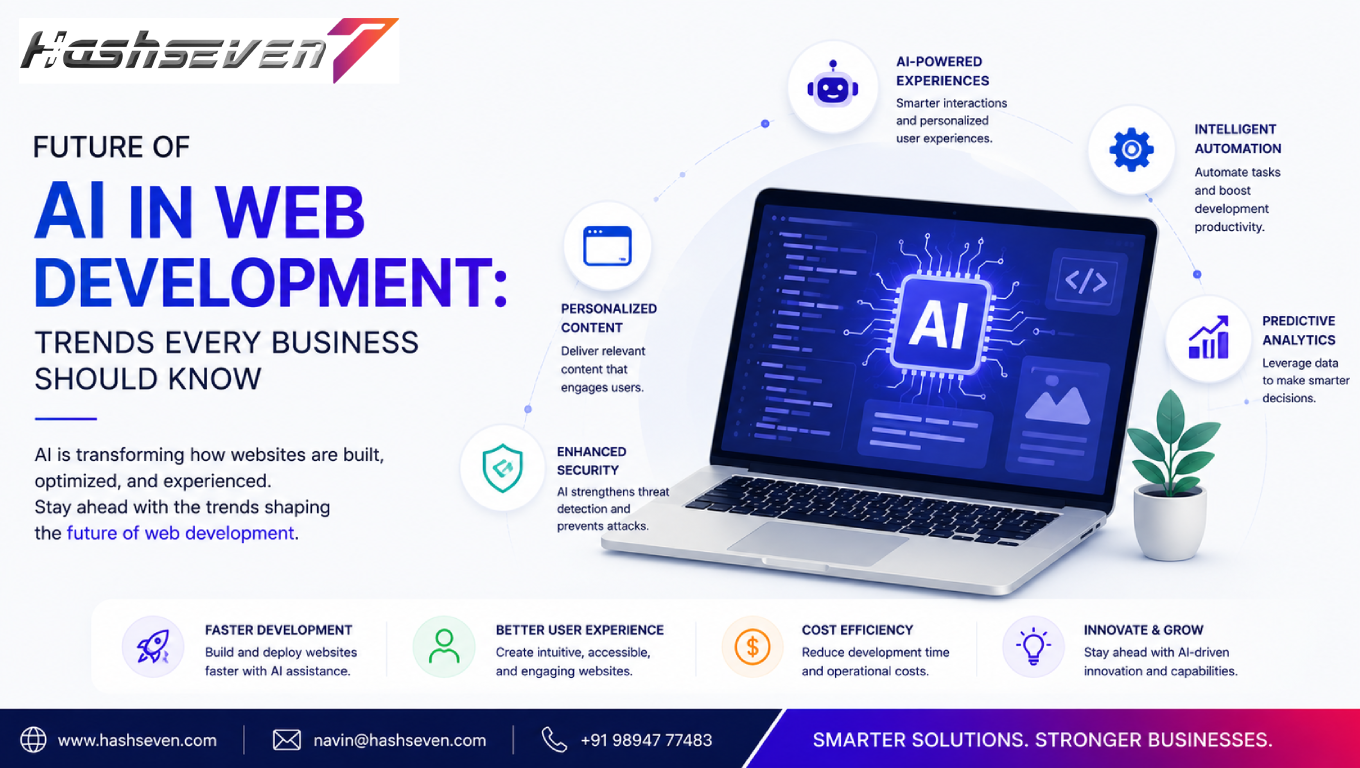

Artificial intelligence is rapidly changing how websites and web applications are designed, developed, tested, optimized, and maintained. Businesses are increasingly using AI to improve development speed, personalize digital experiences, automate repetitive tasks, and build smarter online platforms.
AI in web development is no longer limited to experimental projects. AI-powered coding assistants, intelligent chatbots, automated testing, personalized recommendations, AI search, content generation, and predictive analytics are becoming practical tools for businesses.
For companies planning a new website or upgrading an existing digital platform, understanding these developments is important. AI can help reduce development effort and improve user experiences, but businesses also need to consider security, privacy, accuracy, cost, and human oversight.
This guide explores the future of AI in web development, the most important trends businesses should know, practical applications, benefits, challenges, implementation strategies, and how organizations can prepare for the next generation of intelligent websites.
What Is AI in Web Development?
AI in web development refers to the use of artificial intelligence technologies to support or automate different parts of website and web application development.
AI can be used across the development lifecycle, including:
- Website planning
- UI/UX design
- Code generation
- Content creation
- Software testing
- Bug detection
- Performance optimization
- Search functionality
- Customer support
- Personalization
- Data analysis
- Website security
Traditional web development depends heavily on manually writing code, designing interfaces, testing features, and analyzing user behavior.
AI can assist developers and businesses by automating certain repetitive processes and helping teams make faster, data-informed decisions.
However, AI works best as an enhancement to skilled development rather than a complete replacement for professional developers.
Build a Website That Grows Your Business
A professionally developed website is the foundation of your online success. If you’re planning to create a responsive, fast, and SEO-friendly business website, explore our Website Development Services to see how Hashseven can help transform your ideas into a powerful digital presence.
Why AI Is Becoming Important in Web Development
Businesses increasingly expect websites to be:
- Fast
- Personalized
- Secure
- Interactive
- Mobile-friendly
- Intelligent
- Easy to manage
At the same time, development teams need to deliver these experiences efficiently.
AI can help address both challenges.
For example, AI can help developers generate code suggestions while businesses can use AI-powered systems to understand customers and automate support.
This creates opportunities to improve both development productivity and customer experience.
How AI Is Changing Website Development
AI is influencing almost every stage of modern website development.
AI-Assisted Coding
AI coding assistants can help developers:
- Generate code
- Explain existing code
- Find potential errors
- Suggest improvements
- Create functions
- Write documentation
- Convert code between languages
Developers can use these capabilities to speed up routine programming tasks.
However, generated code still needs human review for correctness, security, maintainability, and compatibility.
AI-Powered UI/UX Design
AI can assist designers in creating and improving user interfaces.
AI-powered design tools can help with:
- Layout suggestions
- Component generation
- Content organization
- Design variations
- Accessibility recommendations
- User-flow analysis
Instead of starting every design decision from scratch, designers can use AI to explore multiple possibilities quickly.
Human designers remain important for understanding brand identity, business objectives, user psychology, and complex user needs.
AI-Powered Website Personalization
Personalization is one of the most promising applications of AI.
Instead of showing every visitor the same experience, AI can analyze user behavior and provide more relevant content.
For example, a website could personalize:
- Product recommendations
- Content
- Offers
- Search results
- Navigation
- Email campaigns
- Product suggestions
An e-commerce website could recommend products based on previous browsing and purchasing behavior.
This can create a more relevant customer experience.
AI Chatbots for Websites
AI chatbots are becoming a major part of customer-facing websites.
Traditional chatbots often rely on predefined responses.
Modern AI-powered chatbots can understand natural-language questions and provide more flexible responses.
Businesses can use them for:
- Customer support
- Product questions
- Lead qualification
- Appointment booking
- Order assistance
- FAQs
- Service recommendations
A well-designed AI chatbot can provide assistance outside normal business hours.
However, businesses should provide a clear path to human support when a question requires human judgment or sensitive assistance.
AI-Powered Search
Website search is also becoming more intelligent.
Traditional search typically matches keywords.
AI-powered search can understand the meaning and intent behind a query.
For example, instead of searching for an exact product name, a customer might type:
“I need a lightweight laptop for college.”
An AI-powered search system can interpret the intent and return relevant products.
This can make large websites easier to navigate.
AI Content Generation
AI can help businesses produce different types of website content.
Possible applications include:
- Product descriptions
- Blog outlines
- FAQ drafts
- Landing page content
- Meta descriptions
- Email content
- Content summaries
However, businesses should not publish AI-generated content without appropriate review.
Content should be:
- Accurate
- Original
- Useful
- Relevant
- Brand-consistent
- Written for users
Google’s guidance emphasizes creating helpful, reliable content for people rather than producing content primarily to manipulate search rankings.
Google Search Central – Creating Helpful Content
AI-Powered Website Analytics
Traditional analytics tells businesses what happened.
AI can help identify patterns and potential reasons behind those results.
AI-powered analytics can help businesses understand:
- Customer behavior
- Conversion patterns
- Traffic trends
- Abandonment points
- Engagement changes
- Customer segments
For example, AI could identify that visitors from a particular campaign frequently leave at the checkout stage.
Businesses can then investigate and optimize the relevant part of the customer journey.
AI for Website Testing
Testing is an important part of web development.
AI can assist with:
- Test generation
- Bug identification
- Regression testing
- User-flow testing
- Error detection
- Performance analysis
Automated testing can help development teams identify problems earlier.
This can reduce the time required for repetitive testing tasks.
AI for Website Accessibility
AI can also support accessibility efforts.
Potential applications include identifying:
- Missing alternative text
- Contrast problems
- Navigation issues
- Form-label problems
- Accessibility inconsistencies
However, automated tools should not be treated as a complete accessibility audit.
Human testing and adherence to established accessibility standards remain important.
The W3C Web Accessibility Initiative provides guidance for creating accessible websites.
W3C Web Accessibility Initiative
AI-Powered Cybersecurity
As websites become more intelligent, cybersecurity remains a major concern.
AI can help security teams detect unusual patterns and potential threats.
Applications can include:
- Anomaly detection
- Suspicious activity monitoring
- Fraud detection
- Automated alerts
- Threat analysis
- Security log analysis
However, AI itself can also introduce security risks.
Businesses should use secure development practices and regularly evaluate AI-powered systems.
OWASP provides resources for understanding security risks associated with modern web applications and AI systems.
AI and Voice Interfaces
Voice-based interactions are another potential direction for web experiences.
Users may increasingly interact with websites through:
- Voice search
- Voice assistants
- Conversational interfaces
- Spoken commands
For businesses, this could create new ways for customers to search for products, services, information, and support.
Websites should continue prioritizing clear content and accessible interfaces as conversational interactions evolve.
AI-Powered Recommendation Systems
Recommendation systems can help businesses deliver relevant products and content.
Examples include:
- “You may also like”
- Related products
- Recommended articles
- Personalized services
- Suggested content
E-commerce businesses can use customer behavior and product data to improve recommendations.
This can increase engagement and potentially improve conversions.
AI for Predictive Analytics
AI can help businesses move beyond analyzing past behavior toward predicting potential future outcomes.
Possible applications include:
- Customer churn prediction
- Demand forecasting
- Sales forecasting
- Lead scoring
- Inventory planning
- Customer segmentation
Predictive systems should be evaluated carefully because predictions are not guarantees.
Businesses should use appropriate data and human judgment when making important decisions.
AI-Powered Web Development Workflows
AI can connect multiple development activities into more efficient workflows.
A modern workflow might involve:
Requirement → Design → Code → Testing → Deployment → Monitoring
AI can assist at several stages.
For example:
- Generate an initial development concept.
- Suggest interface components.
- Generate code.
- Create test cases.
- Identify possible bugs.
- Analyze performance.
- Monitor application behavior.
Developers still need to review and control the process.
AI and Low-Code Development
AI is also influencing low-code and no-code development.
Businesses can increasingly describe what they want in natural language and receive:
- Page layouts
- Database structures
- Workflow suggestions
- Form configurations
- Automation workflows
- Code snippets
This can help non-technical teams build simple digital solutions faster.
Complex applications still require professional development expertise, architecture planning, testing, and security review.
AI and Headless Web Development
AI can also work alongside modern web architectures such as headless systems.
A headless architecture separates the frontend experience from the backend content or data systems.
This can provide flexibility for businesses that need to deliver content across:
- Websites
- Mobile applications
- Digital displays
- E-commerce interfaces
- Other digital channels
AI services can be integrated through APIs to provide intelligent capabilities across these experiences.
AI-Powered E-Commerce Websites
E-commerce is one of the areas where AI in web development can have a significant impact.
Businesses can use AI for:
- Product recommendations
- Intelligent search
- Personalized offers
- Customer support
- Fraud detection
- Inventory forecasting
- Review analysis
- Shopping assistants
For example, an AI shopping assistant could help a customer compare products based on their requirements.
This can create a more personalized shopping experience.
AI in Web Development for Small Businesses
AI is not limited to large enterprises.
Small businesses can use AI to improve:
- Customer support
- Lead generation
- Content creation
- Appointment booking
- Email marketing
- Website search
- Data analysis
- Workflow automation
A small company may start with a simple AI chatbot or automated lead qualification system and expand its AI capabilities over time.
Benefits of AI in Web Development
Faster Development
AI can assist developers with repetitive coding and documentation tasks.
Improved Productivity
Developers and designers can spend more time on complex work.
Better Personalization
AI can help deliver content and recommendations based on customer behavior.
Faster Customer Support
AI-powered assistants can respond to common questions quickly.
Better Data Analysis
AI can identify patterns across large datasets.
Improved Testing
AI can help identify bugs and generate testing scenarios.
More Efficient Operations
AI can automate repetitive business and website processes.
Better User Experiences
Intelligent search, recommendations, personalization, and conversational interfaces can make websites more useful.
Challenges of AI in Web Development
AI offers significant opportunities, but businesses should understand its limitations.
Accuracy
AI-generated information can be incorrect.
Important outputs should be reviewed.
Security
AI systems can introduce new attack surfaces and data risks.
Privacy
Businesses need to understand how customer information is collected, processed, stored, and shared.
Cost
AI APIs and infrastructure can create additional operational costs.
Integration Complexity
Integrating AI with existing systems can require significant technical planning.
Lack of Human Context
AI may not fully understand business-specific situations or sensitive customer needs.
Overdependence on AI
Businesses should avoid relying entirely on AI for critical decisions.
How Businesses Can Prepare for AI in Web Development
Businesses do not need to implement every AI technology immediately.
Instead, follow a practical strategy.
1. Identify Real Business Problems
Start with problems rather than AI tools.
Ask:
- What takes too much time?
- Where do customers need faster support?
- Which processes are repetitive?
- Where could personalization help?
2. Start With a Small Use Case
Choose one practical application.
For example:
- AI chatbot
- Intelligent search
- Automated customer support
- Lead qualification
- Content assistance
Measure the results before expanding.
3. Prepare Your Data
AI systems depend heavily on data quality.
Businesses should organize:
- Customer information
- Product information
- Website content
- Transaction data
- Support records
Clean and structured data can improve AI performance.
4. Protect Customer Data
Establish policies for:
- Data access
- Data storage
- API usage
- User permissions
- Sensitive information
- Third-party AI services
Privacy should be considered before implementation.
5. Keep Humans in the Loop
AI should support human decision-making where appropriate.
Human review is particularly important for:
- Financial decisions
- Sensitive customer interactions
- Security decisions
- Legal matters
- High-impact business decisions
How to Implement AI in a Website
A practical implementation process can follow these steps.
Step 1: Identify the Business Goal
Define what you want AI to improve.
Step 2: Select the Use Case
Choose one specific application.
Step 3: Evaluate Data Requirements
Determine what information the AI system needs.
Step 4: Select the Technology
Evaluate AI models, APIs, frameworks, and infrastructure.
Step 5: Build a Prototype
Create a small proof of concept.
Step 6: Test Accuracy and Security
Evaluate outputs, reliability, privacy, and performance.
Step 7: Integrate With Your Website
Connect the AI system with the appropriate frontend and backend components.
Step 8: Monitor Results
Track performance, customer feedback, costs, and errors.
Step 9: Improve Continuously
AI systems should be reviewed and optimized over time.
AI in Web Development vs Traditional Web Development
| Area | Traditional Approach | AI-Assisted Approach |
|---|---|---|
| Coding | Mostly manual | AI-assisted |
| Testing | Manually designed tests | AI-assisted test generation |
| Search | Keyword-focused | Intent-aware |
| Support | Human or rule-based chatbot | Conversational AI |
| Personalization | Rule-based | Data-driven AI |
| Analytics | Descriptive | Predictive and pattern-based |
| Content | Manually created | AI-assisted with human review |
| Recommendations | Basic rules | AI-driven recommendations |
AI does not eliminate traditional development. Instead, it adds another layer of intelligence and automation.
Future Trends in AI in Web Development
The future of AI in web development is likely to involve deeper integration across development and customer experiences.
Important trends include:
AI-Native Websites
Websites may be designed around intelligent interactions from the beginning rather than adding AI as an afterthought.
Conversational Interfaces
Users may increasingly interact with websites through natural language.
AI-Powered Development Assistants
Development tools will continue assisting with coding, debugging, documentation, and testing.
Hyper-Personalization
Web experiences may become increasingly tailored to individual user needs.
Intelligent Search
Search systems will increasingly understand context and user intent.
Autonomous Testing
AI may increasingly identify testing requirements and potential issues automatically.
AI-Powered Business Workflows
AI and workflow automation will increasingly work together across CRM, ERP, marketing, customer service, and web platforms.
Common Mistakes Businesses Should Avoid
Using AI Without a Clear Goal
AI should solve a measurable problem.
Publishing Unreviewed AI Content
Human review remains essential for accuracy and quality.
Ignoring Privacy
Customer data should be handled responsibly.
Choosing AI Based Only on Trends
Evaluate actual business value.
Ignoring Security
AI integrations should be evaluated for security risks.
Automating Critical Decisions Without Oversight
Important decisions may require human judgment.
Failing to Measure Results
Track whether AI is actually improving business outcomes.
How to Measure the Success of AI
Businesses should define measurable KPIs before implementation.
Possible metrics include:
- Customer response time
- Conversion rate
- Support resolution time
- Development time
- Error rate
- User engagement
- Customer satisfaction
- Lead qualification rate
- Search success rate
- Operational cost
For example, if an AI chatbot is introduced, businesses can compare support response times and resolution rates before and after implementation.
Frequently Asked Questions
1. What is AI in web development?
AI in web development refers to using artificial intelligence to assist with website design, coding, testing, personalization, search, customer support, analytics, security, and other web development processes.
2. How can AI improve website development?
AI can help developers generate code, identify errors, create tests, analyze data, improve workflows, and automate repetitive development tasks, allowing teams to work more efficiently.
3. Will AI replace web developers?
AI is more likely to change how developers work than completely replace them. Developers are still needed for architecture, problem-solving, security, business logic, testing, quality control, and complex decision-making.
4. Can small businesses use AI in web development?
Yes. Small businesses can start with practical applications such as AI chatbots, intelligent search, lead qualification, content assistance, recommendations, and automated customer support.
5. Is AI in web development good for SEO?
AI can support SEO through content assistance, data analysis, personalization, and technical optimization. However, businesses should prioritize useful, accurate, people-first content and avoid using AI solely to produce large amounts of low-quality content.
Conclusion
The future of AI in web development is moving toward smarter, more personalized, automated, and conversational digital experiences.
AI can support developers with coding and testing while helping businesses improve customer service, website search, personalization, analytics, recommendations, and operational efficiency.
However, successful AI adoption requires more than choosing an AI tool. Businesses need clear objectives, quality data, secure integrations, privacy controls, human oversight, and measurable performance goals.
The businesses that benefit most from AI will not necessarily be those that use the most AI. They will be those that use it strategically to solve meaningful problems and improve customer experiences.
As AI technology continues to evolve, businesses should start experimenting with practical use cases today while building a strong technical and data foundation for tomorrow.
Ready to Build a Professional Website for Your Business?
Turn your business into a powerful online brand with Hashseven.
Since 2017, we’ve helped businesses grow through professional website development, mobile apps, custom software, SEO, digital marketing, CRM, POS solutions, and Meta-approved WhatsApp automation. Let’s create a fast, secure, and conversion-focused website that attracts more customers and drives real business growth.