
Generating quality leads is one of the biggest challenges businesses face in a competitive digital marketplace. Visitors may land on a website, explore products or services, and leave without contacting the business. Traditional contact forms often fail to capture these potential customers because they require users to manually enter information and wait for a response.
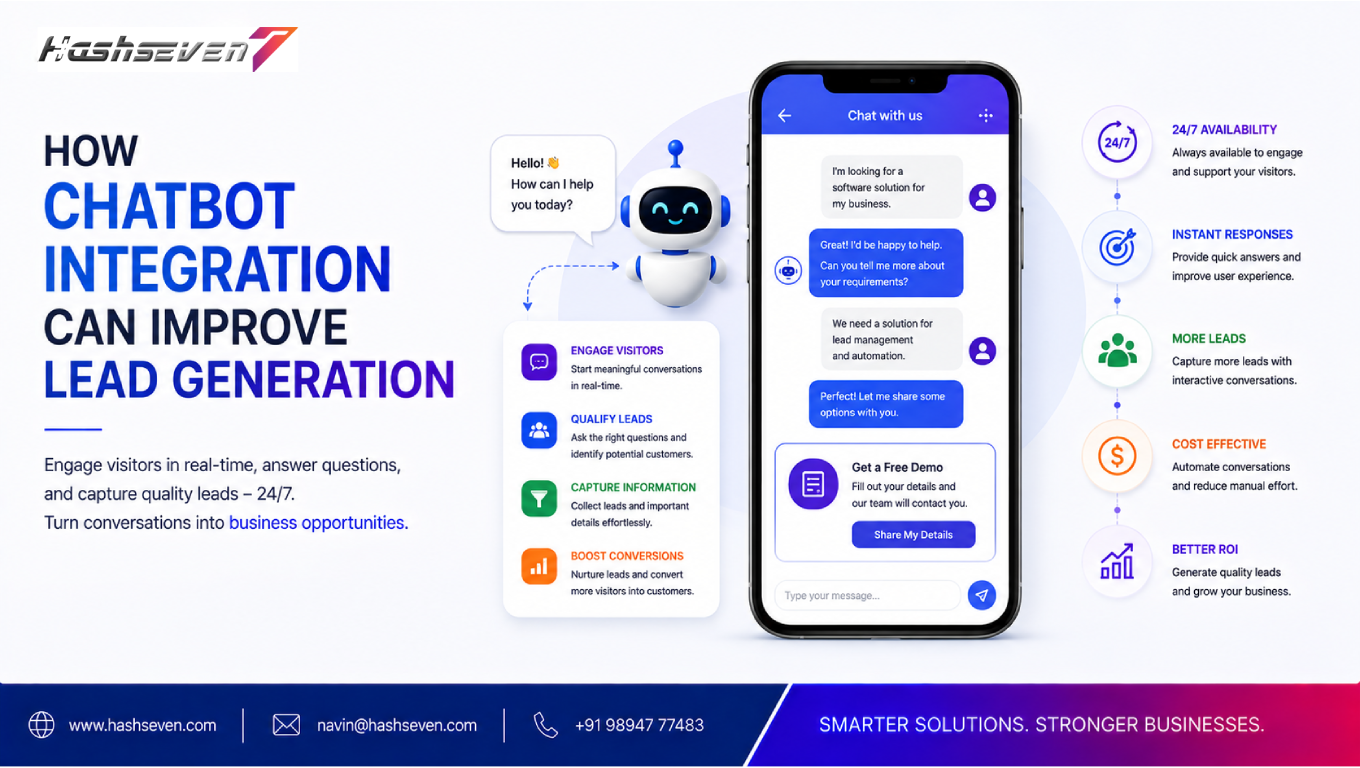
Chatbot integration can help businesses create a faster and more interactive way to engage website visitors. A well-designed chatbot can answer questions, qualify prospects, collect contact information, recommend services, and guide visitors toward the next step.
Chatbot lead generation combines conversational experiences with automated lead-capture processes. Instead of waiting for customers to complete a form, businesses can start conversations immediately and identify potential prospects while they are actively exploring the website.
In this guide, we will explain how chatbot integration works, how it supports lead generation, important benefits, practical use cases, implementation steps, best practices, common mistakes, and future trends businesses should know.
What Is Chatbot Lead Generation?
Chatbot lead generation is the process of using a chatbot to engage website visitors, identify potential customers, collect relevant information, qualify prospects, and move them toward a sales action.
A chatbot can ask visitors questions such as:
- What service are you interested in?
- What type of solution do you need?
- What is your estimated budget?
- When do you need the service?
- How can we contact you?
Based on the visitor’s answers, the chatbot can collect lead information and send it to a CRM or sales platform.
A simple workflow can look like:
Website Visitor → Chatbot Conversation → Lead Qualification → Contact Capture → CRM → Sales Follow-Up
This creates a more interactive lead-generation process.
How Does Chatbot Lead Generation Work?
A chatbot can operate as an automated first point of contact between a business and its website visitors.
A typical process includes:
- Visitor arrives on the website
- Chatbot initiates a conversation
- Visitor selects a requirement
- Chatbot asks qualifying questions
- Contact details are collected
- Lead information is sent to the CRM
- Sales team receives the lead
- Sales representative follows up
The chatbot can operate outside normal business hours, allowing businesses to capture potential leads even when employees are unavailable.
Why Chatbot Lead Generation Matters for Businesses
Website visitors do not always want to fill out lengthy forms.
Some visitors may have simple questions before they are ready to contact a sales representative.
A chatbot provides an alternative way to start a conversation.
It can:
- Engage visitors immediately
- Answer common questions
- Qualify prospects
- Collect contact information
- Recommend relevant services
- Schedule appointments
- Send leads to sales teams
- Provide support outside business hours
This makes chatbots particularly useful for businesses with websites that receive regular traffic but struggle to convert visitors into inquiries.
Build a Website That Grows Your Business
A professionally developed website is the foundation of your online success. If you’re planning to create a responsive, fast, and SEO-friendly business website, explore our Website Development Services to see how Hashseven can help transform your ideas into a powerful digital presence.
Major Benefits of Chatbot Lead Generation
1. Engages Website Visitors Immediately
One of the biggest advantages of chatbot integration is immediate engagement.
A visitor may have questions about pricing, services, availability, or features.
Instead of searching through multiple pages, the visitor can interact directly with the chatbot.
For example:
Visitor: I need a website for my business.
Chatbot: Great! What type of website are you looking for?
Visitor: E-commerce.
The chatbot can continue the conversation and eventually request contact information.
This can create a more interactive customer journey.
2. Captures Leads 24/7
Traditional sales teams have working hours.
Websites, however, receive visitors throughout the day and night.
A chatbot can continue engaging visitors outside business hours.
A visitor who arrives at midnight can still:
- Ask questions
- Request information
- Submit contact details
- Request a quote
- Book an appointment
This allows businesses to capture potential leads that might otherwise be lost.
3. Qualifies Leads Automatically
Not every website visitor is a potential customer.
Chatbots can ask qualifying questions before sending information to the sales team.
For example:
What service do you need?
- Website Development
- Mobile App Development
- Digital Marketing
- Software Development
The chatbot can then ask additional questions based on the visitor’s selection.
This helps businesses identify more relevant prospects.
4. Reduces Response Time
Speed can influence whether a visitor becomes a lead.
If a customer submits a form and waits several hours for a response, they may contact another business.
Chatbots can provide immediate responses to common questions.
This creates a faster initial interaction.
5. Collects Structured Lead Information
Traditional chat conversations can produce unstructured information.
A chatbot can collect specific fields such as:
- Name
- Phone number
- Company
- Service requirement
- Budget
- Project timeline
This creates structured information that can be passed to the sales team.
6. Improves User Experience
Visitors can receive assistance without navigating through multiple pages.
A chatbot can help users find:
- Services
- Products
- Pricing information
- FAQs
- Contact details
- Booking pages
A helpful conversational experience can reduce friction during the customer journey.
7. Supports Sales Teams
Chatbots do not necessarily replace sales representatives.
Instead, they can handle repetitive initial interactions.
The chatbot can collect information and pass qualified leads to the sales team.
Sales representatives can then focus on conversations that require human expertise.
8. Increases Website Conversion Opportunities
A website can receive significant traffic without generating enough leads.
Chatbot integration creates another conversion opportunity.
Instead of relying only on:
Contact Us → Form → Submit
businesses can offer:
Chat → Conversation → Qualification → Lead
This gives visitors another way to engage.
Chatbot Lead Generation vs Traditional Contact Forms
| Factor | Contact Form | Chatbot |
|---|---|---|
| Interaction | Static | Conversational |
| Response | Usually delayed | Immediate |
| Qualification | Manual | Automated |
| Availability | Usually 24/7 form access | 24/7 interaction |
| Lead questions | Fixed fields | Dynamic questions |
| User guidance | Limited | Interactive |
| Lead routing | Often manual | Can be automated |
| Personalization | Limited | Higher potential |
Contact forms are still useful, but chatbots can complement them by providing a more interactive option.
How Chatbots Qualify Leads
Lead qualification is one of the most valuable chatbot functions.
A chatbot can ask questions based on the visitor’s needs.
For example, a software company could ask:
What type of software do you need?
- CRM
- ERP
- POS
- Custom Software
Then:
What is your expected project timeline?
- This month
- 1–3 months
- 3–6 months
- Just researching
The chatbot can use these responses to categorize leads.
For example:
High-Intent Lead → Immediate Sales Notification
Medium-Intent Lead → Email Follow-Up
Low-Intent Visitor → Educational Content
This can help sales teams prioritize their efforts.
Chatbot Integration With CRM Systems
Connecting a chatbot with a CRM can make chatbot lead generation much more effective.
Without CRM integration:
Chatbot → Lead Information
With CRM integration:
Chatbot → Lead → CRM → Sales Assignment → Follow-Up
The chatbot can automatically send information such as:
- Name
- Phone
- Requirements
- Conversation history
- Lead source
- Qualification status
The CRM can then assign the lead to the appropriate salesperson.
Chatbot Integration With Email Marketing
Businesses can also connect chatbots with email marketing systems.
For example:
Chatbot → Email Capture → Marketing Platform → Follow-Up Campaign
If a visitor is interested in a service but is not ready to purchase, the business can continue nurturing the relationship through relevant email content.
This can help move prospects through the sales funnel.
Chatbot Integration With Appointment Booking
Businesses that depend on consultations or appointments can connect chatbots with scheduling systems.
A chatbot can ask:
Would you like to schedule a consultation?
The visitor can then choose a suitable date and time.
This can be useful for:
- Consultants
- Agencies
- Healthcare businesses
- Educational institutions
- Financial services
- Professional service providers
The chatbot can collect basic information before directing the visitor to the booking system.
Chatbot Integration for E-Commerce Lead Generation
E-commerce websites can use chatbots to assist visitors with product discovery.
For example:
Visitor: I need a laptop for graphic design.
Chatbot: What is your preferred budget?
Visitor: Under ₹80,000.
The chatbot can recommend relevant products or direct the visitor toward suitable product categories.
It can also help with:
- Product questions
- Order information
- Discounts
- Shipping
- Returns
- Product recommendations
This can improve the shopping experience while creating opportunities for customer engagement.
Chatbot Lead Generation for B2B Businesses
B2B businesses often have longer sales cycles and more complex qualification requirements.
A chatbot can ask questions such as:
- Company size
- Industry
- Business requirement
- Current software
- Project budget
- Expected implementation timeline
This information can help sales teams understand whether a prospect fits their target customer profile.
For example:
Website Visitor → Chatbot → Qualification → CRM → Sales Representative
This can streamline the initial B2B sales process.
Using AI for Chatbot Lead Generation
Modern AI-powered chatbots can understand natural language and provide more flexible conversations than simple rule-based bots.
AI can help chatbots:
- Understand user questions
- Identify customer intent
- Provide contextual responses
- Recommend relevant content
- Qualify leads
- Summarize conversations
- Route leads
- Support multilingual interactions
However, businesses should ensure that AI-generated responses are accurate and aligned with their brand and business information.
How to Create an Effective Lead Generation Chatbot
Step 1: Define Your Goal
First, determine what the chatbot should accomplish.
Possible goals include:
- Generate leads
- Qualify prospects
- Book appointments
- Recommend products
- Answer FAQs
- Collect inquiries
- Provide customer support
Avoid trying to make one chatbot handle every possible task from the beginning.
Step 2: Identify Your Target Audience
Understand:
- Who visits your website?
- What problems do they have?
- What questions do they ask?
- What information do they need before contacting you?
This helps you create useful chatbot conversations.
Step 3: Create Conversation Flows
Plan the conversation before development.
For example:
Welcome → Requirement → Qualification → Contact Details → Next Step
Keep the conversation simple and focused.
Step 4: Choose the Right Chatbot Technology
Businesses can choose between:
- Rule-based chatbots
- AI-powered chatbots
- Hybrid chatbots
The right option depends on business requirements, budget, complexity, and expected conversation volume.
Step 5: Connect the CRM
Connect the chatbot to your CRM so collected information can be stored and managed automatically.
Step 6: Add Lead Qualification
Create questions that help identify high-value prospects.
Step 7: Provide Human Handoff
Visitors should have an option to speak with a human when necessary.
Step 8: Test the Chatbot
Test:
- Conversation flow
- Lead capture
- CRM integration
- Mobile experience
- Error handling
- Human handoff
- Form validation
Step 9: Monitor Performance
Track chatbot performance regularly and improve the conversation based on actual user behavior.
Key Chatbot Lead Generation Metrics
Businesses should measure chatbot performance using meaningful metrics.
Chatbot Engagement Rate
Measures how many visitors interact with the chatbot.
Lead Capture Rate
Measures how many chatbot conversations result in captured lead information.
Lead Qualification Rate
Shows how many captured leads meet your qualification criteria.
Conversion Rate
Measures how many chatbot-generated leads eventually become customers or complete the desired action.
Human Handoff Rate
Shows how frequently visitors require assistance from a human representative.
Drop-Off Rate
Identifies where visitors stop interacting with the chatbot.
These metrics can help businesses identify opportunities for improvement.
Common Chatbot Lead Generation Mistakes
1. Asking Too Many Questions
Long conversations can frustrate visitors.
Ask only questions that are genuinely useful.
2. Making the Chatbot Too Aggressive
A chatbot that immediately asks for personal information can discourage visitors.
Start with helpful information before requesting contact details.
3. Hiding the Human Option
Some questions require human expertise.
Provide an easy way to contact a representative.
4. Using Generic Responses
Generic responses can make the chatbot feel unhelpful.
Customize conversations around your products, services, and audience.
5. Ignoring Mobile Users
Many website visitors use smartphones.
Ensure the chatbot works smoothly across different screen sizes.
6. Not Connecting the CRM
Collecting leads without organizing them can reduce the value of the chatbot.
CRM integration can help businesses manage and follow up with captured leads.
7. Not Reviewing Chatbot Conversations
Businesses should analyze conversations regularly.
Real customer conversations can reveal:
- Frequently asked questions
- Customer concerns
- Conversion barriers
- Missing information
- New sales opportunities
Chatbot Security and Privacy
Lead-generation chatbots may collect personal information such as names, email addresses, and phone numbers.
Businesses should therefore consider:
- Secure data transmission
- Access controls
- Secure storage
- Data minimization
- Appropriate consent
- Privacy policies
- Secure third-party integrations
Businesses should collect only information that is necessary for the intended purpose.
For API and application security guidance, businesses can refer to the OWASP API Security Project.
Best Practices for Chatbot Lead Generation
Keep Conversations Short
Ask one question at a time and avoid unnecessary steps.
Give Clear Options
Buttons and predefined choices can make conversations easier.
Use Natural Language
The chatbot should communicate in a simple and conversational way.
Provide Immediate Value
Answer a question or offer useful information before asking for contact details.
Personalize the Experience
Use the visitor’s selected service, industry, or requirement to make responses more relevant.
Make Human Handoff Easy
Allow users to connect with a human representative when necessary.
Integrate With Your Sales Workflow
Connect the chatbot to CRM, email, calendar, and sales systems where appropriate.
Continuously Optimize
Use performance data and conversation analysis to improve the chatbot over time.
How Chatbot Lead Generation Supports the Sales Funnel
A chatbot can support multiple stages of the customer journey.
Awareness
The chatbot answers basic questions and helps visitors understand available solutions.
Consideration
It provides information about products or services and helps visitors compare options.
Decision
It can collect requirements, provide next steps, or schedule a consultation.
Conversion
It can capture contact information and send qualified leads to the sales team.
Retention
After conversion, the chatbot can assist with support, FAQs, and account-related questions.
This makes chatbot technology useful beyond initial lead generation.
Future of Chatbot Lead Generation
The future of chatbot lead generation is likely to become more intelligent and personalized.
Important trends include:
AI-Powered Conversations
AI can make conversations more flexible and context-aware.
Personalized Recommendations
Chatbots can use customer information and behavior to provide more relevant recommendations.
Voice-Enabled Chatbots
Voice interfaces may allow customers to interact with businesses using spoken conversations.
Omnichannel Chatbots
Businesses can connect chatbot experiences across websites, messaging platforms, and other digital channels.
Automated Lead Scoring
AI can analyze conversations and help identify high-intent prospects.
Deeper CRM Integration
Chatbots will increasingly become connected components of broader sales and marketing systems
How Chatbot Integration Can Improve Lead Generation
Imagine a business website receives 1,000 visitors every month.
Only a small percentage may complete the traditional contact form.
A chatbot creates another opportunity to engage visitors.
For example:
1,000 Website Visitors
↓
Chatbot Engages Interested Visitors
↓
Visitors Ask Questions
↓
Chatbot Qualifies Prospects
↓
Contact Information Collected
↓
Qualified Leads Sent to CRM
↓
Sales Team Follows Up
This process can help businesses capture potential opportunities that may otherwise leave the website without taking action.
The chatbot itself does not guarantee more customers. Its effectiveness depends on the quality of the conversation, targeting, offer, website experience, sales follow-up, and overall lead-generation strategy.
Frequently Asked Questions
1. What is chatbot lead generation?
Chatbot lead generation uses automated conversations to engage website visitors, collect information, qualify prospects, and send potential customers into a sales or marketing process.
2. Can chatbots generate leads 24/7?
Yes. Chatbots can engage website visitors outside normal business hours and collect inquiries or contact information automatically.
3. Can a chatbot connect to a CRM?
Yes. Chatbots can integrate with CRM systems to automatically send collected lead information, conversation details, and qualification data to sales teams.
4. Are AI chatbots better for lead generation?
AI chatbots can provide more flexible and natural conversations, but the best solution depends on the business’s goals, audience, budget, and integration requirements.
5. How can businesses improve chatbot lead generation?
Businesses can improve results by creating short conversations, asking relevant qualification questions, providing useful answers, offering human handoff, integrating the CRM, and continuously analyzing chatbot performance.
Conclusion
Chatbot lead generation can give businesses a practical way to engage website visitors, answer questions, qualify prospects, and capture potential customers.
Instead of relying exclusively on static contact forms, businesses can use conversational experiences to reduce friction and provide immediate assistance.
When integrated with CRM, email marketing, appointment scheduling, and sales systems, a chatbot can become an important part of a broader lead-generation strategy.
However, successful chatbot integration requires more than simply adding a chat widget to a website. Businesses need clear goals, useful conversation flows, relevant qualification questions, strong security practices, human handoff options, and continuous performance optimization.
When implemented strategically, chatbot technology can help businesses turn more website interactions into meaningful sales opportunities.
Ready to Build a Professional Website for Your Business?
Turn your business into a powerful online brand with Hashseven.
Since 2017, we’ve helped businesses grow through professional website development, mobile apps, custom software, SEO, digital marketing, CRM, POS solutions, and Meta-approved WhatsApp automation. Let’s create a fast, secure, and conversion-focused website that attracts more customers and drives real business growth.