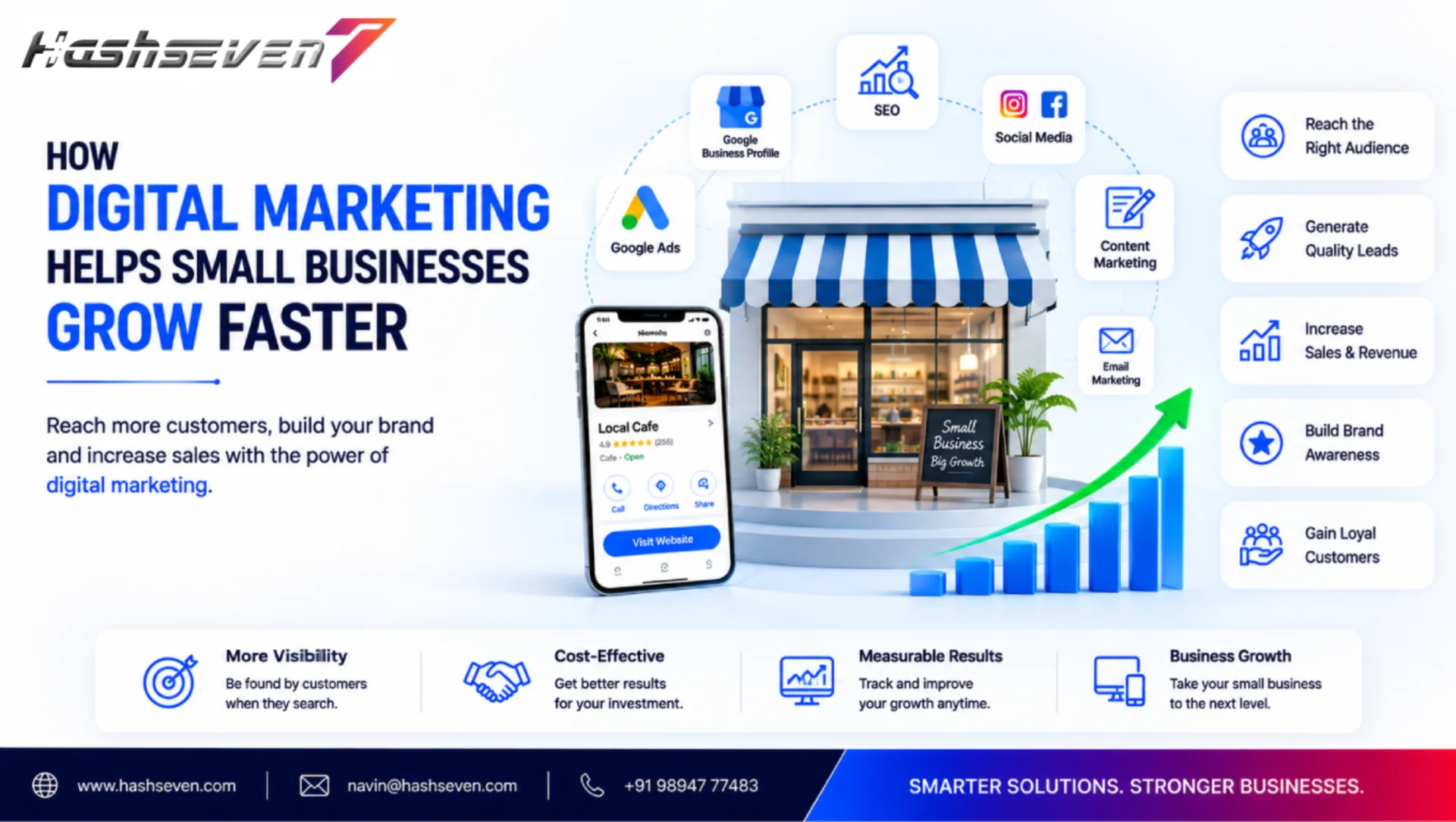

Digital marketing for small business growth has become one of the most effective ways for companies to reach potential customers, build brand awareness, generate leads, and increase sales. Unlike traditional marketing, digital channels allow businesses to connect with specific audiences, measure campaign performance, and adjust strategies based on real-time results.
Small businesses often operate with limited budgets and resources. This makes it important to invest marketing money where it can create measurable results. Search engines, social media, email, content marketing, online advertising, and local search can help small businesses compete with larger companies.
A strong digital marketing strategy doesn’t require using every available platform. Instead, businesses should identify where their target customers spend time online and build campaigns around those channels.
In this guide, we’ll explain how digital marketing for small business growth works, the most effective channels to consider, common mistakes to avoid, and how businesses can create a practical digital marketing strategy.
What Is Digital Marketing for Small Business?
Digital marketing for small business refers to using online channels and digital technologies to promote products, services, and brands to potential customers.
Common digital marketing channels include:
- Search engine optimization
- Social media marketing
- Content marketing
- Email marketing
- Pay-per-click advertising
- Local SEO
- Online reputation management
- Video marketing
- Website marketing
- Conversion rate optimization
Instead of relying only on traditional advertising, small businesses can use digital channels to reach customers where they already spend time: online.
Build a Website That Grows Your Business
A professionally developed website is the foundation of your online success. If you’re planning to create a responsive, fast, and SEO-friendly business website, explore our Website Development Services to see how Hashseven can help transform your ideas into a powerful digital presence.
Why Digital Marketing Matters for Small Businesses
Small businesses face strong competition from local companies, national brands, and online businesses.
Digital marketing helps level the playing field by allowing smaller companies to:
- Reach specific audiences
- Target particular locations
- Build brand awareness
- Generate website traffic
- Collect leads
- Communicate with customers
- Measure campaign results
- Improve marketing strategies
A small company doesn’t necessarily need the largest advertising budget. It needs a strategy that focuses on the right audience and measurable business goals.
1. Build a Strong Online Presence
A professional online presence helps potential customers learn about your business before contacting you.
Your online presence may include:
- Business website
- Google Business Profile
- Social media profiles
- Business listings
- Customer reviews
- Blog
- Product pages
- Service pages
Your website should clearly explain what you offer, who you serve, and how customers can contact you.
A strong digital presence can also increase trust when customers research your company before making a purchase.
2. Reach the Right Target Audience
One of the major benefits of digital marketing for small business campaigns is audience targeting.
Traditional advertising often reaches a broad audience, but digital platforms allow businesses to focus on specific groups.
You can target customers based on factors such as:
- Location
- Age range
- Interests
- Search behavior
- Online activity
- Previous website visits
- Purchase behavior
For example, a local restaurant doesn’t necessarily need to advertise to an entire state. It may benefit more from reaching people within a specific geographic area.
3. Improve Search Engine Visibility
Search engines are an important source of potential customers.
People search online when they want to:
- Find a local service
- Compare products
- Research companies
- Read reviews
- Solve problems
- Find prices
- Make purchases
Search engine optimization helps businesses improve their visibility for relevant searches.
An effective SEO strategy can include:
- Keyword research
- On-page optimization
- Technical SEO
- Content creation
- Internal linking
- Local SEO
- Website performance optimization
Organic search can become a valuable long-term traffic source when SEO is implemented consistently.
4. Generate More Qualified Leads
Digital marketing can help businesses generate leads from people who are already interested in their products or services.
For example, someone searching for:
“web development company near me”
may already have a strong intention to find a service provider.
Businesses can capture these prospects using:
- Contact forms
- Quote request forms
- Phone calls
- Appointment bookings
- Newsletter signups
- Landing pages
The goal isn’t simply to attract more traffic. It is to attract relevant traffic that has the potential to become customers.
5. Use Social Media Marketing
Social media can help small businesses create awareness and communicate directly with customers.
Depending on the target audience, businesses may use platforms such as:
- YouTube
- TikTok
- X
Social media content can include:
- Product demonstrations
- Educational posts
- Customer stories
- Behind-the-scenes content
- Short videos
- Offers
- Testimonials
- Industry tips
The most effective platform depends on where your target audience spends time.
6. Invest in Local SEO
For businesses that serve specific locations, local SEO can be especially valuable.
Local search optimization can help customers discover businesses when they search for nearby products and services.
Important local SEO activities include:
- Optimizing your Google Business Profile
- Maintaining accurate business information
- Collecting genuine customer reviews
- Creating location-focused content
- Building relevant local citations
- Maintaining consistent business details
For example, a small plumbing company may want to appear when customers search for:
“plumber in [city]”
or
“emergency plumbing service near me.”
Local SEO can help businesses connect with customers who are already looking for nearby services.
7. Create Valuable Content
Content marketing allows small businesses to demonstrate knowledge and answer customer questions.
Content can include:
- Blog posts
- Guides
- Tutorials
- Videos
- Infographics
- Case studies
- FAQs
- Social media posts
For example, a digital marketing company could publish articles about:
- SEO
- Website development
- Local SEO
- Social media marketing
- Website speed
- Online advertising
Useful content can attract search traffic while helping potential customers understand your expertise.
8. Use Email Marketing
Email marketing remains useful for maintaining relationships with existing and potential customers.
Businesses can send:
- Newsletters
- Product updates
- Special offers
- Educational content
- Event announcements
- Follow-up messages
- Customer updates
The key is to send useful and relevant information rather than overwhelming subscribers with excessive promotional messages.
Segmenting audiences can also make email campaigns more relevant.
9. Run Targeted Paid Advertising
Paid advertising can help small businesses reach potential customers quickly.
Common advertising channels include:
- Search advertising
- Social media advertising
- Display advertising
- Video advertising
- Remarketing
Paid campaigns can be targeted based on location, keywords, interests, demographics, and other factors depending on the platform.
For example, a local business can target advertisements to customers within its service area instead of paying to reach an unrelated national audience.
10. Improve Customer Engagement
Digital marketing isn’t only about acquiring new customers.
It can also help businesses communicate with existing customers.
Businesses can use:
- Social media
- Messaging
- Online reviews
- Website chat
- Customer support forms
Fast communication can improve the customer experience and encourage repeat business.
Customers appreciate businesses that provide convenient ways to ask questions and receive support.
11. Build Brand Awareness
Consistent digital marketing can help people recognize your business.
Brand awareness can be built through:
- Consistent visual identity
- Educational content
- Social media
- Video marketing
- Search visibility
- Customer reviews
- Email campaigns
When customers repeatedly encounter useful content from your business, they may become more familiar with your brand.
Over time, this familiarity can contribute to trust and customer consideration.
12. Measure Marketing Performance
One of the biggest advantages of digital marketing is the ability to measure results.
Businesses can track metrics such as:
- Website traffic
- Organic search traffic
- Leads
- Conversion rate
- Cost per lead
- Click-through rate
- Email engagement
- Social media engagement
- Advertising performance
- Revenue
Tools such as Google Analytics can help businesses understand website traffic and user behavior.
Measurement allows businesses to identify which channels are producing meaningful results.
13. Improve Conversion Rates
Getting visitors to your website is only one part of marketing.
You also need to encourage them to take action.
Conversion-focused improvements can include:
- Clear calls to action
- Simple contact forms
- Easy navigation
- Trust signals
- Customer testimonials
- Clear service descriptions
- Transparent pricing where appropriate
- Mobile-friendly design
For example, instead of simply placing:
“Contact Us”
a business could use a more specific CTA such as:
“Request Your Free Consultation.”
Small improvements to website usability can make it easier for visitors to become leads.
14. Compete With Larger Businesses
Small businesses don’t always have the advertising budgets of large companies.
However, digital marketing can help them compete by focusing on specific niches and locations.
For example, instead of competing nationally for a highly competitive keyword, a local company might target:
“web design services in [city]”
This approach can help businesses focus on smaller but highly relevant audiences.
Specialized content and local visibility can become valuable advantages.
15. Retarget Interested Customers
Not everyone becomes a customer during their first website visit.
Some visitors may:
- Browse products
- Read blog posts
- Compare services
- Add items to a cart
- Leave without contacting you
Retargeting campaigns can help businesses reconnect with eligible audiences through supported advertising platforms.
The objective is to remind interested visitors about your brand or offer rather than repeatedly advertising to people who have no relevant interest.
16. Build Long-Term Customer Relationships
Successful marketing isn’t just about getting one sale.
Businesses should aim to build long-term relationships.
Digital channels can support customer retention through:
- Helpful emails
- Loyalty programs
- Educational content
- Personalized offers
- Customer support
- Social media engagement
- Follow-up campaigns
Returning customers can become an important source of long-term revenue and referrals.
17. Reduce Marketing Waste
Traditional advertising can make it difficult to understand exactly which campaigns are generating results.
Digital marketing provides more measurable data.
Businesses can compare:
- Campaign performance
- Traffic sources
- Lead quality
- Conversion rates
- Advertising costs
- Customer acquisition costs
If one campaign produces poor results while another performs well, the business can adjust its budget accordingly.
This makes data-driven marketing particularly valuable for small businesses with limited resources.
Digital Marketing Strategy for Small Businesses
A successful strategy doesn’t have to be complicated.
Follow these steps.
Step 1: Define Your Goals
Decide what you want to achieve.
Examples:
- Increase leads
- Generate sales
- Increase website traffic
- Improve local visibility
- Build brand awareness
Step 2: Identify Your Target Audience
Understand:
- Who your customers are
- What problems they have
- What they search for
- Where they spend time online
- What influences their buying decisions
Step 3: Build a Strong Website
Your website should be:
- Mobile-friendly
- Fast
- Secure
- Easy to navigate
- Search optimized
- Conversion focused
Step 4: Choose the Right Channels
You don’t need every platform.
Choose channels based on your audience and business goals.
Step 5: Create Useful Content
Publish content that answers real customer questions.
Step 6: Track Performance
Monitor traffic, leads, conversions, and campaign results.
Step 7: Improve Continuously
Use data to refine your strategy.
Common Digital Marketing Mistakes
Small businesses should avoid these common mistakes:
1. Trying Every Platform
Being active on every social platform isn’t necessary.
Focus on channels that reach your target customers.
2. Ignoring SEO
A website without search optimization may miss valuable organic traffic opportunities.
3. Creating Content Without a Strategy
Publishing random posts without understanding customer needs can produce limited results.
4. Focusing Only on Traffic
Traffic is useful, but leads, sales, and customer quality are more important business metrics.
5. Ignoring Mobile Users
Many customers browse and interact with businesses using smartphones.
6. Not Tracking Results
Without measurement, it becomes difficult to know which marketing activities are working.
7. Expecting Immediate Results
Some channels, particularly SEO and content marketing, require consistent effort before producing significant long-term results.
How to Measure Digital Marketing Success
The right metrics depend on your goals.
| Goal | Useful Metrics |
|---|---|
| Increase traffic | Organic traffic, sessions, users |
| Generate leads | Leads, conversion rate |
| Increase sales | Revenue, transactions |
| Improve SEO | Rankings, impressions, clicks |
| Improve advertising | CPC, CTR, conversions |
| Build engagement | Comments, shares, engagement rate |
| Improve retention | Repeat customers, email engagement |
Don’t focus on vanity metrics alone.
A campaign with fewer visitors but higher-quality leads may be more valuable than a campaign generating large amounts of irrelevant traffic.
Why Professional Digital Marketing Services Matter
Managing digital marketing across multiple channels can be time-consuming.
Professional digital marketing services can help businesses with:
- SEO
- Local SEO
- Social media marketing
- Content marketing
- Paid advertising
- Email marketing
- Website optimization
- Analytics
- Conversion optimization
A professional team can help businesses create a strategy based on goals, audience, budget, and performance data.
Why Choose Hashseven Inc?
Hashseven Inc provides digital marketing and technology solutions designed to help businesses build stronger online visibility.
Our digital marketing services can include:
- SEO
- Local SEO
- Social media marketing
- Content marketing
- Paid advertising
- Website optimization
- Conversion optimization
- Analytics and reporting
We focus on creating practical strategies that connect online marketing activities with measurable business objectives.
Frequently Asked Questions
1. What is digital marketing for small business?
Digital marketing for small business is the use of online channels such as SEO, social media, email, content marketing, websites, and paid advertising to attract customers and grow a business.
2. Is digital marketing expensive for small businesses?
Digital marketing costs vary depending on the channels, goals, competition, and campaign size. Small businesses can begin with focused strategies and gradually increase investment as they identify channels that generate results.
3. Which digital marketing strategy is best for small businesses?
There is no single strategy that works for every business. SEO, local SEO, social media, content marketing, email marketing, and paid advertising can all be useful depending on the target audience and business objectives.
4. How long does digital marketing take to produce results?
The timeline varies by channel. Paid advertising can generate traffic quickly, while SEO and content marketing generally require consistent effort and time to build sustainable visibility.
5. Can digital marketing help a local business?
Yes. Local SEO, Google Business Profile optimization, social media, reviews, local content, and targeted advertising can help local businesses reach customers in their service areas.
Conclusion
Digital marketing for small business growth provides businesses with practical ways to reach customers, build trust, generate leads, and increase sales.
From SEO and local search to social media, content marketing, email, and paid advertising, businesses have many channels available. However, success doesn’t come from using every platform at once.
The best strategy starts with understanding your customers and business goals. Once those are clear, you can select the channels that offer the greatest opportunity to reach the right audience.
Digital marketing is also measurable. Businesses can monitor traffic, leads, conversions, engagement, and revenue to understand what’s working and improve campaigns over time.
For small businesses, the goal should not simply be to get more online visibility. It should be to turn that visibility into meaningful customer relationships and sustainable growth.
Ready to Build a Professional Website for Your Business?
Turn your business into a powerful online brand with Hashseven.
Since 2017, we’ve helped businesses grow through professional website development, mobile apps, custom software, SEO, digital marketing, CRM, POS solutions, and Meta-approved WhatsApp automation. Let’s create a fast, secure, and conversion-focused website that attracts more customers and drives real business growth.