
Lead generation strategies are essential for businesses that want to attract potential customers, build a strong sales pipeline, and increase revenue in 2026. Getting website visitors is useful, but turning the right visitors into qualified leads is what creates real business opportunities.
Modern customers research businesses before making purchasing decisions. They may discover a company through Google, social media, online advertisements, videos, blogs, reviews, or recommendations. Businesses therefore need a connected strategy that makes it easy for prospects to discover the brand, understand its value, and take the next step.
The best lead generation strategy is not always the one that produces the largest number of leads. It is the strategy that attracts relevant prospects who have a genuine possibility of becoming customers.
In this guide, we’ll explore practical lead generation strategies that businesses can use in 2026, including SEO, content marketing, landing pages, social media, paid advertising, email marketing, WhatsApp, automation, and conversion optimization.
What Is Lead Generation?
Lead generation is the process of attracting people who may be interested in your products or services and encouraging them to provide their contact information or take a meaningful business action.
A lead may:
- Submit a contact form
- Request a quote
- Book a consultation
- Download an ebook
- Subscribe to an email list
- Start a WhatsApp conversation
- Request a product demo
- Call your business
- Register for an event
The objective is to move potential customers from initial awareness toward a sales conversation or purchase.
Why Lead Generation Matters in 2026
Competition across digital channels continues to increase.
Businesses need more than simple online visibility. They need systems that turn attention into measurable opportunities.
Effective lead generation strategies can help businesses:
- Attract qualified prospects
- Increase website conversions
- Build sales pipelines
- Reduce wasted advertising spend
- Improve customer acquisition
- Increase brand awareness
- Create repeatable marketing processes
A strong lead generation system connects marketing activities with measurable business outcomes.
Build a Website That Grows Your Business
A professionally developed website is the foundation of your online success. If you’re planning to create a responsive, fast, and SEO-friendly business website, explore our Website Development Services to see how Hashseven can help transform your ideas into a powerful digital presence.
What Makes a Lead Qualified?
Not every lead has the same value.
A qualified lead generally has a stronger combination of:
- Genuine interest
- Relevant needs
- Appropriate budget
- Buying intent
- Suitable location
- Good fit for your product or service
For example, 100 random website visitors may be less valuable than 20 visitors who are actively searching for your service and requesting quotes.
That’s why businesses should optimize for lead quality, not simply lead quantity.
1. Build a High-Converting Website
Your website is often the center of your lead generation system.
A high-converting website should clearly communicate:
- What you offer
- Who you serve
- Why customers should choose you
- What action visitors should take
Important elements include:
- Clear headlines
- Strong value propositions
- Simple navigation
- Trust signals
- Testimonials
- Service pages
- Contact options
- Clear CTAs
- Mobile-friendly design
- Fast loading performance
A beautiful website is useful, but a website that encourages visitors to take action is even more valuable.
2. Use SEO to Capture Search Demand
Search engine optimization can attract prospects who are actively looking for solutions.
Businesses can target keywords based on different stages of the customer journey.
Informational keywords
Examples:
- How does CRM software work?
- What is technical SEO?
Commercial keywords
Examples:
- Best CRM software for small business
- SEO services for local businesses
Transactional keywords
Examples:
- Buy CRM software
- Hire SEO company
Creating content for different search intents can help businesses attract prospects at multiple stages of the buying journey.
Google’s official SEO Starter Guide provides useful guidance on search optimization.
3. Create High-Value Content
Content marketing is one of the most useful long-term lead generation strategies.
Instead of only promoting products, create content that solves customer problems.
Content formats can include:
- Blog posts
- Guides
- Tutorials
- Case studies
- Checklists
- Videos
- Webinars
- Infographics
- FAQs
For example, a digital marketing company could publish:
“Complete SEO Checklist for Small Businesses.”
At the end of the guide, visitors could be invited to request an SEO consultation.
This turns educational content into a lead generation opportunity.
4. Build Dedicated Landing Pages
Sending advertising traffic to a generic homepage can reduce conversion opportunities.
Instead, create landing pages that match the visitor’s intent.
For example:
Ad:
“Professional SEO Services for Small Businesses”
Landing Page:
“SEO Services for Small Businesses”
The page should provide:
- Clear headline
- Relevant benefits
- Supporting information
- Testimonials
- Trust signals
- Strong CTA
- Simple lead form
The closer the landing page matches the visitor’s expectations, the easier it becomes for them to understand what to do next.
5. Use Strong Calls to Action
A visitor may be interested but still leave if they don’t know what to do next.
Use clear calls to action such as:
- Get a Free Consultation
- Request a Quote
- Book a Demo
- Start Your Project
- Download the Guide
- Talk to an Expert
- Get Started Today
Avoid using vague CTAs when a more specific action can explain the next step.
6. Offer Lead Magnets
A lead magnet is a valuable resource offered in exchange for appropriate contact information.
Examples include:
- Free ebooks
- Checklists
- Templates
- Industry reports
- Guides
- Free consultations
- Calculators
- Webinars
- Product demos
For example:
“Download Our 2026 SEO Checklist.”
The visitor receives something useful while the business gains an opportunity to continue a relevant conversation.
7. Use Local SEO
Local SEO is especially important for businesses that serve specific geographic areas.
Potential customers frequently search for:
- Services near me
- Local companies
- Businesses in a particular city
- Nearby professionals
Businesses can improve local visibility through:
- Location-specific service pages
- Local content
- Business listings
- Customer reviews
- Accurate business information
- Local backlinks
- Google Business Profile optimization
Local search visibility can help connect businesses with prospects who are already looking for their services.
8. Optimize Your Google Business Profile
A well-maintained Google Business Profile can help local businesses appear when customers search for relevant products or services.
Businesses should keep information accurate, including:
- Business name
- Address
- Phone number
- Website
- Opening hours
- Services
- Photos
Encourage genuine customers to leave reviews and respond professionally to reviews.
A strong local presence can support discovery and lead generation.
9. Use Social Media Marketing
Social media can generate awareness and direct potential customers toward your website or sales channels.
Content ideas include:
- Educational posts
- Short videos
- Customer stories
- Product demonstrations
- Testimonials
- Industry insights
- Behind-the-scenes content
- Offers
Don’t focus only on follower counts.
Instead, monitor:
- Website visits
- Enquiries
- Messages
- Leads
- Engagement
- Conversions
The best social media strategy connects content with a meaningful business objective.
10. Invest in Paid Search Advertising
Paid search can help businesses reach people who are actively searching for products and services.
Search advertising can be useful for high-intent keywords such as:
- Web development company
- SEO services near me
- CRM software pricing
- Digital marketing agency
Google Ads provides businesses with tools for creating and managing online advertising campaigns.
The key is to connect advertising keywords, ad copy, landing pages, and conversion tracking.
11. Use Email Marketing
Email marketing can help businesses nurture prospects who aren’t ready to buy immediately.
An email sequence may include:
Email 1: Welcome
Introduce your company and explain what subscribers can expect.
Email 2: Education
Share useful information related to their problem.
Email 3: Proof
Show testimonials or case studies.
Email 4: Offer
Introduce an appropriate product or service.
Email 5: Follow-Up
Encourage the prospect to take the next step.
This approach helps move prospects through the buying journey gradually.
12. Use WhatsApp for Lead Follow-Ups
WhatsApp can be useful for businesses that need direct customer communication.
Potential customers may prefer messaging because they can ask questions and receive answers quickly.
Businesses can use WhatsApp for:
- Lead follow-ups
- Product questions
- Appointment bookings
- Customer support
- Service enquiries
- Notifications
For businesses interested in WhatsApp-based communication, WhatsApp Business provides official information about business messaging solutions.
Always follow applicable platform policies and customer-consent requirements.
13. Add Live Chat and Conversational Tools
Visitors may have questions before they submit a form.
Live chat and conversational tools can help answer common questions such as:
- What does this service cost?
- How long does the project take?
- Do you serve my location?
- How can I book a consultation?
- What services do you provide?
Fast answers can reduce friction and help qualified visitors move forward.
14. Use Marketing Automation
Automation can reduce repetitive manual tasks.
Businesses can automate suitable workflows for:
- Lead notifications
- Email follow-ups
- Lead scoring
- Appointment reminders
- Customer onboarding
- CRM updates
- Sales alerts
For example:
Website Form → CRM → Lead Notification → Email → Sales Follow-Up
Automation helps ensure that leads don’t get forgotten.
15. Create Case Studies and Testimonials
Prospects want evidence that your business can deliver results.
Use:
- Customer testimonials
- Reviews
- Case studies
- Portfolio examples
- Before-and-after examples
- Client success stories
A case study can explain:
Problem → Solution → Implementation → Outcome
This gives prospects more confidence when evaluating your business.
16. Use Video Marketing
Video can explain complex products and services quickly.
Businesses can create:
- Product demonstrations
- Tutorials
- Customer testimonials
- Explainer videos
- Webinars
- Behind-the-scenes videos
A short video can sometimes communicate a concept more effectively than several paragraphs of text.
Add a relevant CTA to guide viewers toward the next step.
17. Retarget Interested Visitors
Many people won’t convert during their first visit.
They may:
- Read a blog post
- Visit a service page
- View a product
- Start filling out a form
- Compare multiple companies
Retargeting can help businesses reconnect with eligible audiences through advertising platforms.
However, retargeting should be relevant and respectful rather than excessive.
18. Build Referral Programs
Existing customers can become an important source of new business.
A referral strategy may encourage satisfied customers to recommend your company to:
- Friends
- Colleagues
- Business partners
- Family
- Professional networks
Businesses can create referral incentives where appropriate, while keeping the process simple.
A good customer experience is the foundation of successful referrals.
19. Optimize Lead Forms
Long forms can discourage visitors.
Only request information that you genuinely need.
For example, a basic consultation form might ask for:
- Name
- Phone
- Company
- Service required
- Message
You can test shorter and longer forms to determine what produces the best combination of conversion rate and lead quality.
20. Measure Lead Generation Performance
Effective lead generation strategies require measurement.
Track metrics such as:
- Number of leads
- Qualified leads
- Conversion rate
- Cost per lead
- Customer acquisition cost
- Lead-to-customer rate
- Landing page conversion rate
- Traffic source
- Revenue generated
Website analytics platforms such as Google Analytics can help businesses understand website traffic and user behavior.
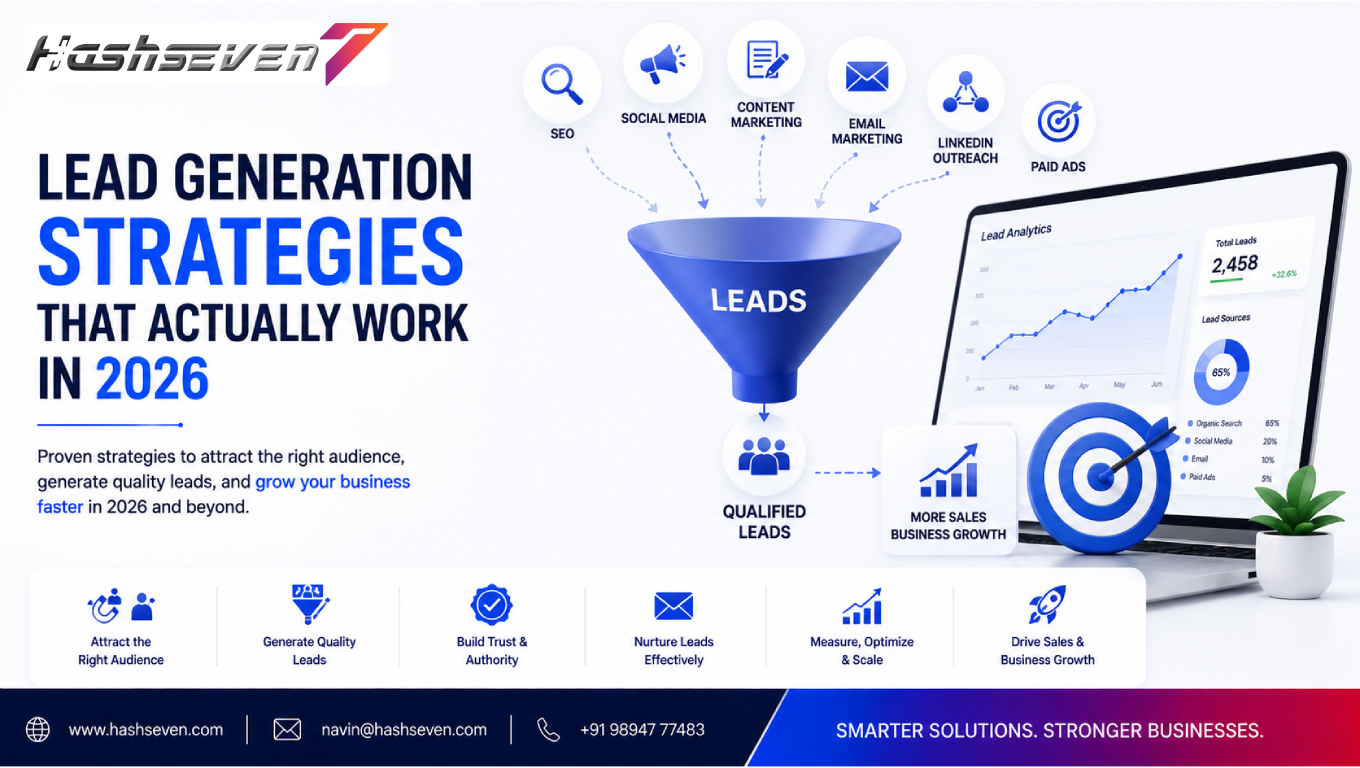
Lead Generation Funnel
A basic lead generation funnel looks like this:
Stage 1: Awareness
Potential customers discover your business through:
- SEO
- Social media
- Advertising
- Content
- Referrals
Stage 2: Interest
They visit your website, read content, watch videos, or explore services.
Stage 3: Consideration
They compare your solution with alternatives.
Stage 4: Conversion
They:
- Submit a form
- Call
- Book a meeting
- Request a quote
- Start a conversation
Stage 5: Nurturing
You follow up and provide relevant information.
Stage 6: Customer
The lead becomes a paying customer.
How to Build a Lead Generation Strategy
Follow these practical steps.
Step 1: Define Your Ideal Customer
Understand:
- Who you want to attract
- What problems they have
- What services they need
- Where they search
- What influences their decisions
Step 2: Set Measurable Goals
Examples:
- Generate 100 qualified leads per month
- Increase website conversion rate
- Reduce cost per lead
- Increase consultation bookings
Step 3: Select the Right Channels
Choose channels based on your customers.
You might use:
- SEO
- Content marketing
- Paid advertising
- Social media
- Local SEO
Step 4: Create Conversion Assets
Build:
- Landing pages
- Forms
- Lead magnets
- CTAs
- Contact pages
- Case studies
Step 5: Connect Your Tools
Connect your website with:
- Analytics
- CRM
- Email marketing
- Advertising platforms
Step 6: Track Results
Measure leads, quality, conversions, and revenue.
Step 7: Improve Continuously
Test:
- Headlines
- CTAs
- Forms
- Landing pages
- Offers
- Ad campaigns
Common Lead Generation Mistakes
1. Focusing Only on Traffic
More visitors don’t automatically mean more customers.
2. Targeting Everyone
A specific audience often produces better-quality opportunities.
3. Using Weak CTAs
Visitors need a clear next step.
4. Ignoring Mobile Users
Your forms and landing pages must work well on smartphones.
5. Not Following Up
A good lead can be lost if nobody responds promptly.
6. Buying Low-Quality Leads
Cheap leads aren’t necessarily valuable leads.
7. Not Tracking Conversions
Without conversion tracking, it becomes difficult to understand ROI.
8. Using Too Many Channels
Focus on channels that produce meaningful results instead of spreading resources too thin.
Frequently Asked Questions
1. What are the most effective lead generation strategies in 2026?
Effective lead generation strategies include SEO, content marketing, landing pages, local SEO, paid search, social media marketing, email marketing, WhatsApp communication, referrals, and marketing automation.
2. How can small businesses generate more leads?
Small businesses can focus on local SEO, useful content, optimized service pages, strong CTAs, Google Business Profile optimization, social media, referrals, and targeted advertising.
3. Is SEO good for lead generation?
Yes. SEO can attract people who are actively searching for products, services, and solutions. Well-optimized content and landing pages can turn search traffic into enquiries and customers.
4. What is the difference between a lead and a qualified lead?
A lead is a potential customer who has shown some interest. A qualified lead generally matches your target customer profile and has a stronger possibility of purchasing.
5. How can businesses improve lead quality?
Improve lead quality by targeting specific audiences, using high-intent keywords, creating relevant landing pages, asking useful qualifying questions, and tracking which sources produce actual customers.
Conclusion
The most effective lead generation strategies in 2026 are focused on attracting the right people and giving them a clear path toward becoming customers.
SEO can capture search demand. Content marketing can build trust. Landing pages can convert visitors. Paid advertising can reach high-intent audiences. Social media can create awareness. Email and WhatsApp can nurture relationships. Automation can make follow-up more consistent.
However, successful lead generation is not about collecting the largest possible number of contacts.
Quality matters more than quantity.
Businesses should identify their ideal customers, create useful content, build conversion-focused experiences, track performance, and continually improve their marketing campaigns.
When these elements work together, lead generation becomes a repeatable system that supports sustainable business growth.
Ready to Build a Professional Website for Your Business?
Turn your business into a powerful online brand with Hashseven.
Since 2017, we’ve helped businesses grow through professional website development, mobile apps, custom software, SEO, digital marketing, CRM, POS solutions, and Meta-approved WhatsApp automation. Let’s create a fast, secure, and conversion-focused website that attracts more customers and drives real business growth.