
WhatsApp marketing for business has become an increasingly useful way for companies to communicate with customers, share updates, generate leads, provide support, and promote relevant offers. At the same time, email marketing remains an important digital marketing channel for newsletters, long-form communication, promotions, and customer retention.
So, which one works better: email marketing or WhatsApp marketing?
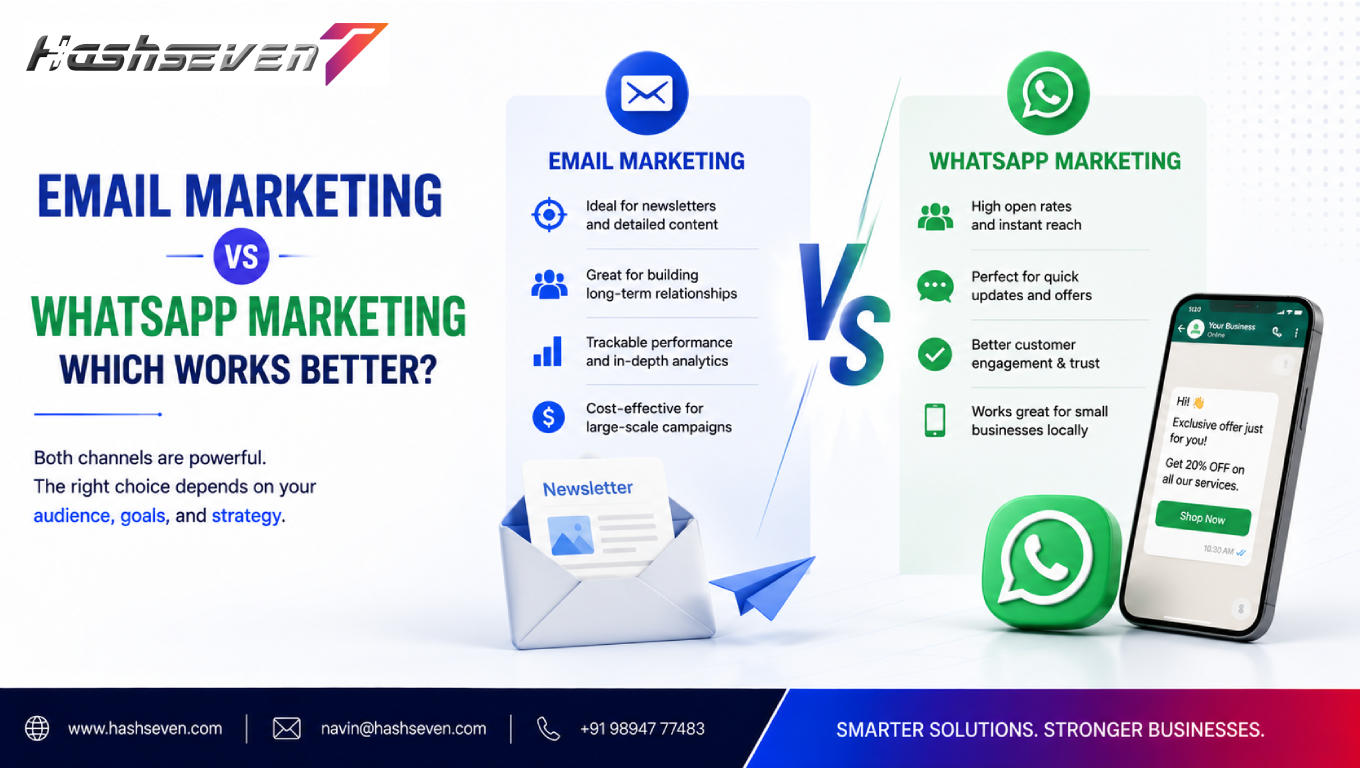
The answer depends on your audience, business goals, message type, customer preferences, and how quickly you need to communicate. WhatsApp can be highly effective for direct, conversational communication, while email can be better suited to detailed information, newsletters, and structured campaigns.
Instead of treating them as competitors, businesses can use both channels as part of a broader customer communication strategy.
In this guide, we’ll compare email marketing and WhatsApp marketing, explain their advantages and limitations, discuss when to use each channel, and show how businesses can create an effective combined strategy.
What Is WhatsApp Marketing for Business?
WhatsApp marketing for business involves using WhatsApp to communicate with customers and prospects for legitimate business purposes.
Depending on the tools and applicable policies, businesses can use WhatsApp to:
- Answer customer questions
- Send updates
- Provide customer support
- Follow up with leads
- Share product information
- Send appointment reminders
- Confirm orders
- Communicate relevant offers
- Provide notifications
- Start customer conversations
For businesses that already communicate with customers through messaging apps, WhatsApp can provide a convenient conversational channel.
However, businesses should always follow applicable WhatsApp policies and obtain appropriate customer consent where required.
WhatsApp Business provides official information about business messaging solutions.
What Is Email Marketing?
Email marketing involves sending messages to subscribers or customers through email.
Businesses commonly use email for:
- Newsletters
- Promotional campaigns
- Product announcements
- Educational content
- Offers
- Customer onboarding
- Follow-up communication
- Event invitations
- Company updates
- Lead nurturing
Email is particularly useful when a business needs more space to explain a topic or provide multiple pieces of information in a structured format.
Build a Website That Grows Your Business
A professionally developed website is the foundation of your online success. If you’re planning to create a responsive, fast, and SEO-friendly business website, explore our Website Development Services to see how Hashseven can help transform your ideas into a powerful digital presence.
WhatsApp Marketing vs Email Marketing
Both channels can support business growth, but they work differently.
| Factor | WhatsApp Marketing | Email Marketing |
|---|---|---|
| Communication style | Conversational | Structured |
| Speed | Very fast | Fast |
| Best for | Direct communication | Detailed communication |
| Customer support | Strong | Moderate |
| Long-form content | Limited | Excellent |
| Newsletters | Less suitable | Excellent |
| Lead follow-up | Excellent | Good |
| Personal conversations | Excellent | Limited |
| Automation | Available | Extensive |
| Segmentation | Useful | Highly developed |
| Promotions | Useful when relevant | Excellent |
| Customer retention | Strong | Strong |
The best choice depends on the customer’s needs and the objective of the campaign.
1. Customer Reach and Accessibility
WhatsApp can be useful when customers prefer messaging over traditional communication channels.
Customers may already use WhatsApp every day to communicate with friends, family, and businesses.
Email, however, remains widely useful for professional and commercial communication.
For example:
WhatsApp:
“Your appointment is confirmed for tomorrow at 10 AM.”
Email:
“Here is your complete appointment confirmation, preparation guide, terms, contact details, and additional information.”
Each channel serves a different communication purpose.
2. Speed of Communication
One of the major advantages of WhatsApp marketing for business is its conversational nature.
Businesses can use WhatsApp for time-sensitive communication such as:
- Appointment reminders
- Order updates
- Customer questions
- Lead follow-ups
- Service notifications
Email can also be delivered quickly, but customers may not check their inbox immediately.
For conversations where timing matters, messaging can be particularly useful.
3. Customer Engagement
WhatsApp encourages direct conversations.
Customers can respond to a message and continue the interaction without switching to another platform.
For example:
Business:
“Would you like to know more about our website development package?”
Customer:
“Yes. Can you share the pricing?”
This conversational format can make WhatsApp valuable for sales and customer support.
Email is generally more suitable for one-to-many communication.
4. Personalization
Both channels can support personalization.
Email campaigns can personalize elements such as:
- Customer name
- Product recommendations
- Location
- Purchase history
- Interests
- Customer segment
WhatsApp can make communication feel more conversational.
For example:
“Hi Arun, your service appointment is confirmed for Friday.”
The more relevant the communication, the more useful it can be to the customer.
5. Lead Generation
Businesses can use both channels to generate and nurture leads.
WhatsApp can be particularly useful for leads who want quick answers.
For example, a website visitor may click a WhatsApp button and ask:
“Can you tell me more about your package?”
The business can then answer questions, understand the customer’s needs, and move the conversation toward an appropriate next step.
Email is useful for longer lead-nurturing sequences that provide:
- Educational content
- Case studies
- Guides
- Product information
- Offers
- Follow-ups
6. Customer Support
WhatsApp can be highly useful for conversational support.
Customers can ask questions and receive responses without making a phone call.
Businesses can use messaging for:
- Product questions
- Booking support
- Order updates
- Service queries
- Basic troubleshooting
- Follow-up conversations
Email can be more appropriate for detailed support requests that require documentation, attachments, or formal communication.
7. Promotional Campaigns
Both channels can be used for promotions.
WhatsApp can work well for short, relevant messages such as:
“Our weekend offer is now available. Reply to learn more.”
Email can provide more detailed promotional information, including:
- Product descriptions
- Multiple offers
- Images
- Terms
- Product comparisons
- Detailed calls to action
The key is relevance. Businesses should avoid sending excessive or unwanted promotional messages.
8. Content and Message Length
Email has a major advantage when businesses need to communicate detailed information.
For example, an email can contain:
- Articles
- Guides
- Product comparisons
- Multiple sections
- Images
- Links
- Downloadable resources
WhatsApp is generally better for concise, direct communication.
Use WhatsApp when the customer needs a quick answer.
Use email when the customer needs more information to read and review.
9. Automation
Both channels can support automation.
Email automation can be used for:
- Welcome sequences
- Lead nurturing
- Abandoned-cart communication
- Follow-ups
- Customer onboarding
- Birthday campaigns
- Re-engagement campaigns
WhatsApp automation can support workflows such as:
- FAQs
- Lead qualification
- Appointment reminders
- Order updates
- Customer notifications
- Automated responses
Businesses should design automation around customer needs rather than simply sending more messages.
10. Customer Retention
Existing customers are valuable for long-term business growth.
Email can help businesses stay connected through:
- Newsletters
- Product updates
- Educational content
- Loyalty campaigns
- Special offers
WhatsApp can support ongoing conversations and timely customer updates.
Using both channels can create a stronger customer communication system.
11. Cost Considerations
Marketing costs vary considerably depending on:
- Platform
- Software
- Message volume
- Audience size
- Automation requirements
- Advertising
- Service provider
- Region
- Campaign type
Businesses should evaluate the total cost of a campaign against the business result it produces.
Instead of asking only:
“Which channel is cheaper?”
ask:
“Which channel generates better results for this particular customer and business objective?”
12. Trust and Customer Preferences
Customers have different communication preferences.
Some people prefer email because it is organized and easy to search.
Others prefer WhatsApp because it is convenient and conversational.
Businesses should respect:
- Customer consent
- Communication preferences
- Opt-out requests
- Platform policies
- Data privacy requirements
Trust should always come before aggressive marketing.
When Should Businesses Use WhatsApp Marketing?
WhatsApp marketing for business can be a strong option when your objective involves direct communication.
Consider WhatsApp for:
- Lead follow-ups
- Customer support
- Appointment reminders
- Order notifications
- Service updates
- Quick questions
- Conversational sales
- Customer engagement
For example, a salon can send appointment reminders, while a service company can use WhatsApp to answer customer questions.
When Should Businesses Use Email Marketing?
Email marketing is especially useful when you need to communicate more information.
Use email for:
- Newsletters
- Educational content
- Long-form updates
- Product announcements
- Lead nurturing
- Customer onboarding
- Detailed promotions
- Industry reports
- Case studies
Email is also valuable when customers need to save or revisit information later.
Can Businesses Use WhatsApp and Email Together?
Yes.
In many cases, combining both channels can produce a more complete communication strategy.
For example:
Step 1: Email
Send a detailed product guide.
Step 2: WhatsApp
Follow up with an appropriate message asking whether the customer has questions.
Step 3: Sales Conversation
If the customer responds positively, continue the conversation.
Step 4: Email
Send the requested proposal, pricing, or detailed documentation.
Step 5: WhatsApp
Send an appropriate follow-up reminder when permitted.
This approach allows each channel to perform the task it handles best.
How to Create a WhatsApp Marketing Strategy
Step 1: Define Your Objective
Decide whether you want to:
- Generate leads
- Support customers
- Promote products
- Send updates
- Increase bookings
- Improve retention
Step 2: Understand Your Audience
Identify:
- Customer needs
- Preferred communication style
- Buying journey
- Common questions
- Communication preferences
Step 3: Build Permission-Based Communication
Use appropriate consent and follow applicable platform requirements before sending marketing communications.
Step 4: Create Useful Messages
Keep messages:
- Clear
- Relevant
- Concise
- Helpful
- Action-oriented
Step 5: Automate Repetitive Tasks
Automate appropriate workflows such as FAQs, notifications, and reminders.
Step 6: Measure Results
Track relevant metrics such as:
- Conversations
- Leads
- Response rates
- Conversions
- Customer satisfaction
How to Create an Email Marketing Strategy
Step 1: Build a Quality Email List
Use legitimate, permission-based methods to grow your subscriber base.
Step 2: Segment Your Audience
Create groups based on:
- Interests
- Customer type
- Purchase history
- Location
- Engagement
Step 3: Create Valuable Content
Give subscribers a reason to open your emails.
Step 4: Write Strong Subject Lines
Keep subject lines clear and relevant.
Step 5: Optimize for Mobile
Ensure emails are readable on smartphones.
Step 6: Track Campaign Performance
Monitor:
- Open rates
- Click rates
- Conversions
- Unsubscribes
- Revenue
Common Marketing Mistakes to Avoid
1. Sending Too Many Messages
High-frequency communication can annoy customers.
2. Ignoring Consent
Only communicate with customers in ways permitted by applicable laws, regulations, and platform policies.
3. Using Generic Messages
Personalize communication where appropriate.
4. Focusing Only on Promotions
Provide useful information instead of making every message a sales pitch.
5. Not Providing an Opt-Out
Respect customers who no longer want marketing communications.
6. Ignoring Analytics
Without measurement, you won’t know which campaigns are effective.
7. Using the Same Message Everywhere
WhatsApp and email have different strengths. Adapt the content to the channel.
WhatsApp Marketing Best Practices
Follow these practices when implementing WhatsApp marketing for business:
- Get appropriate customer permission.
- Send relevant information.
- Keep messages concise.
- Personalize when useful.
- Provide clear calls to action.
- Respect customer preferences.
- Avoid excessive messaging.
- Use automation responsibly.
- Monitor customer responses.
- Follow WhatsApp’s business and messaging policies.
Email Marketing Best Practices
For email campaigns:
- Use permission-based lists.
- Write clear subject lines.
- Segment audiences.
- Personalize where appropriate.
- Make emails mobile-friendly.
- Include clear CTAs.
- Provide an easy unsubscribe option.
- Test different campaign formats.
- Monitor performance.
- Keep content useful.
Email Marketing vs WhatsApp Marketing: Which Is Better?
There is no universal winner.
WhatsApp may be better for:
- Direct conversations
- Quick responses
- Customer support
- Lead follow-ups
- Appointment reminders
- Order updates
- Short messages
Email may be better for:
- Newsletters
- Detailed information
- Long-form content
- Lead nurturing
- Product announcements
- Educational resources
- Structured promotions
The best approach?
Use both strategically.
WhatsApp can handle conversational communication while email can support detailed information and long-term nurturing.
How Hashseven Inc Can Help
Hashseven Inc provides digital solutions that can help businesses build stronger customer communication and marketing systems.
Our solutions can support:
- WhatsApp automation
- Business messaging
- Digital marketing
- Website development
- CRM integration
- Lead generation
- Marketing automation
- Customer communication workflows
A well-planned digital strategy can connect marketing, sales, customer service, and automation into one streamlined customer journey.
Frequently Asked Questions
1. Is WhatsApp marketing better than email marketing?
Neither channel is universally better. WhatsApp marketing for business can be more effective for direct conversations and quick communication, while email is often better for newsletters, detailed information, and long-term lead nurturing.
2. Is WhatsApp good for business marketing?
Yes. WhatsApp can help businesses communicate with customers, answer questions, follow up with leads, provide updates, and support appropriate promotional communication when conducted according to applicable policies and customer permissions.
3. Can WhatsApp and email marketing work together?
Yes. Businesses can use WhatsApp for conversational communication and email for detailed information, newsletters, lead nurturing, and customer retention.
4. Which is better for lead generation: WhatsApp or email?
WhatsApp can be useful for leads who want immediate conversations, while email can be effective for nurturing prospects over time. The better option depends on the customer journey and business model.
5. How can businesses start WhatsApp marketing?
Start by defining your goal, understanding your audience, obtaining appropriate customer permission, creating relevant messages, selecting suitable business tools, and tracking results.
Conclusion
Email marketing and WhatsApp marketing are both valuable digital communication channels, but they serve different purposes.
WhatsApp marketing for business is particularly useful for conversational communication, quick customer support, lead follow-ups, reminders, and timely updates. Email remains powerful for newsletters, detailed information, educational content, lead nurturing, and structured campaigns.
Instead of choosing one channel for every situation, businesses should understand the strengths of each.
A combined strategy can often deliver a better customer experience: use WhatsApp when customers need a quick conversation and email when they need detailed information they can read, save, and revisit.
The most important factor isn’t simply choosing the channel with the highest engagement. It’s delivering the right message, to the right customer, through the right channel, at the right time.
Ready to Build a Professional Website for Your Business?
Turn your business into a powerful online brand with Hashseven.
Since 2017, we’ve helped businesses grow through professional website development, mobile apps, custom software, SEO, digital marketing, CRM, POS solutions, and Meta-approved WhatsApp automation. Let’s create a fast, secure, and conversion-focused website that attracts more customers and drives real business growth.