
Growing a local business requires more than simply having a good product or service. Customers need to discover your business, trust your brand, understand what you offer, and have an easy way to contact or buy from you.
This is where local business marketing becomes important.
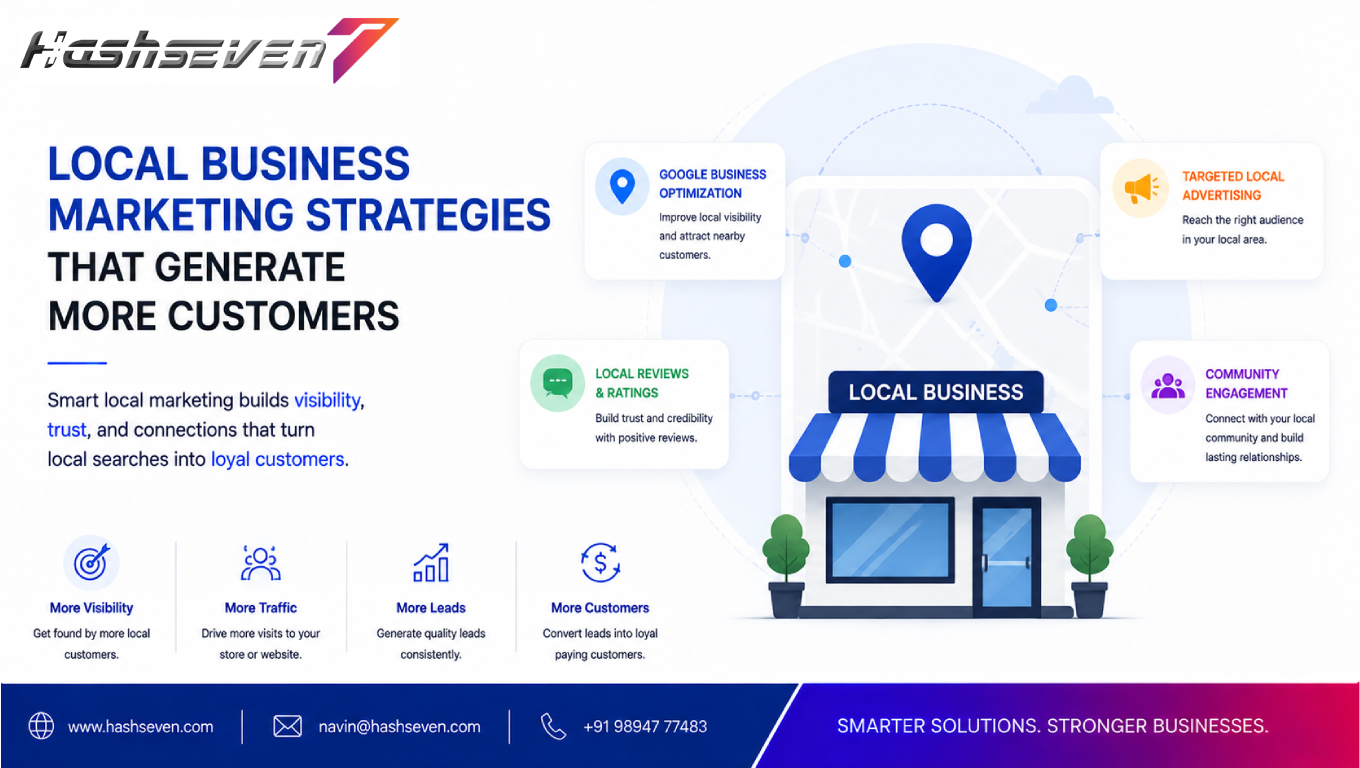
Local business marketing focuses on reaching customers in a specific geographic area through channels such as search engines, Google Business Profile, social media, online reviews, local content, email, advertising, and a professional website.
In 2026, local customers have more ways than ever to discover businesses. They may search Google, check reviews, compare websites, view social media profiles, ask AI tools for recommendations, or use maps to find nearby services.
A strong local marketing strategy connects these touchpoints and makes it easy for potential customers to choose your business.
This guide explains practical local business marketing strategies that can help businesses improve visibility, attract qualified customers, generate leads, and build long-term local growth.
What Is Local Business Marketing?
Local business marketing is the process of promoting a business to customers within a specific geographic area.
It can include:
- Local SEO
- Google Business Profile optimization
- Local content marketing
- Online reviews
- Social media marketing
- Local advertising
- Email marketing
- Website optimization
- Community marketing
- Referral marketing
- Location-based campaigns
The objective is simple:
Get your business in front of the right local customers at the right time.
For example, a person searching for “plumber near me” already has a specific need. A plumber with strong local visibility has an opportunity to appear in front of that potential customer.
Build a Website That Grows Your Business
A professionally developed website is the foundation of your online success. If you’re planning to create a responsive, fast, and SEO-friendly business website, explore our Website Development Services to see how Hashseven can help transform your ideas into a powerful digital presence.
Why Local Business Marketing Matters
Local customers often search online before contacting a business.
They may look for:
- Nearby restaurants
- Home service providers
- Healthcare services
- Retail stores
- Salons
- Repair services
- Professional services
- Local agencies
This makes online visibility extremely important for businesses that depend on customers from a particular area.
A strong local marketing strategy can help businesses:
- Increase local visibility
- Generate qualified leads
- Increase calls and inquiries
- Drive website traffic
- Attract store visits
- Build customer trust
- Increase repeat business
- Compete with larger companies
1. Optimize Your Google Business Profile
One of the most important foundations of local business marketing is a well-maintained Google Business Profile.
Your profile can help customers discover important information such as:
- Business name
- Address
- Phone number
- Website
- Business hours
- Services
- Photos
- Reviews
- Directions
Businesses should keep this information accurate and up to date.
Best practices include:
- Select the most relevant primary category.
- Add appropriate secondary categories.
- Keep business hours accurate.
- Add high-quality photos.
- List relevant services.
- Keep contact information consistent.
- Respond to customer reviews.
- Publish appropriate updates when useful.
A complete and accurate profile makes it easier for customers to understand your business.
2. Invest in Local SEO
Local SEO helps businesses improve their visibility when people search for products and services in a specific location.
For example:
“digital marketing agency near me”
or
“best bakery in [city]”
Local SEO can involve:
- Google Business Profile optimization
- Local keyword research
- Location pages
- Local citations
- Online reviews
- Local backlinks
- Website optimization
- Structured data
Google provides guidance on how businesses can improve their presence in search.
Google Search Central – SEO Starter Guide
3. Build a Professional Local Business Website
Your website is often one of the first places potential customers visit after discovering your business.
A strong local business website should clearly communicate:
- What you offer
- Where you operate
- Why customers should choose you
- How customers can contact you
Important website elements include:
- Clear homepage
- Service pages
- Location information
- Contact details
- Testimonials
- Reviews
- FAQs
- Call-to-action buttons
- Mobile-friendly design
Your website should make it easy for a customer to take the next step.
4. Use Location-Based Keywords
Keyword research helps identify what local customers search for.
Instead of targeting only broad keywords, businesses can target phrases that include local intent.
Examples:
- digital marketing agency in Chennai
- web development company in Coimbatore
- accounting services near me
- best restaurant in [city]
- home cleaning services in [area]
However, businesses should avoid inserting location keywords unnaturally.
Use location terms where they genuinely help customers understand your service area.
5. Create Dedicated Location Pages
Businesses serving multiple locations can create useful location-specific pages.
For example:
- Services in Chennai
- Services in Coimbatore
- Services in Madurai
Each page should provide genuinely useful information about the location.
Avoid creating dozens of nearly identical pages simply by replacing the city name.
A strong location page can include:
- Services available
- Areas served
- Local customer needs
- Relevant testimonials
- Contact information
- Useful local information
6. Encourage Genuine Customer Reviews
Reviews are extremely important in local business marketing.
Customers often compare businesses based on:
- Number of reviews
- Review quality
- Recent feedback
- Business responses
- Overall reputation
After providing a good experience, businesses can politely encourage customers to leave honest reviews.
Do not:
- Buy fake reviews
- Create fake customer accounts
- Incentivize misleading reviews
- Ask only for positive reviews
Authentic customer feedback creates stronger long-term trust.
7. Respond to Customer Reviews
Getting reviews is only part of reputation management.
Businesses should also respond appropriately.
For positive reviews:
Thank the customer and acknowledge their feedback.
For negative reviews:
Respond professionally, recognize the concern, and provide an appropriate way to resolve the issue.
A thoughtful response demonstrates that the business pays attention to customers.
8. Create Local Content
Content marketing can support local visibility when the content addresses real customer needs.
Businesses can create:
- Local guides
- How-to articles
- Service guides
- Frequently asked questions
- Neighborhood-specific resources
- Industry insights
- Customer stories
For example, a home service company could publish:
“How to Prepare Your Home for the Monsoon Season”
This can provide useful information while naturally connecting the topic to the company’s services.
9. Use Local Content to Build Authority
Local content should not simply repeat keywords.
Instead, it should demonstrate knowledge about:
- Customer problems
- Local conditions
- Industry challenges
- Service requirements
- Community needs
Useful local content can help establish your business as a knowledgeable resource.
10. Optimize for Mobile Users
Many local searches happen on mobile devices.
Customers may search for a business while:
- Traveling
- Shopping
- Comparing services
- Looking for directions
- Searching for emergency services
Your website should work properly on smartphones.
Important mobile elements include:
- Responsive design
- Fast loading
- Readable text
- Easy navigation
- Click-to-call buttons
- Simple contact forms
A poor mobile experience can cause potential customers to leave before contacting your business.
11. Improve Website Speed
Website speed affects user experience.
A local customer looking for a service may quickly move to another business if a website takes too long to load.
Businesses can improve performance by:
- Compressing images
- Using caching
- Reducing unnecessary scripts
- Optimizing CSS and JavaScript
- Using suitable hosting
- Implementing a CDN where appropriate
Google provides PageSpeed Insights for testing website performance.
12. Use Strong Calls to Action
A visitor may be interested in your service but still not know what to do next.
Use clear calls to action such as:
- Call Now
- Request a Quote
- Book an Appointment
- Get Directions
- Contact Us
- Schedule a Consultation
- Send a WhatsApp Message
Place CTAs where customers naturally need them.
13. Make Contact Information Easy to Find
Local businesses should make their contact details highly visible.
Include:
- Phone number
- Address
- Business hours
- Contact form
- Map or directions where appropriate
The phone number should be clickable on mobile devices.
Do not force visitors to search through multiple pages to find basic contact information.
14. Use Social Media Marketing
Social media can help local businesses stay visible and connected with customers.
Businesses can share:
- Products
- Services
- Customer stories
- Behind-the-scenes content
- Offers
- Events
- Educational tips
- Short videos
The goal should be consistent and useful communication rather than posting simply for the sake of activity.
15. Focus on Short-Form Video
Short videos can help local businesses capture attention quickly.
Examples include:
- Product demonstrations
- Before-and-after projects
- Customer testimonials
- Quick tips
- Staff introductions
- Behind-the-scenes videos
- Frequently asked questions
Local businesses can also show their location and team to make the brand feel more authentic.
16. Use WhatsApp for Customer Communication
Messaging can be particularly useful for local businesses.
WhatsApp can support:
- Customer inquiries
- Appointment requests
- Quote discussions
- Order updates
- Customer support
- Follow-ups
A WhatsApp button on your website can make contacting your business easier.
However, businesses should communicate responsibly and avoid unwanted promotional messages.
17. Run Local Online Advertising
Paid advertising can help businesses reach local audiences quickly.
Potential advertising platforms include:
- Google Ads
- Meta Ads
- YouTube Ads
- Local display campaigns
Businesses can target campaigns based on:
- Geographic area
- Search intent
- Audience characteristics
- Interests
- Customer behavior
Paid advertising can complement organic local SEO rather than replacing it.
18. Use Google Ads for High-Intent Searches
Google Ads can help businesses appear when customers actively search for relevant services.
For example:
“emergency electrician near me”
can indicate strong buying intent.
Businesses should create highly relevant landing pages for their advertisements.
A campaign should connect:
Search → Advertisement → Landing Page → Contact → Conversion
If the landing page does not match the customer’s search intent, advertising costs can increase without producing good results.
19. Build Local Backlinks
Backlinks from relevant websites can support a business’s online authority.
Local backlink opportunities may include:
- Local business directories
- Community organizations
- Industry associations
- Local publications
- Event websites
- Business partnerships
Focus on relevance and quality rather than collecting large numbers of low-quality links.
20. Maintain Consistent Business Information
Your business name, address, and phone number should be consistent across important online platforms.
This information is commonly referred to as NAP:
Name + Address + Phone Number
Check your:
- Website
- Google Business Profile
- Business directories
- Social profiles
- Local listings
Inconsistent information can create confusion for customers and make online business information less reliable.
21. Use Local Business Schema
Structured data can help search engines understand information about your business.
Depending on the business, relevant structured data may include:
- LocalBusiness
- Organization
- Product
- Service
- FAQ
Structured data should accurately represent visible information on the website.
Do not add misleading or inaccurate structured data simply to try to influence search results.
22. Participate in the Local Community
Offline activities can also support local marketing.
Businesses can participate in:
- Community events
- Local sponsorships
- Workshops
- Charity activities
- Business networking
- Industry events
These activities can increase brand awareness and create opportunities for legitimate local mentions and relationships.
23. Build a Referral Marketing Strategy
Satisfied customers can become one of the strongest sources of new business.
A referral strategy can encourage existing customers to recommend your business to people they know.
Businesses can build referrals through:
- Excellent service
- Follow-up communication
- Referral programs
- Customer appreciation
- Easy sharing options
The foundation of referral marketing is a customer experience worth recommending.
24. Use Email Marketing for Customer Retention
Local business marketing should not focus only on acquiring new customers.
Email can help businesses maintain relationships with existing customers.
Businesses can send:
- Newsletters
- Service reminders
- New product announcements
- Helpful tips
- Event invitations
- Customer offers
Always use appropriate consent and provide a clear way for recipients to manage marketing communications.
25. Create Seasonal Marketing Campaigns
Local customer demand may change throughout the year.
Businesses can create campaigns around:
- Holidays
- Seasonal services
- Local events
- Weather-related needs
- School seasons
- Festivals
- Business anniversaries
Seasonal campaigns can make marketing more relevant to current customer needs.
26. Use Customer Testimonials
Testimonials provide social proof.
A good testimonial can explain:
- What problem the customer had
- What service they used
- How the business helped
- What result they experienced
Whenever possible, display authentic testimonials with appropriate customer permission.
27. Create Service-Specific Landing Pages
If your business offers multiple services, create dedicated pages.
For example:
Digital Marketing
SEO Services
Web Development
Social Media Marketing
Each page should explain:
- What the service is
- Who it is for
- Benefits
- Process
- FAQs
- Relevant proof
- Call to action
This can improve both user experience and search relevance.
28. Use Local Landing Pages for Advertising
Paid campaigns should direct customers to pages relevant to their search.
For example:
Ad: “SEO Services in Chennai”
Landing Page: “SEO Services for Businesses in Chennai”
The landing page should provide useful information rather than simply repeating the keyword.
29. Monitor Local Search Performance
Businesses should regularly measure their marketing performance.
Important metrics include:
- Website visitors
- Phone calls
- Form submissions
- Direction requests
- Search visibility
- Leads
- Conversion rate
- Review growth
- Customer acquisition cost
Use analytics and search tools to identify which channels are generating meaningful results.
30. Use Conversion Rate Optimization
Getting local traffic is not enough.
Businesses must also convert visitors into customers.
Test:
- Headlines
- CTAs
- Contact forms
- Phone buttons
- Landing pages
- Testimonials
- Pricing presentation
For example, if a website receives many visitors but very few inquiries, improving the contact experience may produce better results than simply increasing traffic.
31. Build Trust With Professional Branding
Customers want to feel confident before contacting a business.
Trust signals can include:
- Professional website
- Real business information
- Customer reviews
- Testimonials
- Certifications
- Awards
- Portfolio
- Team information
- Secure website
Consistent branding across your website and social profiles can also improve recognition.
32. Optimize for “Near Me” Searches Naturally
Search engines can understand local intent without businesses repeating “near me” throughout their websites.
Instead, businesses should clearly communicate:
- Where they operate
- What services they provide
- Their physical location when applicable
- Areas they serve
Use natural language rather than keyword stuffing.
33. Use AI to Support Local Marketing
AI tools can help businesses with:
- Content ideas
- Customer segmentation
- Marketing analysis
- Chatbots
- Email personalization
- Campaign reporting
However, businesses should review AI-generated content before publishing it.
Local content should contain accurate, useful, and genuinely relevant information.
34. Track Customer Acquisition Sources
Businesses should understand where customers come from.
Possible sources include:
- Google Search
- Google Business Profile
- Social media
- Referrals
- Paid advertisements
- Direct traffic
Knowing which channels generate actual customers helps businesses allocate their marketing budget more effectively.
35. Create an Omnichannel Local Marketing Strategy
Customers may discover a business through one channel and convert through another.
For example:
Google Search → Website → Instagram → WhatsApp → Purchase
A strong local strategy should create a consistent experience across these touchpoints.
Keep your:
- Brand message
- Contact information
- Offers
- Visual identity
- Service information
consistent across important channels.
Local Business Marketing Strategy for 2026
A practical strategy can be organized into five stages.
Stage 1: Get Found
Focus on:
- Google Business Profile
- Local SEO
- Search visibility
- Local directories
Stage 2: Build Trust
Focus on:
- Reviews
- Testimonials
- Professional website
- Social proof
Stage 3: Generate Leads
Focus on:
- CTAs
- Landing pages
- Forms
- Phone calls
Stage 4: Convert Customers
Focus on:
- Follow-ups
- Personalization
- Sales processes
- Customer experience
Stage 5: Retain Customers
Focus on:
- Email marketing
- Customer support
- Loyalty
- Referral marketing
This creates a complete customer journey instead of focusing only on visibility.
Local Business Marketing Checklist
Use this checklist to evaluate your current strategy:
- Google Business Profile is claimed and optimized
- Business information is accurate
- Website is mobile-friendly
- Website loads quickly
- Local keywords are used naturally
- Service pages are optimized
- Location pages are useful
- Customer reviews are encouraged
- Reviews receive professional responses
- Social media profiles are active
- Short-form videos are being tested
- Website has clear CTAs
- Phone number is easy to find
- WhatsApp communication is available where appropriate
- Local backlinks are being developed
- Business information is consistent
- Email marketing is used appropriately
- Customer referrals are encouraged
- Analytics are configured
- Marketing conversions are tracked
Common Local Business Marketing Mistakes
Relying Only on Social Media
Social media is useful, but businesses should also maintain an owned website and search presence.
Ignoring Google Business Profile
A neglected profile can make it harder for customers to find accurate information.
Buying Fake Reviews
Fake reviews can damage credibility and violate platform policies.
Keyword Stuffing
Repeating city names and keywords excessively creates poor content.
Having a Slow Website
Customers may leave before contacting you.
Ignoring Mobile Users
Many local searches happen on smartphones.
Not Tracking Leads
Without measurement, businesses cannot determine which marketing activities are generating customers.
Focusing Only on New Customers
Existing customers can generate repeat purchases and referrals.
Frequently Asked Questions
1. What is local business marketing?
Local business marketing is the process of promoting a business to customers within a specific geographic area using channels such as local SEO, Google Business Profile, social media, websites, reviews, advertising, email, and referrals.
2. What is the most effective local business marketing strategy?
There is no single strategy that works for every business. A strong combination of Google Business Profile optimization, local SEO, reviews, a professional website, useful content, and clear conversion opportunities provides a strong foundation.
3. How can a small business attract more local customers?
Small businesses can improve local visibility through Google Business Profile optimization, local SEO, customer reviews, social media, local content, referrals, targeted advertising, and a mobile-friendly website.
4. How long does local business marketing take to work?
The timeframe varies depending on the industry, competition, website authority, marketing channels, and consistency. Paid advertising can generate visibility quickly, while SEO and reputation-building generally require sustained effort.
5. Is Google Business Profile important for local businesses?
Yes. A well-maintained Google Business Profile can make it easier for customers to discover important business information, view reviews, find directions, visit the website, and contact the business.
Conclusion
Local business marketing is about making your business easy to discover, trust, contact, and choose.
A successful local strategy goes beyond simply ranking for local keywords. Businesses need to create a complete customer journey that connects search visibility, Google Business Profile, website experience, reviews, social media, content, advertising, customer communication, and retention.
The most important steps are to build a strong online foundation, maintain accurate business information, create useful local content, earn genuine reviews, optimize for mobile users, and track the actions that actually generate customers.
Businesses should also avoid trying to use every marketing channel at once. Start with the channels most relevant to your customers, measure the results, and gradually expand.
With consistent execution and a customer-focused approach, local business marketing can become a powerful source of qualified leads, repeat customers, referrals, and sustainable business growth.
Ready to Build a Professional Website for Your Business?
Turn your business into a powerful online brand with Hashseven.
Since 2017, we’ve helped businesses grow through professional website development, mobile apps, custom software, SEO, digital marketing, CRM, POS solutions, and Meta-approved WhatsApp automation. Let’s create a fast, secure, and conversion-focused website that attracts more customers and drives real business growth.