
As businesses continue to embrace digital transformation, choosing the right Enterprise Resource Planning (ERP) system has become one of the most important technology decisions. Whether you’re a startup, a growing company, or an established enterprise, selecting the right cloud ERP software can significantly improve operational efficiency, reduce costs, and support long-term business growth.
Traditionally, businesses relied on on-premise ERP systems that required expensive hardware, dedicated IT teams, and ongoing maintenance. Today, cloud technology has transformed how organizations manage their operations. Modern cloud ERP software offers greater flexibility, remote accessibility, automatic updates, and lower infrastructure costs, making it the preferred choice for many businesses.
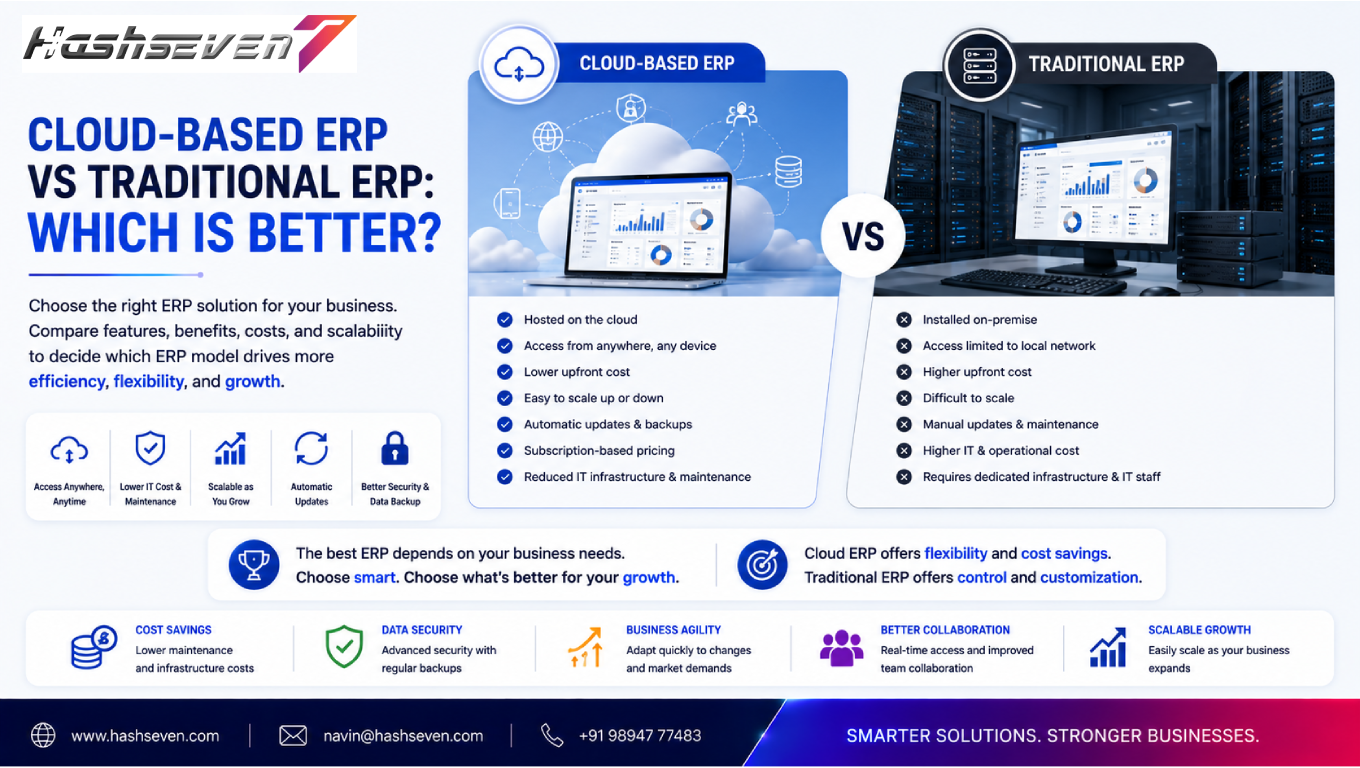
However, traditional ERP systems still provide advantages for organizations with strict security requirements, complex customizations, or industry-specific compliance needs. Understanding the differences between cloud-based ERP and traditional ERP helps businesses choose the solution that best aligns with their goals and operational requirements.
In this guide, we’ll compare cloud ERP software and traditional ERP systems, explore their benefits and limitations, and help you determine which option is best for your business in 2026.
What Is Cloud ERP Software?
Cloud ERP software is an Enterprise Resource Planning system hosted on remote servers and accessed through the internet. Instead of installing software on local computers or company-owned servers, businesses use a secure cloud platform managed by the ERP provider.
Modern cloud ERP software integrates multiple business functions into a centralized platform, including:
- Finance and accounting
- Inventory management
- Sales management
- Customer Relationship Management (CRM)
- Human resources
- Payroll
- Procurement
- Supply chain management
- Manufacturing
- Business analytics
Since the software is cloud-hosted, employees can securely access business data from anywhere using a desktop, laptop, tablet, or smartphone.
What Is Traditional ERP?
Traditional ERP, also known as on-premise ERP, is installed and managed on a company’s own servers and IT infrastructure. The organization is responsible for software installation, maintenance, security updates, backups, and hardware management.
Traditional ERP systems are commonly used by organizations that require:
- Complete infrastructure control
- Extensive customization
- Industry-specific compliance
- Internal data hosting
- Dedicated IT management
Although traditional ERP provides greater control, it generally requires higher upfront investment and ongoing maintenance costs.
Build a Website That Grows Your Business
A professionally developed website is the foundation of your online success. If you’re planning to create a responsive, fast, and SEO-friendly business website, explore our Website Development Services to see how Hashseven can help transform your ideas into a powerful digital presence.
Cloud ERP vs Traditional ERP: Key Differences
1. Deployment
Cloud ERP Software
- Hosted by the service provider
- Accessible through the internet
- No local server installation
- Automatic deployment
Traditional ERP
- Installed on company servers
- Managed internally
- Requires hardware infrastructure
- Manual installation
Cloud deployment simplifies implementation and reduces IT complexity.
2. Initial Cost
One of the biggest differences is cost.
Cloud ERP Software
- Lower upfront investment
- Subscription-based pricing
- No expensive hardware
- Lower maintenance costs
Traditional ERP
- Higher initial investment
- Server infrastructure costs
- Software licensing
- IT staffing expenses
Cloud ERP is often more affordable for startups and small to medium-sized businesses.
3. Scalability
Business growth requires flexible software.
Modern cloud ERP software allows businesses to:
- Add users instantly
- Expand storage
- Integrate new modules
- Support multiple business locations
Traditional ERP scaling often requires additional servers, licenses, and infrastructure upgrades.
4. Accessibility
Remote work has become a standard business practice.
Cloud ERP Software enables employees to:
- Work from anywhere
- Access data securely
- Collaborate in real time
- Use mobile applications
Traditional ERP usually requires VPN access or local network connections.
5. Maintenance
Maintenance responsibilities differ significantly.
Cloud ERP Software
The provider manages:
- Security updates
- System maintenance
- Software upgrades
- Backups
- Performance optimization
Traditional ERP
The business manages:
- Software updates
- Hardware maintenance
- Database management
- Security patches
- Disaster recovery
Cloud ERP significantly reduces IT workload.
6. Security
Security is a major concern for every organization.
Modern cloud ERP software providers invest heavily in:
- Data encryption
- Multi-factor authentication (MFA)
- Regular security updates
- Continuous monitoring
- Disaster recovery
Traditional ERP provides complete infrastructure control but requires dedicated internal security management.
7. Implementation Time
Deployment speed affects business productivity.
Cloud ERP Software
Typical implementation:
- Faster deployment
- Minimal hardware setup
- Easy onboarding
- Rapid configuration
Traditional ERP
Implementation often requires:
- Server installation
- Hardware procurement
- Network configuration
- Extensive testing
Cloud ERP implementations are generally completed much faster.
Benefits of Cloud ERP Software
Businesses increasingly choose cloud ERP software because of its flexibility and operational advantages.
Lower Operational Costs
Cloud ERP eliminates the need for expensive server infrastructure, reducing both capital investment and ongoing maintenance expenses.
Automatic Software Updates
Businesses always have access to the latest features without manually upgrading the system.
Better Collaboration
Teams across different departments and locations can access the same real-time information, improving communication and decision-making.
Improved Business Continuity
Cloud providers offer reliable backup systems and disaster recovery solutions that help protect business data.
Easy Integration
Modern cloud ERP software integrates with:
- CRM software
- Accounting platforms
- HR management systems
- Payment gateways
- Business intelligence tools
- eCommerce platforms
Integration improves workflow automation and operational efficiency.
Enhanced Business Analytics
Cloud ERP provides real-time dashboards that help monitor:
- Sales
- Inventory
- Revenue
- Customer orders
- Financial performance
- Employee productivity
Data-driven insights help businesses make smarter strategic decisions.
Benefits of Traditional ERP
Although cloud ERP continues to grow, traditional ERP still offers important advantages for certain organizations.
Complete Infrastructure Control
Businesses have full control over servers, databases, and software configurations.
Extensive Customization
Traditional ERP systems can often be customized extensively to meet highly specialized business processes.
Internal Data Hosting
Organizations with strict compliance or regulatory requirements may prefer storing sensitive data within their own infrastructure.
Industry-Specific Compliance
Some industries, such as government, defense, or highly regulated sectors, require on-premise systems to meet security and compliance standards.
Which Businesses Should Choose Cloud ERP?
Cloud ERP software is an excellent choice for:
- Startups
- Small businesses
- Medium-sized businesses
- Multi-location companies
- Remote and hybrid teams
- Fast-growing organizations
- Businesses seeking lower IT costs
- Companies undergoing digital transformation
Cloud ERP offers flexibility, scalability, and ease of management, making it suitable for most modern businesses.
Which Businesses Should Choose Traditional ERP?
Traditional ERP may be the better option for:
- Large enterprises with existing infrastructure
- Organizations requiring extensive customization
- Businesses with strict regulatory requirements
- Companies that need complete control over their IT environment
- Industries with highly specialized operational processes
Choosing the right ERP solution depends on your business goals, budget, compliance needs, and long-term growth strategy.
Common ERP Implementation Challenges
Regardless of the deployment model, businesses should avoid these common ERP implementation mistakes:
- Poor project planning
- Selecting the wrong ERP platform
- Insufficient employee training
- Poor data migration
- Lack of executive support
- Unrealistic implementation timelines
- Inadequate testing
- Ignoring user feedback
- Weak change management
- Insufficient post-launch support
Working with an experienced ERP implementation partner helps ensure a smoother deployment and higher return on investment.
Future Trends in Cloud ERP Software
As digital transformation accelerates, cloud ERP software continues to evolve with advanced technologies that help businesses become more agile, efficient, and data-driven. Organizations adopting modern ERP solutions gain a competitive advantage through automation, real-time insights, and scalable infrastructure.
AI-Powered ERP Systems
Artificial Intelligence (AI) is transforming ERP systems by automating repetitive tasks and providing predictive analytics.
Benefits include:
- Smart workflow automation
- Predictive inventory management
- Intelligent financial forecasting
- AI-powered customer insights
- Automated reporting
Modern cloud ERP software enables businesses to make faster and more informed decisions.
Cloud-Native ERP Platforms
Cloud-native ERP solutions are designed specifically for cloud environments, offering improved flexibility and performance.
Advantages include:
- Faster deployment
- Automatic software updates
- High availability
- Lower maintenance costs
- Better scalability
Cloud-native architecture ensures businesses always have access to the latest features without complex upgrades.
Real-Time Business Intelligence
Modern ERP platforms provide live dashboards that display important business metrics.
Organizations can monitor:
- Revenue
- Sales performance
- Inventory levels
- Cash flow
- Customer orders
- Employee productivity
Real-time reporting helps management respond quickly to business challenges and opportunities.
Mobile ERP Access
With hybrid and remote work becoming the norm, mobile accessibility is essential.
Modern cloud ERP software supports:
- Mobile approvals
- Inventory tracking
- Sales management
- Expense reporting
- Customer management
Employees can securely access business information from anywhere.
Enhanced Cybersecurity
Cloud ERP providers invest heavily in protecting business data through:
- Multi-factor authentication (MFA)
- End-to-end encryption
- Automated backups
- Continuous monitoring
- Disaster recovery solutions
These security features help businesses protect sensitive information while meeting compliance requirements.
Why Choose Hashseven Inc for Cloud ERP Software?
Hashseven Inc develops customized cloud ERP software solutions that help businesses automate operations, improve collaboration, and achieve sustainable growth.
Our Cloud ERP Services Include
- Custom Cloud ERP Development
- Finance & Accounting Modules
- Inventory Management
- CRM Integration
- Human Resource Management
- Payroll Management
- Procurement Management
- Sales & Purchase Management
- Manufacturing Management
- Business Intelligence Dashboards
- Cloud Migration Services
- ERP Maintenance & Technical Support
Our experienced development team creates scalable, secure, and user-friendly ERP solutions tailored to your business requirements.
Frequently Asked Questions
1. What is cloud ERP software?
Cloud ERP software is an Enterprise Resource Planning system hosted on cloud servers that enables businesses to manage finance, inventory, HR, sales, CRM, and other operations through an internet-based platform.
2. Is cloud ERP software better than traditional ERP?
For many businesses, cloud ERP software offers greater flexibility, lower infrastructure costs, automatic updates, remote accessibility, and easier scalability. However, traditional ERP may be suitable for organizations requiring extensive customization or strict regulatory compliance.
3. Is cloud ERP software secure?
Yes. Most cloud ERP providers implement enterprise-grade security features such as encryption, multi-factor authentication, automatic backups, and continuous monitoring to protect business data.
4. Which businesses benefit most from cloud ERP software?
Startups, small businesses, growing enterprises, retailers, manufacturers, healthcare organizations, logistics companies, and service providers can all benefit from implementing cloud ERP software.
5. Why choose Hashseven Inc for cloud ERP software development?
Hashseven Inc delivers customized cloud ERP software solutions with industry-specific features, secure architecture, seamless integration, and ongoing technical support to help businesses improve efficiency and scale confidently.
Conclusion
Selecting the right ERP solution is a critical decision that directly impacts operational efficiency, productivity, and long-term business success. While traditional ERP systems continue to serve organizations with specialized infrastructure and compliance requirements, cloud ERP software has become the preferred choice for most modern businesses due to its flexibility, scalability, cost-effectiveness, and ease of maintenance.
By adopting cloud ERP software, businesses can automate workflows, centralize data, improve collaboration, and gain real-time insights that support faster and smarter decision-making. Whether you’re a startup looking for an affordable solution or an established company planning digital transformation, cloud ERP provides the tools needed to stay competitive in 2026 and beyond.
At Hashseven Inc, we specialize in designing and developing secure, scalable, and customized cloud ERP software solutions that streamline business operations and drive measurable growth. Our team works closely with clients to deliver ERP systems that align with their goals and future expansion plans.
Ready to Build a Professional Website for Your Business?
Turn your business into a powerful online brand with Hashseven.
Since 2017, we’ve helped businesses grow through professional website development, mobile apps, custom software, SEO, digital marketing, CRM, POS solutions, and Meta-approved WhatsApp automation. Let’s create a fast, secure, and conversion-focused website that attracts more customers and drives real business growth.