
As businesses grow, managing customer relationships and internal operations becomes increasingly complex. Organizations often invest in business management software to improve efficiency, streamline workflows, and support long-term growth. Two of the most popular solutions are Customer Relationship Management (CRM) software and Enterprise Resource Planning (ERP) software. Understanding CRM vs ERP is essential for choosing the right solution for your business.
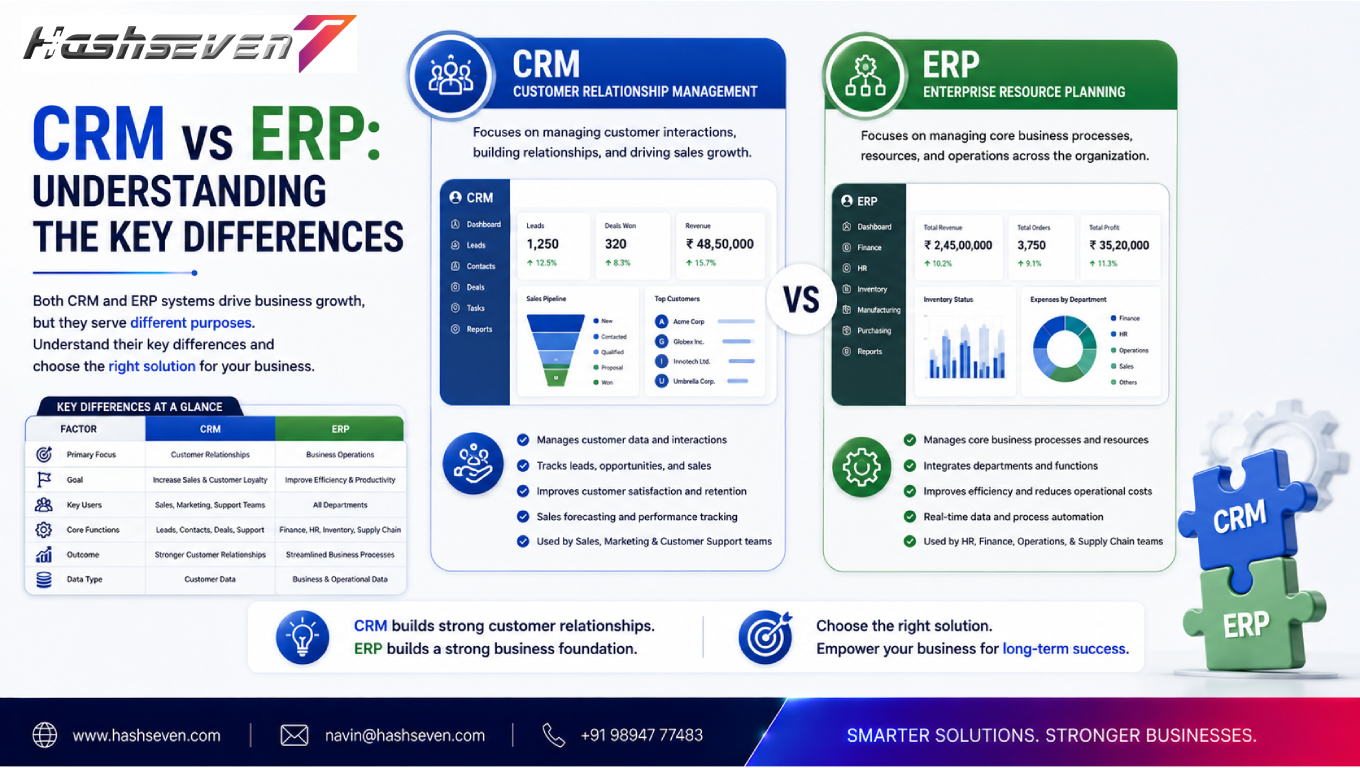
Although CRM and ERP systems both help improve productivity, they serve different purposes. CRM focuses on managing customer interactions, sales, and marketing activities, while ERP integrates core business processes such as finance, inventory, human resources, procurement, and operations into a centralized platform.
Many businesses assume they must choose one over the other. However, modern organizations often use both systems together to create a unified business ecosystem that improves customer satisfaction and operational efficiency.
In this comprehensive guide, we’ll explain the differences between CRM vs ERP, compare their features, benefits, and use cases, and help you determine which solution is best suited for your business in 2026.
What Is CRM?
Customer Relationship Management (CRM) software is designed to help businesses manage customer interactions, sales activities, marketing campaigns, and customer support from a centralized platform.
CRM software focuses on building stronger customer relationships by organizing customer information and improving communication throughout the sales journey.
A modern CRM system typically includes:
- Lead management
- Contact management
- Sales pipeline tracking
- Customer support
- Marketing automation
- Email integration
- Task management
- Customer communication history
- Sales reporting
- Business analytics
CRM software helps businesses improve customer satisfaction while increasing sales productivity.
What Is ERP?
Enterprise Resource Planning (ERP) software is a business management solution that integrates multiple departments into one centralized system.
Unlike CRM, ERP focuses on internal business operations.
A modern ERP system typically manages:
- Finance and accounting
- Inventory management
- Human resources
- Payroll
- Procurement
- Manufacturing
- Supply chain management
- Project management
- Business reporting
- Asset management
ERP systems improve operational efficiency by connecting departments and eliminating data silos.
CRM vs ERP: Key Differences
Although both systems improve business performance, the difference between CRM vs ERP lies in their primary objectives.
| CRM | ERP |
|---|---|
| Focuses on customers | Focuses on business operations |
| Improves sales and marketing | Improves internal processes |
| Manages customer interactions | Manages organizational resources |
| Tracks leads and opportunities | Tracks inventory, finance, and operations |
| Used by sales and marketing teams | Used by finance, HR, operations, and management |
| Increases customer satisfaction | Increases operational efficiency |
Understanding CRM vs ERP helps businesses choose software that aligns with their immediate needs and future growth plans.
Benefits of CRM Software
CRM software provides several advantages for businesses focused on customer engagement and revenue growth.
Better Customer Relationship Management
CRM centralizes customer information, making it easier for teams to deliver personalized experiences and improve communication.
Improved Sales Performance
Sales representatives can:
- Track leads
- Manage opportunities
- Monitor sales pipelines
- Schedule follow-ups
- Close deals faster
Enhanced Marketing Campaigns
CRM software helps businesses:
- Segment audiences
- Automate email campaigns
- Track marketing performance
- Generate qualified leads
Better Customer Support
Customer service teams gain quick access to customer history, enabling faster issue resolution and improved customer satisfaction.
Real-Time Reporting
CRM dashboards provide valuable insights into:
- Sales performance
- Lead conversion
- Customer engagement
- Marketing ROI
Benefits of ERP Software
ERP software streamlines internal operations across the organization.
Centralized Business Data
ERP stores all operational data in one platform, improving collaboration between departments.
Financial Management
Finance teams benefit from:
- Budget tracking
- Expense management
- Financial reporting
- Tax management
- Cash flow analysis
Inventory Control
ERP systems help businesses:
- Monitor stock levels
- Track inventory
- Reduce shortages
- Automate purchasing
Human Resource Management
HR departments can manage:
- Employee records
- Payroll
- Attendance
- Leave management
- Recruitment
Business Process Automation
ERP automates repetitive business tasks, reducing manual work and improving operational efficiency.
CRM vs ERP Feature Comparison
Customer Management
CRM excels at managing customer relationships, while ERP stores customer information mainly for operational purposes.
Sales Management
CRM provides advanced sales pipeline tracking, lead nurturing, and opportunity management.
ERP focuses on order processing and financial transactions after the sale.
Inventory Management
Inventory management is one of ERP’s strongest features.
CRM systems generally provide limited inventory functionality.
Financial Management
ERP includes advanced accounting and financial reporting features.
CRM systems usually require integration with accounting software.
Reporting & Analytics
Both CRM and ERP offer reporting capabilities.
CRM reports focus on:
- Sales
- Marketing
- Customers
ERP reports focus on:
- Finance
- Operations
- Inventory
- Productivity
When Should You Choose CRM?
CRM software is ideal if your business wants to:
- Increase sales
- Improve customer relationships
- Automate marketing
- Improve customer support
- Track leads efficiently
- Build customer loyalty
Small businesses, sales teams, and service providers often benefit from CRM-first implementation.
When Should You Choose ERP?
ERP software is the better choice when businesses need to:
- Manage multiple departments
- Improve operational efficiency
- Automate workflows
- Control inventory
- Manage finances
- Support business growth
Manufacturing companies, retailers, logistics firms, and large organizations often prioritize ERP implementation.
Build a Website That Grows Your Business
A professionally developed website is the foundation of your online success. If you’re planning to create a responsive, fast, and SEO-friendly business website, explore our Website Development Services to see how Hashseven can help transform your ideas into a powerful digital presence.
Can CRM and ERP Work Together?
Absolutely.
Modern businesses increasingly integrate CRM and ERP systems to create a connected business environment.
Benefits of integration include:
- Improved customer experience
- Shared business data
- Better collaboration
- Faster order processing
- Accurate reporting
- Increased productivity
- Better forecasting
- Enhanced decision-making
Using CRM and ERP together allows businesses to combine customer-focused strategies with efficient operational management.
Common Mistakes When Choosing CRM or ERP
Businesses should avoid these common mistakes:
- Choosing software without defining business goals
- Ignoring future scalability
- Selecting features they don’t need
- Failing to train employees
- Overlooking integration capabilities
- Ignoring mobile accessibility
- Not evaluating implementation costs
- Choosing software based only on price
- Poor data migration planning
- Lack of executive support
Careful planning ensures a successful CRM or ERP implementation that delivers long-term value.
Future Trends in CRM and ERP
As businesses continue to adopt digital technologies, both CRM and ERP systems are becoming more intelligent, connected, and automated. Modern organizations are increasingly investing in integrated platforms that improve customer experiences while optimizing internal operations.
AI-Powered CRM and ERP
Artificial Intelligence (AI) is transforming both CRM and ERP systems by automating repetitive tasks and providing predictive insights.
Benefits include:
- Sales forecasting
- Customer behavior analysis
- Automated workflows
- Smart inventory forecasting
- Predictive maintenance
- Intelligent reporting
AI-powered solutions help businesses make faster and more informed decisions.
Cloud-Based Business Management
Cloud deployment is becoming the preferred choice for businesses because it offers flexibility, scalability, and lower infrastructure costs.
Modern cloud solutions provide:
- Remote accessibility
- Automatic software updates
- Improved collaboration
- Better security
- Lower maintenance costs
Cloud-based CRM and ERP systems enable employees to work efficiently from anywhere.
Business Intelligence and Analytics
Modern CRM and ERP platforms include advanced analytics dashboards that provide real-time insights into business performance.
Organizations can monitor:
- Sales performance
- Revenue growth
- Customer engagement
- Inventory levels
- Employee productivity
- Financial performance
These insights support data-driven decision-making and long-term business planning.
Mobile Accessibility
Mobile applications allow employees to access CRM and ERP systems anytime, anywhere.
Benefits include:
- Real-time approvals
- Customer information access
- Inventory tracking
- Sales monitoring
- Expense management
Mobile accessibility improves responsiveness and operational efficiency.
Enhanced Security
Modern CRM and ERP solutions include enterprise-grade security features such as:
- Multi-factor authentication (MFA)
- Data encryption
- Role-based access control
- Automated backups
- Continuous monitoring
These security measures protect sensitive business and customer information while supporting regulatory compliance.
Why Choose Hashseven Inc for CRM and ERP Solutions?
Hashseven Inc develops customized CRM and ERP solutions that help businesses streamline operations, improve customer relationships, and accelerate digital transformation.
Our Services Include
- Custom CRM Development
- Custom ERP Development
- CRM & ERP Integration
- Cloud-Based Business Solutions
- Sales Automation
- Inventory Management Systems
- HR & Payroll Solutions
- Finance & Accounting Modules
- Business Intelligence Dashboards
- API Integration
- Cloud Migration
- Ongoing Support & Maintenance
Our experienced team designs scalable, secure, and user-friendly business management solutions tailored to your organization’s needs.
Add Your Heading Text Here
1. What is the difference between CRM vs ERP?
CRM vs ERP differs in purpose. CRM focuses on managing customer relationships, sales, marketing, and support, while ERP manages internal business operations such as finance, inventory, HR, procurement, and production.
2. Can CRM and ERP work together?
Yes. Integrating CRM and ERP allows businesses to share customer, sales, inventory, and financial data across departments, improving collaboration and decision-making.
3. Which is better, CRM or ERP?
Neither is universally better. CRM is ideal for improving customer relationships and sales, while ERP is best for streamlining internal operations. Many growing businesses benefit from using both together.
4. Which businesses should implement CRM and ERP?
Businesses of all sizes—including retail, manufacturing, healthcare, logistics, education, and service providers—can benefit from CRM and ERP systems based on their operational needs.
5. Why choose Hashseven Inc for CRM and ERP development?
Hashseven Inc delivers customized CRM and ERP solutions that improve efficiency, automate workflows, integrate departments, and support long-term business growth.
Conclusion
Understanding CRM vs ERP is essential for selecting the right business management solution. While CRM helps businesses build stronger customer relationships, manage sales pipelines, and improve customer service, ERP streamlines internal operations by integrating finance, inventory, human resources, procurement, and other core business processes.
Rather than choosing one over the other, many organizations achieve the best results by integrating CRM and ERP into a unified system. This combination improves collaboration, eliminates data silos, enhances decision-making, and supports sustainable business growth.
At Hashseven Inc, we specialize in developing customized CRM and ERP solutions that align with your business goals. Whether you need a standalone CRM, a comprehensive ERP system, or an integrated platform, our experienced team can help you build a scalable solution that drives efficiency and long-term success.
Ready to Build a Professional Website for Your Business?
Turn your business into a powerful online brand with Hashseven.
Since 2017, we’ve helped businesses grow through professional website development, mobile apps, custom software, SEO, digital marketing, CRM, POS solutions, and Meta-approved WhatsApp automation. Let’s create a fast, secure, and conversion-focused website that attracts more customers and drives real business growth.