
Businesses increasingly need more than a website that simply publishes content. Customers now interact with brands through websites, mobile applications, email, social platforms, customer portals, search engines, and other digital channels.
This shift has created growing interest in digital experience platform technology.
At the same time, content management systems (CMS) remain one of the most popular ways to build and manage business websites. This creates an important question: Should your business choose a traditional CMS or invest in a digital experience platform?
The answer depends on your business goals, digital maturity, content requirements, customer journeys, budget, integrations, and future growth plans.
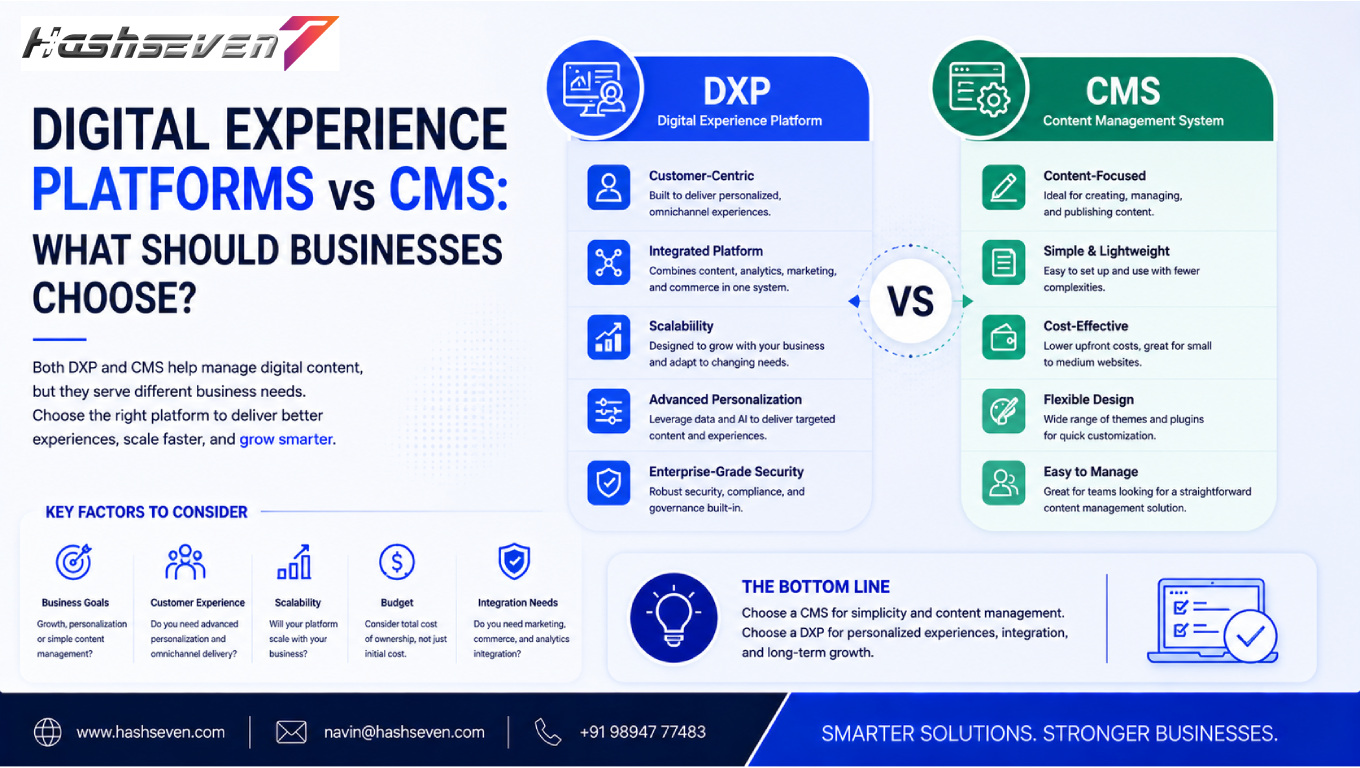
A CMS primarily focuses on creating, organizing, managing, and publishing digital content. A DXP goes beyond content management by bringing together capabilities for creating, managing, delivering, personalizing, and optimizing digital experiences across multiple channels. IBM describes a DXP as an integrated suite designed to manage and optimize digital experiences across multichannel customer journeys.
In this guide, we will compare CMS and DXP platforms, explain their differences, benefits, limitations, costs, use cases, and help you determine which solution is right for your business.
What Is a CMS?
CMS stands for Content Management System.
A CMS allows businesses to create, manage, organize, edit, and publish website content without requiring developers to manually code every page.
A typical CMS can help manage:
- Website pages
- Blog posts
- Images
- Videos
- Documents
- Navigation
- Categories
- Users
- SEO information
- Forms
- Website settings
For many small and medium-sized businesses, a CMS provides everything necessary to operate a professional website.
A CMS is particularly useful when the main requirement is managing website content efficiently.
What Is a Digital Experience Platform?
A digital experience platform is a broader technology solution designed to manage and improve digital interactions across multiple customer touchpoints.
Instead of focusing primarily on content, a DXP can bring together capabilities such as:
- Content management
- Personalization
- Customer data
- Analytics
- Marketing automation
- Search
- Commerce
- Customer journeys
- Omnichannel delivery
- Digital asset management
- Experience optimization
The exact capabilities vary significantly between DXP products.
The main difference is therefore not simply “CMS versus better CMS.” A DXP generally addresses a wider digital-experience ecosystem, while a CMS is primarily centered around content management.
CMS vs Digital Experience Platform
The simplest way to understand the difference is:
CMS = Manage and publish content
DXP = Manage, deliver, personalize, measure, and optimize digital experiences
A CMS can be sufficient when a business mainly needs a website and content publishing system.
A DXP becomes more valuable when a business needs connected digital experiences across multiple channels and systems.
Build a Website That Grows Your Business
A professionally developed website is the foundation of your online success. If you’re planning to create a responsive, fast, and SEO-friendly business website, explore our Website Development Services to see how Hashseven can help transform your ideas into a powerful digital presence.
Key Differences Between CMS and DXP
| Feature | CMS | Digital Experience Platform |
|---|---|---|
| Content management | Excellent | Excellent |
| Website publishing | Yes | Yes |
| Content workflows | Yes | Advanced |
| Personalization | Limited to advanced | Strong |
| Analytics | Basic to advanced | Advanced |
| Customer data | Limited | Stronger |
| Marketing automation | Often through integrations | Often integrated |
| Omnichannel delivery | Varies | Core capability |
| Digital asset management | Varies | Often available |
| Commerce | Plugins/integrations | Often integrated |
| Customer journey management | Limited | Advanced |
| Enterprise integrations | Available | Strong focus |
| Complexity | Lower | Higher |
| Initial investment | Usually lower | Usually higher |
| Scalability | Good | Excellent for complex ecosystems |
| Best suited for | Websites and content | Complex digital experiences |
How a CMS Helps Businesses
A CMS remains an excellent choice for many organizations.
Easy Content Management
Marketing teams can create and update content without depending on developers for every change.
This can speed up:
- Blog publishing
- Landing page creation
- Product updates
- Service page changes
- Image replacement
- Promotional campaigns
Lower Initial Cost
Many CMS solutions are available with relatively affordable hosting, themes, plugins, and development options.
This makes CMS platforms attractive to:
- Startups
- Small businesses
- Local businesses
- Professional service companies
- Bloggers
- Growing companies
Faster Website Development
A CMS can significantly reduce development time because many common website capabilities already exist.
Businesses can start with:
- Templates
- Plugins
- Themes
- Extensions
- Pre-built integrations
SEO Management
Modern CMS platforms can support SEO features such as:
- Page titles
- Meta descriptions
- URL management
- Image optimization
- XML sitemaps
- Structured data
- Redirects
- Blogging
The exact SEO capabilities depend on the CMS and its extensions.
Flexible Content Publishing
Businesses can create different types of content without rebuilding the entire website.
This makes CMS platforms useful for content-driven websites.
Limitations of a Traditional CMS
Although a CMS is powerful, it may not be ideal for every organization.
Common limitations can include:
- Limited personalization
- Separate analytics tools
- Multiple third-party integrations
- Fragmented customer data
- Plugin dependency
- Limited omnichannel functionality
- More manual marketing processes
As digital operations become more complex, businesses may need additional platforms around their CMS.
This can create a technology ecosystem that becomes difficult to manage.
How a Digital Experience Platform Helps Businesses
A digital experience platform can help organizations bring multiple digital capabilities together.
Centralized Digital Experiences
A DXP can provide a more connected environment for managing customer interactions.
Instead of treating the website, customer data, analytics, personalization, and marketing as completely separate systems, businesses can connect these capabilities within a broader digital experience architecture.
Personalization
Personalization is one of the major reasons businesses consider DXP technology.
A DXP can help businesses deliver different experiences based on information such as:
- Customer behavior
- Previous interactions
- Location
- Customer segment
- Interests
- Purchase history
- Account information
For example, an e-commerce business may display different product recommendations based on customer activity.
Omnichannel Experiences
Customers may interact with a company through multiple channels.
These can include:
- Website
- Mobile application
- Customer portal
- Social media
- Digital signage
- Chatbots
- E-commerce platforms
A DXP can help businesses deliver more consistent experiences across these touchpoints.
Customer Journey Management
A DXP can support more sophisticated customer journeys.
For example:
Website Visit → Product Interest → Personalized Content → Email → Purchase → Customer Portal → Retention Campaign
A traditional CMS may manage the website portion of this journey, while a DXP can help connect more of the experience.
Advanced Analytics
A DXP can integrate analytics and customer behavior data to help organizations understand how users interact with digital experiences.
Businesses can analyze:
- Customer journeys
- Conversion behavior
- Content engagement
- Campaign performance
- User segments
- Channel performance
These insights can support more informed marketing decisions.
Digital Experience Platform and CMS: Are They Competitors?
Not necessarily.
A CMS can actually be part of a broader DXP architecture.
In many modern digital ecosystems, content management remains an important component of the overall experience platform.
The distinction is better understood as scope.
A CMS focuses primarily on content.
A DXP focuses on the broader digital experience.
Contentful describes the evolution from traditional CMS solutions toward headless and composable approaches and broader DXP capabilities as digital experiences have expanded across channels.
Traditional CMS vs Headless CMS
Businesses should also understand the difference between traditional and headless CMS platforms before choosing a DXP.
Traditional CMS
A traditional CMS usually manages both:
- Content
- Presentation
The CMS controls how content is displayed on the website.
Headless CMS
A headless CMS separates the content management layer from the presentation layer.
Content can be delivered through APIs to:
- Websites
- Mobile apps
- Digital displays
- Customer portals
- Other digital interfaces
This provides greater flexibility for businesses with multiple digital channels.
Composable Architecture
Composable approaches allow businesses to combine specialized technologies instead of relying on one large system for everything.
This can provide flexibility but may also increase integration and management complexity.
When Should a Business Choose a CMS?
A CMS is usually the better option when your business primarily needs a professional website.
Consider a CMS if you need:
- Company website
- Service pages
- Blog
- Landing pages
- Basic forms
- SEO functionality
- Product pages
- Simple e-commerce
- Content publishing
A CMS can provide excellent value without introducing unnecessary complexity.
When Should a Business Choose a Digital Experience Platform?
A DXP may be more appropriate when your organization has complex digital requirements.
Consider a DXP if you need:
- Multiple digital channels
- Advanced personalization
- Omnichannel experiences
- Complex customer journeys
- Large content operations
- Advanced analytics
- Marketing automation
- Customer data integration
- Enterprise commerce
- Multiple regional websites
- Large-scale digital transformation
The more complex your customer experience becomes, the more valuable a broader experience platform can become.
Digital Experience Platform for Enterprise Businesses
Large organizations often manage multiple:
- Brands
- Products
- Regions
- Languages
- Websites
- Customer segments
- Marketing campaigns
Managing these independently can create inconsistency.
A DXP can help centralize digital experience management while still allowing teams to operate across different markets and channels.
This can be particularly valuable for enterprise organizations with complex customer journeys.
Digital Experience Platform for Small Businesses
Small businesses generally do not need a full enterprise DXP.
For many small businesses, a well-configured CMS is more practical.
A CMS can provide the essential functionality required to:
- Build a website
- Publish content
- Generate leads
- Improve SEO
- Promote services
- Communicate with customers
Choosing a DXP simply because it has more features can create unnecessary expenses and technical complexity.
The right platform should solve actual business problems rather than provide features that will never be used.
Cost Comparison
Cost is one of the most important considerations.
CMS Costs
A CMS may involve:
- Hosting
- Domain
- Theme or design
- Development
- Plugins
- Maintenance
- Security
- Premium extensions
The total cost depends on the website’s complexity.
DXP Costs
A DXP can involve:
- Platform licensing
- Implementation
- Custom development
- Integrations
- Data migration
- Personalization
- Analytics
- Training
- Infrastructure
- Maintenance
- Consulting
DXP implementations can therefore require significantly more investment.
However, businesses should evaluate cost against the complexity of the digital experience they need to deliver.
Scalability Comparison
Both CMS and DXP platforms can scale, but they address different types of growth.
A CMS can scale effectively when the main growth involves:
- More website traffic
- More pages
- More blog content
- More products
- More users
A DXP becomes more valuable when growth involves:
- More channels
- More customer segments
- More personalization
- More integrations
- More markets
- More complex customer journeys
Therefore, scalability should be evaluated according to the type of growth your business expects.
Integration Capabilities
Modern businesses rarely operate using one software system.
They may use:
- CRM
- ERP
- Marketing automation
- E-commerce
- Payment gateways
- Customer support
- Analytics
- Email marketing
- Inventory management
A CMS can integrate with these systems through plugins and APIs.
A DXP is generally designed with broader integration and orchestration requirements in mind.
Security Considerations
Security is important regardless of platform choice.
Businesses should consider:
- Secure authentication
- User permissions
- Software updates
- Data protection
- Secure APIs
- Encryption
- Monitoring
- Backup systems
- Vulnerability management
A more advanced platform does not automatically mean a perfectly secure website.
Security depends on implementation, configuration, maintenance, integrations, infrastructure, and operational processes.
SEO Considerations
Both CMS and DXP platforms can support SEO.
Important SEO capabilities include:
- Clean URLs
- Metadata
- Structured content
- Canonical URLs
- XML sitemaps
- Redirect management
- Page performance
- Mobile optimization
- Structured data
- Internal linking
The platform itself is only one part of SEO.
Technical implementation, content quality, search intent, site architecture, performance, and ongoing optimization remain important.
Accessibility Considerations
Accessibility should be considered regardless of whether a business chooses a CMS or DXP.
A platform should support the creation of accessible:
- Navigation
- Forms
- Content
- Buttons
- Images
- Multimedia
- Interactive components
W3C’s WCAG 2.2 provides international accessibility guidance covering web content across devices, including mobile.
Businesses should also test the final implementation rather than assuming the platform automatically makes every page accessible.
Digital Experience Platform and AI
AI is becoming increasingly important in digital experiences.
Modern platforms may incorporate AI for:
- Content recommendations
- Search
- Personalization
- Customer support
- Content generation
- Customer segmentation
- Predictive analytics
- Marketing automation
However, businesses should evaluate AI capabilities based on practical use cases rather than choosing a platform simply because it includes AI features.
Common Mistakes When Choosing a Platform
Choosing Based Only on Popularity
A popular CMS may not be the right solution for every business.
Choosing Too Many Features
More features do not necessarily mean better results.
Ignoring Integration Requirements
Businesses should identify existing software before selecting a platform.
Underestimating Implementation Costs
Platform licensing may be only one part of the total cost.
Ignoring Future Growth
The platform should support realistic future requirements.
Focusing Only on Technology
Business goals and customer needs should drive technology decisions.
Neglecting Training
Employees need appropriate training to use complex platforms effectively.
Ignoring Maintenance
Every digital platform requires ongoing maintenance and optimization.
How to Choose Between a CMS and DXP
Follow these steps before making a decision.
Step 1: Define Your Business Goals
Ask:
- What are we trying to achieve?
- What customer problems are we solving?
- How important is digital experience to our business?
Step 2: Identify Your Channels
List all current and planned digital channels.
Step 3: Evaluate Content Requirements
Determine how much content you create, manage, translate, personalize, and distribute.
Step 4: Review Your Integrations
Identify systems that need to communicate with the platform.
Step 5: Evaluate Personalization Needs
Determine whether customers require significantly different experiences based on their behavior or profiles.
Step 6: Calculate Total Cost of Ownership
Consider:
- Development
- Licensing
- Hosting
- Integrations
- Training
- Maintenance
- Security
- Upgrades
Step 7: Consider Scalability
Choose a platform that matches your expected growth.
Step 8: Test the User Experience
Evaluate both the customer experience and the experience of internal content teams.
Decision Framework
Use this simple framework:
| Business Requirement | Recommended Option |
|---|---|
| Basic business website | CMS |
| Blog-focused website | CMS |
| Small company website | CMS |
| Simple lead-generation website | CMS |
| Basic e-commerce | CMS or commerce platform |
| Multiple websites | CMS or DXP |
| Advanced personalization | DXP |
| Omnichannel experience | DXP |
| Complex customer journeys | DXP |
| Enterprise digital ecosystem | DXP |
| Multiple markets and languages | DXP or advanced CMS |
| Advanced customer data integration | DXP |
| Highly connected digital operations | DXP |
Can Businesses Move From CMS to DXP Later?
Yes.
Businesses do not always need to start with a DXP.
A company can begin with a CMS and gradually add:
- CRM
- Analytics
- Marketing automation
- Personalization
- E-commerce
- Customer portals
- APIs
As digital requirements become more sophisticated, the business can evaluate whether moving toward a DXP or composable architecture makes sense.
This approach can reduce unnecessary investment during the early stages of growth.
Future of Digital Experience Platforms
Digital experiences are becoming increasingly connected.
Businesses are moving toward:
- AI-powered personalization
- Composable architectures
- Headless content
- Omnichannel delivery
- Real-time analytics
- Automated customer journeys
- Intelligent search
- Customer data platforms
- Connected commerce
This means the distinction between content management and digital experience management will continue to evolve.
W3C is also developing WCAG 3, although it remains an incomplete working draft rather than the current replacement for WCAG 2.2.
Businesses should therefore select platforms that can adapt rather than relying solely on today’s requirements.
Frequently Asked Questions
1. What is the difference between a CMS and a digital experience platform?
A CMS primarily focuses on creating, managing, and publishing content. A digital experience platform provides broader capabilities for managing, delivering, personalizing, analyzing, and optimizing digital experiences across multiple channels.
2. Is a digital experience platform better than a CMS?
Not necessarily. A CMS can be better for businesses that mainly need a website and content management. A DXP is generally more suitable for organizations with complex personalization, omnichannel, analytics, integration, and customer journey requirements.
3. Should a small business invest in a digital experience platform?
Most small businesses can begin with a capable CMS. A DXP may be unnecessary unless the business has complex digital channels, advanced personalization, large-scale content operations, or enterprise-level integration requirements.
4. Can a CMS integrate with CRM and other business software?
Yes. Many CMS platforms can integrate with CRM, ERP, analytics, payment, marketing, and other systems through plugins, APIs, or custom development.
5. Can a business move from a CMS to a DXP later?
Yes. Businesses can start with a CMS and transition toward a broader digital experience architecture as their digital requirements and customer journeys become more complex.
Conclusion
Choosing between a CMS and a digital experience platform should not be based simply on which technology has more features.
A CMS is an excellent solution for businesses that primarily need efficient content management, website publishing, SEO functionality, and a manageable digital presence.
A DXP becomes more valuable when businesses need sophisticated personalization, omnichannel delivery, advanced analytics, connected customer journeys, marketing automation, and complex integrations.
The best choice depends on your business size, digital maturity, customer expectations, technical requirements, budget, and future growth strategy.
For many businesses, starting with a powerful CMS and expanding the technology ecosystem over time can be the most practical approach. For organizations already managing complex digital experiences across multiple channels, investing in a DXP may provide the centralized capabilities needed for long-term growth.
The goal is not to choose the most advanced platform. The goal is to choose the platform that best supports your customers and business objectives.
Ready to Build a Professional Website for Your Business?
Turn your business into a powerful online brand with Hashseven.
Since 2017, we’ve helped businesses grow through professional website development, mobile apps, custom software, SEO, digital marketing, CRM, POS solutions, and Meta-approved WhatsApp automation. Let’s create a fast, secure, and conversion-focused website that attracts more customers and drives real business growth.