
Customer expectations are changing rapidly. Visitors no longer want to browse generic websites that show the same content to everyone. They expect businesses to understand their interests, provide relevant information, and make their online experience convenient.
This is where a website personalization strategy can make a significant difference.
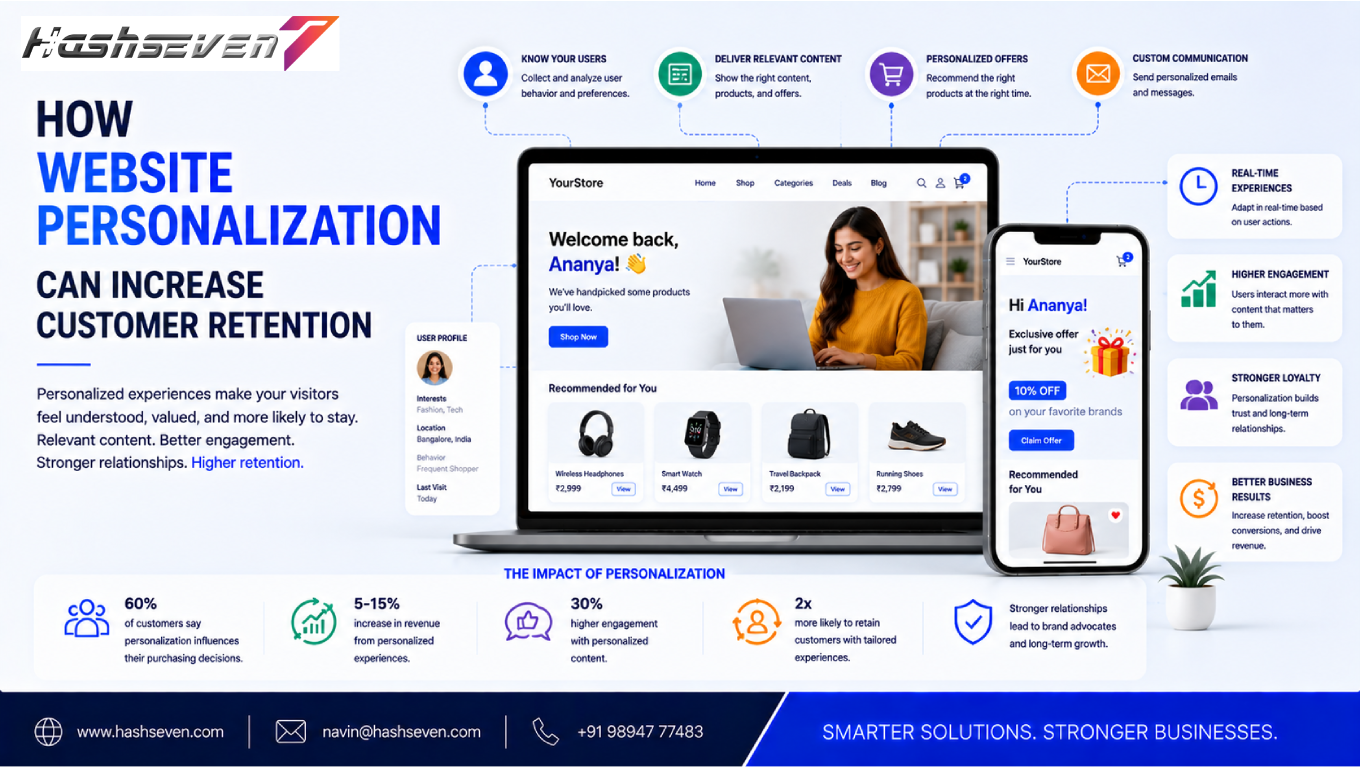
Website personalization allows businesses to customize website content, recommendations, offers, messages, and experiences based on customer behavior, preferences, location, previous interactions, and other relevant signals.
Instead of presenting exactly the same experience to every visitor, personalization helps businesses deliver more relevant experiences to different customer segments.
This can improve engagement, make customers feel understood, simplify their journey, and encourage them to return.
Customer retention is especially important because acquiring new customers can require significant marketing effort and investment. A strong personalization strategy can help businesses build stronger relationships with existing customers and encourage repeat interactions.
In this guide, we will explore what website personalization means, how it works, how it supports customer retention, useful personalization techniques, implementation steps, common mistakes, privacy considerations, and best practices businesses can follow.
What Is Website Personalization?
Website personalization is the process of adapting a website experience based on information about a visitor or customer.
A personalized website may change elements such as:
- Content
- Product recommendations
- Offers
- Images
- Calls to action
- Navigation
- Search results
- Messages
- Pricing information
- Product suggestions
- Customer dashboards
For example, an e-commerce website could recommend products based on a customer’s previous browsing or purchasing behavior.
A B2B website could display different content depending on whether a visitor is a startup, enterprise company, or existing customer.
The objective is simple: show the right experience to the right visitor at the right time.
What Is a Website Personalization Strategy?
A website personalization strategy is a structured approach to using customer data and behavioral insights to create more relevant website experiences.
Instead of randomly changing website elements, businesses establish specific personalization goals.
A strategy may define:
- Which customers should receive personalized experiences.
- What information should be used.
- Which website elements should change.
- What business goal personalization should support.
- How performance will be measured.
- How customer data will be protected.
For example, a business might create a strategy that displays personalized product recommendations to returning customers.
The goal could be to increase:
- Repeat purchases
- Engagement
- Average order value
- Customer loyalty
- Returning visitors
A successful strategy connects personalization activities with measurable business objectives.
Why Customer Retention Matters
Customer retention refers to a business’s ability to keep customers and encourage them to continue using its products or services.
Retention matters because existing customers are already familiar with the brand.
They may already understand:
- Products
- Services
- Pricing
- Brand values
- Customer support
- Buying process
A positive experience can encourage them to return.
Businesses can improve retention by providing:
- Consistent service
- Relevant communication
- Personalized experiences
- Helpful content
- Easy account management
- Fast customer support
- Loyalty benefits
Website personalization can support several of these areas directly.
Build a Website That Grows Your Business
A professionally developed website is the foundation of your online success. If you’re planning to create a responsive, fast, and SEO-friendly business website, explore our Website Development Services to see how Hashseven can help transform your ideas into a powerful digital presence.
How Website Personalization Improves Customer Retention
1. Creates More Relevant Experiences
Customers are more likely to engage with content that matches their needs.
Imagine two visitors arriving on the same website.
One visitor is interested in enterprise software, while another is looking for a basic solution for a small business.
Showing identical content to both visitors may not provide the best experience.
A personalization system can use available signals to deliver more relevant content.
This can make the website feel more useful and reduce the effort required to find information.
2. Helps Customers Find Products Faster
Customers do not want to spend excessive time searching for products or services.
Personalized recommendations can shorten the customer journey.
For example:
Previous Activity → Customer Interest → Personalized Recommendation → Product Page → Purchase
This can make browsing more convenient.
When customers consistently find what they need quickly, they may be more likely to return.
3. Improves Customer Engagement
Generic content can become less engaging over time.
Personalized experiences can introduce customers to content that is more relevant to their interests.
Examples include:
- Recommended products
- Relevant blog articles
- Related services
- Personalized offers
- Recently viewed items
- Suggested resources
Higher relevance can encourage visitors to explore more of the website.
4. Makes Returning Customers Feel Recognized
Returning customers have already interacted with the business.
A personalized website can acknowledge that relationship.
For example, a customer dashboard might display:
Welcome Back
Then show:
- Recent orders
- Recommended products
- Saved items
- Relevant resources
- Account updates
This creates a more connected experience than treating every returning visitor as a completely new user.
5. Supports Repeat Purchases
Personalization can help businesses identify opportunities for repeat purchases.
For example, an online store may recommend:
- Complementary products
- Frequently purchased items
- Replacement products
- New versions
- Related accessories
These recommendations can make it easier for customers to discover products that match their previous purchases.
6. Builds Stronger Customer Relationships
Personalization is not only about selling more.
It can also help businesses provide more useful information.
For example, a software company can recommend:
- Relevant tutorials
- Product guides
- Feature documentation
- Training resources
- Support articles
Providing useful information can increase the value customers receive from the brand.
Key Elements of a Website Personalization Strategy
Customer Segmentation
Customer segmentation divides visitors into meaningful groups.
Possible segments include:
- New visitors
- Returning visitors
- Existing customers
- High-value customers
- Frequent buyers
- Inactive customers
- Geographic segments
- Industry segments
- Product-interest segments
Segmentation helps businesses create experiences that are more relevant to specific groups.
Behavioral Data
Behavioral data can provide valuable personalization signals.
Examples include:
- Pages viewed
- Products viewed
- Search activity
- Previous purchases
- Downloads
- Clicks
- Time spent on pages
- Content engagement
- Website visits
Businesses should collect and use data responsibly.
Personalized Content
Website content can be adapted according to customer interests.
For example, a visitor interested in e-commerce solutions could see more e-commerce-related content.
A visitor interested in web development could see relevant development services.
Product Recommendations
Product recommendations are one of the most common forms of personalization.
A recommendation engine may use:
- Previous purchases
- Browsing history
- Similar products
- Customer segments
- Popular products
This can help customers discover relevant products more efficiently.
Personalized Calls to Action
Different visitors may have different goals.
A new visitor might see:
Explore Our Services
A returning customer might see:
Continue Your Project
An existing customer might see:
Access Your Account
Personalized calls to action can make the next step more relevant.
Website Personalization Strategy for E-Commerce
E-commerce businesses can benefit significantly from personalization.
A personalized e-commerce website can provide:
- Product recommendations
- Recently viewed products
- Personalized offers
- Related products
- Personalized search results
- Shopping reminders
- Personalized category pages
- Customer-specific dashboards
For example:
Customer views laptop → Website recommends accessories → Customer views accessories → Website recommends compatible products
This creates a connected shopping experience.
Website Personalization Strategy for B2B Businesses
Personalization is not limited to e-commerce.
B2B businesses can personalize websites according to:
- Industry
- Company size
- Business needs
- Customer stage
- Previous interactions
- Existing products
- Geographic market
For example, an enterprise visitor may be directed toward:
- Enterprise solutions
- Case studies
- Security information
- Integration documentation
- Consultation options
A smaller business may see:
- Starter packages
- Pricing information
- Beginner resources
- Product demonstrations
This helps visitors reach relevant information faster.
Website Personalization for Returning Customers
Returning customers are especially valuable for personalization.
A business can create personalized experiences such as:
- Recently viewed products
- Previous orders
- Recommended content
- Saved items
- Account updates
- Personalized support
- Relevant offers
The objective is to make the second, third, and future visits more useful than the first.
Personalized Website Content
Content personalization can improve the relevance of website experiences.
For example, a business website could recommend blog articles based on previous reading behavior.
If a visitor reads several articles about SEO, the website could recommend additional content about:
- Technical SEO
- Local SEO
- Keyword research
- SEO analytics
This creates a natural content journey.
It can also encourage visitors to spend more time exploring useful information.
Personalized Offers and Promotions
Businesses can use personalization to deliver relevant offers.
Examples include:
- Returning-customer discounts
- Loyalty rewards
- Product-specific offers
- Seasonal promotions
- Subscription incentives
- Cross-selling offers
However, businesses should avoid excessive promotional personalization.
Customers should not feel that every interaction is designed only to make a sale.
Personalization Through Customer Portals
Customer portals can provide highly personalized experiences because customers are authenticated.
A portal can display information specific to each account, such as:
- Orders
- Documents
- Support requests
- Invoices
- Messages
- Account details
- Recommended services
This is a strong example of personalization because the experience is directly connected to the customer’s account.
Personalization and Customer Loyalty
Personalization can contribute to customer loyalty by making interactions more relevant and convenient.
A customer who repeatedly receives useful recommendations and relevant information may develop stronger engagement with the brand.
However, personalization alone does not create loyalty.
Businesses also need:
- Quality products
- Reliable service
- Competitive value
- Strong customer support
- Consistent experiences
Personalization should support these fundamentals rather than replace them.
Website Personalization and Customer Experience
Customer experience includes every interaction a customer has with a business.
Website personalization can improve several parts of that journey.
For example:
Discovery → Personalized Content → Product Exploration → Purchase → Account Experience → Repeat Visit
At each stage, personalization can help reduce friction.
A better experience can make it easier for customers to continue interacting with the business.
Using AI for Website Personalization
Artificial intelligence can make personalization more sophisticated.
AI-powered systems can analyze large amounts of behavioral data and identify patterns.
Businesses can use AI for:
- Product recommendations
- Content recommendations
- Customer segmentation
- Predictive personalization
- Personalized search
- Chatbot experiences
- Customer behavior analysis
- Next-best-action recommendations
For example, an AI system can identify products that customers with similar browsing or purchasing patterns frequently purchase.
AI can therefore help businesses deliver personalization at a larger scale.
Personalization and Marketing Automation
Website personalization can work together with marketing automation.
For example:
Website Visit → Customer Interest Identified → Personalized Content → Email Follow-Up → Website Return → Personalized Offer
This creates a connected customer journey.
Marketing automation can help businesses maintain relevant communication beyond the website.
Website Personalization and Analytics
Analytics is essential for measuring personalization performance.
Businesses can compare personalized experiences against standard experiences.
Important metrics include:
- Returning visitor rate
- Conversion rate
- Repeat purchase rate
- Engagement rate
- Average order value
- Pages per session
- Customer lifetime value
- Cart abandonment rate
- Retention rate
These metrics help businesses understand whether personalization is producing meaningful results.
A/B Testing Personalized Experiences
Businesses should not assume that every personalization idea will work.
Testing can help determine which experiences perform better.
For example:
Version A: Generic product recommendations
Version B: Personalized product recommendations
Businesses can compare metrics such as:
- Click-through rate
- Conversion rate
- Revenue
- Engagement
- Repeat purchases
A/B testing helps turn personalization from guesswork into a measurable process.
Privacy and Website Personalization
Personalization depends on data, which means privacy should be treated as a major consideration.
Businesses should be transparent about:
- What data they collect
- Why they collect it
- How it is used
- How long it is retained
- Who can access it
Businesses should also follow applicable privacy laws and regulations.
The goal should be useful personalization without compromising customer trust.
For broader privacy guidance, businesses can review resources from the International Association of Privacy Professionals.
Data Security in Personalization
Personalization systems can process customer information.
Therefore, businesses should implement appropriate security controls.
Important considerations include:
- Secure authentication
- Access controls
- Encryption
- Data minimization
- Secure APIs
- Monitoring
- Regular security testing
- Proper data retention
Personalization should never become an excuse for collecting unnecessary customer information.
Common Website Personalization Mistakes
1. Over-Personalization
Showing too many personalized messages can make a website feel intrusive.
2. Using Poor-Quality Data
Incorrect data can produce irrelevant recommendations.
3. Collecting Too Much Information
Businesses should collect only information that has a legitimate purpose.
4. Ignoring New Visitors
Personalization should not make first-time visitors feel excluded.
5. Creating Inconsistent Experiences
Personalization should remain consistent across relevant customer touchpoints.
6. Focusing Only on Sales
Personalization should also provide useful information and better service.
7. Not Testing Personalization
Without testing, businesses may not know whether personalization is actually improving results.
8. Ignoring Mobile Users
Personalized experiences should work properly across smartphones, tablets, and desktop devices.
9. Poor Website Performance
Personalization systems should not significantly slow down the website.
10. Ignoring Privacy
Customer trust can quickly disappear if personalization is perceived as invasive.
Best Practices for Website Personalization Strategy
Start With a Clear Goal
Define what you want personalization to achieve.
Possible goals include:
- Improve retention
- Increase repeat purchases
- Improve engagement
- Increase conversions
- Improve customer satisfaction
Start Small
Do not attempt to personalize every part of the website immediately.
Begin with high-value areas such as:
- Product recommendations
- Returning customer experiences
- Content recommendations
- Personalized CTAs
Use Relevant Data
Choose data that directly supports the personalization objective.
Keep Experiences Helpful
Every personalized element should provide value to the customer.
Respect Privacy
Be transparent and follow applicable privacy requirements.
Test Everything
Measure results before expanding personalization across the website.
Monitor Performance
Make sure personalization does not negatively affect website speed or usability.
Connect Personalization With Business Goals
Personalization should contribute to measurable outcomes.
Step-by-Step Website Personalization Strategy
Step 1: Define Your Customer Goals
Identify the customer experience problems you want to solve.
Step 2: Identify Customer Segments
Create meaningful groups based on customer behavior and business requirements.
Step 3: Collect Relevant Data
Identify useful first-party data and other appropriate signals.
Step 4: Choose Personalization Opportunities
Select website areas where personalization can create the most value.
Step 5: Create Personalized Experiences
Develop content, recommendations, offers, and calls to action for different segments.
Step 6: Integrate Required Technology
Connect the website with appropriate:
- CRM systems
- Analytics platforms
- Marketing automation tools
- Customer data platforms
- E-commerce systems
- Recommendation engines
Step 7: Test the Experiences
Run controlled tests to measure effectiveness.
Step 8: Analyze Results
Compare personalized experiences with standard experiences.
Step 9: Improve Continuously
Use customer behavior and feedback to refine the strategy.
Step 10: Scale Gradually
Expand successful personalization methods to additional pages and customer segments.
Technology Needed for Website Personalization
A personalization ecosystem may include:
- CMS
- CRM
- Customer data platform
- Analytics
- Marketing automation
- Recommendation engine
- AI tools
- APIs
- E-commerce platform
- Customer portal
Not every business needs all these technologies.
The technology stack should match the company’s size, requirements, customer journey, and budget.
Website Personalization Strategy for Small Businesses
Small businesses do not necessarily need expensive enterprise personalization platforms.
They can begin with simple techniques such as:
- Returning-customer content
- Personalized product recommendations
- Location-based information
- Relevant blog recommendations
- Customer-specific offers
- Personalized email-to-website journeys
The important thing is to start with practical opportunities that can produce measurable value.
Website Personalization for Enterprise Businesses
Large businesses may manage millions of customer interactions.
Enterprise personalization can involve:
- Multiple customer segments
- Multiple websites
- Multiple languages
- Multiple geographic markets
- Customer data platforms
- AI recommendations
- Real-time personalization
- Omnichannel experiences
A scalable architecture becomes increasingly important as personalization requirements grow.
How to Measure Customer Retention
To determine whether a website personalization strategy improves retention, businesses should monitor customer behavior over time.
Useful measurements include:
Repeat Purchase Rate
Measures how many customers return to make additional purchases.
Customer Retention Rate
Shows the percentage of customers who continue doing business with the company during a defined period.
Customer Lifetime Value
Estimates the value a customer generates throughout the relationship with the business.
Returning Visitor Rate
Measures how frequently visitors return to the website.
Engagement Rate
Helps determine whether customers interact with personalized content.
The exact metrics should match the business model and personalization objective.
Future of Website Personalization
Website personalization is moving toward increasingly intelligent and real-time experiences.
Future developments may include:
- AI-powered recommendations
- Predictive customer experiences
- Real-time content personalization
- Conversational personalization
- Personalized search
- Dynamic landing pages
- AI customer assistants
- Predictive retention campaigns
- Cross-channel personalization
Businesses will increasingly use customer data and AI to create experiences that adapt to individual needs.
However, transparency and privacy will remain essential.
The most successful personalization strategies will balance relevance, convenience, performance, and customer trust.
Frequently Asked Questions
1. What is a website personalization strategy?
A website personalization strategy is a planned approach to customizing website content, recommendations, offers, messages, and user experiences based on customer behavior, preferences, segments, and other relevant information.
2. How does website personalization improve customer retention?
Website personalization can make experiences more relevant and convenient, helping customers find useful products, content, services, and information faster. This can encourage repeat visits and stronger engagement.
3. Is website personalization useful for small businesses?
Yes. Small businesses can start with simple personalization methods such as relevant product recommendations, returning-customer content, personalized offers, and content suggestions without requiring a complex enterprise platform.
4. Can AI be used for website personalization?
Yes. AI can analyze customer behavior and help businesses provide personalized recommendations, search results, content, customer segmentation, and predictive experiences.
5. Is website personalization safe for customer data?
Website personalization can be implemented safely when businesses use appropriate security, privacy, access controls, data-minimization practices, and transparent data policies while following applicable privacy requirements.
Conclusion
A well-planned website personalization strategy can help businesses create more relevant, convenient, and engaging digital experiences.
Instead of presenting identical content to every visitor, businesses can use appropriate customer insights to personalize recommendations, content, offers, calls to action, account experiences, and customer journeys.
This can help customers find what they need faster, increase engagement, encourage repeat purchases, and create stronger relationships with a brand.
However, effective personalization is not simply about collecting as much customer data as possible. Businesses need to focus on useful information, responsible data practices, strong security, clear objectives, continuous testing, and customer privacy.
The best approach is to start with a specific retention or customer-experience goal, introduce practical personalization features, measure the results, and gradually expand what works.
When implemented thoughtfully, website personalization can become an important part of a long-term customer retention and digital growth strategy.
Ready to Build a Professional Website for Your Business?
Turn your business into a powerful online brand with Hashseven.
Since 2017, we’ve helped businesses grow through professional website development, mobile apps, custom software, SEO, digital marketing, CRM, POS solutions, and Meta-approved WhatsApp automation. Let’s create a fast, secure, and conversion-focused website that attracts more customers and drives real business growth.