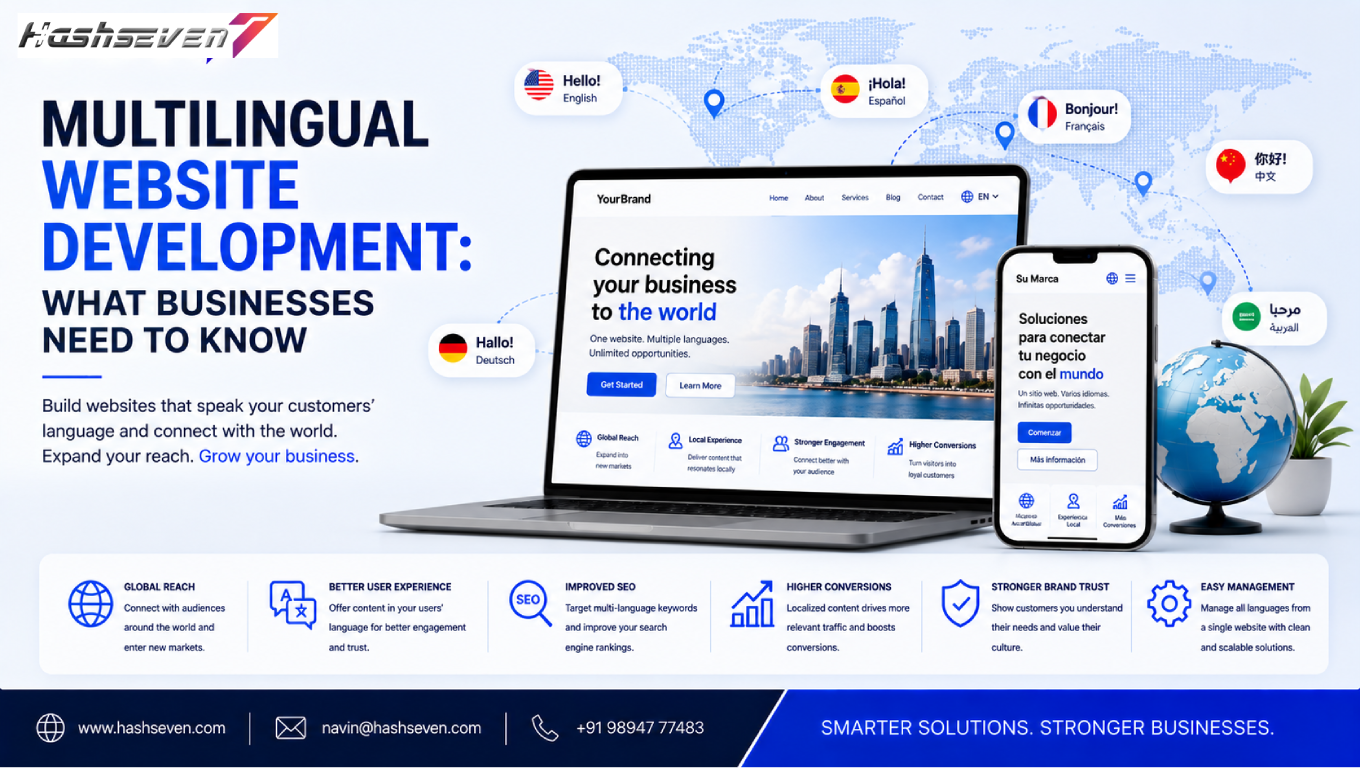

Businesses today can reach customers far beyond their local markets. A website can attract visitors from different countries, regions, and language groups, creating new opportunities for growth. However, reaching international customers successfully requires more than translating a few web pages.
Multilingual website development involves designing and developing a website that can support multiple languages while maintaining usability, performance, accessibility, SEO, and a consistent brand experience.
A multilingual website allows customers to browse products, understand services, read information, submit inquiries, and complete purchases in their preferred language. For businesses targeting international markets, this can make the website more accessible and relevant to a wider audience.
In this guide, we will explain what multilingual website development means, why it matters, the difference between translation and localization, technical considerations, multilingual SEO, URL structures, CMS selection, design requirements, common mistakes, best practices, and a practical implementation process.
What Is Multilingual Website Development?
Multilingual website development is the process of creating a website that supports content and functionality in two or more languages.
A multilingual website may provide:
- English content
- Spanish content
- French content
- German content
- Japanese content
- Hindi content
- Arabic content
- Other regional languages
The website should allow users to access the appropriate language version easily while maintaining the same core functionality.
Multilingual development can involve both technical and content-related work.
Technical development may include:
- Language routing
- Database structures
- URL architecture
- Character encoding
- Language selectors
- Translation management
- SEO implementation
- Right-to-left support
- Locale-specific formatting
Content work may include:
- Translation
- Localization
- Keyword research
- Metadata adaptation
- Image adaptation
- Regional terminology
Why Multilingual Website Development Matters
Language can significantly influence how customers interact with a website.
When visitors can access information in a language they understand comfortably, they may find it easier to:
- Understand products
- Compare services
- Navigate pages
- Contact a business
- Complete forms
- Make purchasing decisions
For businesses expanding into new markets, multilingual websites can support broader digital reach.
A multilingual website can help:
- Expand market reach
- Improve user experience
- Support international SEO
- Build customer trust
- Increase engagement
- Generate international leads
- Support e-commerce expansion
- Strengthen global branding
Build a Website That Grows Your Business
A professionally developed website is the foundation of your online success. If you’re planning to create a responsive, fast, and SEO-friendly business website, explore our Website Development Services to see how Hashseven can help transform your ideas into a powerful digital presence.
Multilingual Website Development vs Website Translation
These terms are related but not identical.
Website Translation
Translation converts existing content from one language into another.
For example:
English:
“Contact our team for more information.”
French:
“Contactez notre équipe pour plus d’informations.”
Multilingual Website Development
Multilingual development creates the technical structure required to manage multiple language versions throughout the website.
This includes:
- Language switching
- Localized URLs
- Database support
- SEO metadata
- Language attributes
- Content management
- Regional formatting
Therefore:
Translation = Convert the content
Multilingual development = Build the website to support multiple languages
Both are necessary for a successful multilingual website.
Multilingual Website Development vs Localization
Localization goes beyond literal translation.
It adapts the website to the cultural and commercial expectations of a particular audience.
Localization may involve:
- Language
- Currency
- Date formats
- Measurements
- Images
- Payment methods
- Local expressions
- Cultural references
- Product information
For example, an international e-commerce business may need different pricing, payment methods, and shipping information for different markets.
This makes localization an important part of multilingual website development.
Benefits of Multilingual Website Development
Reach More Customers
A multilingual website can make your products and services accessible to people who prefer different languages.
Improve User Experience
Visitors can browse information in a language they understand more comfortably.
Build Trust
Providing professional local-language content can make an international business feel more accessible.
Support International SEO
Localized content can create opportunities to appear for searches conducted in different languages.
Increase Conversion Opportunities
Customers may be more comfortable submitting an inquiry or purchasing when important information is available in their preferred language.
Support Global Expansion
A flexible multilingual architecture can make it easier to add additional markets later.
Plan Your Languages Before Development
One of the first steps is identifying the languages the business actually needs.
Do not add languages simply because they are available.
Consider:
- Target markets
- Customer demographics
- Website traffic
- Sales opportunities
- Search demand
- Business expansion plans
- Available translation resources
For example, a business targeting customers in three countries may initially need only three language versions.
Starting with a focused language strategy can simplify development and maintenance.
Choose the Right Website Architecture
A multilingual website needs a clear architecture.
Common approaches include:
- Subdirectories
- Subdomains
- Country-code domains
The choice should consider SEO, development resources, branding, analytics, maintenance, and future expansion.
Subdirectory Structure
Example:
example.com/en/
example.com/fr/
example.com/de/
Subdirectories keep language versions within the same domain.
This can simplify centralized website management.
Subdomain Structure
Example:
en.example.com
fr.example.com
de.example.com
Subdomains provide clear separation between language versions.
They may be useful when regional websites have significantly different structures or operational requirements.
Country-Code Domains
Example:
example.fr
example.de
example.jp
Country-code domains can provide strong geographic signals and may be appropriate when a business operates independently in specific countries.
However, managing multiple domains can require more resources.
Multilingual URL Best Practices
A multilingual website should use clear and consistent URLs.
Good examples include:
example.com/en/services/
example.com/fr/services/
example.com/de/services/
Avoid confusing URL structures that do not clearly identify language versions.
Keep URLs:
- Short
- Consistent
- Descriptive
- Crawlable
- Easy to understand
Multilingual Website Development and SEO
SEO becomes more complex when multiple language versions are involved.
Search engines need to understand:
- Which page is intended for which language
- Which regional version should be shown
- How different language pages relate to each other
Google provides guidance for multilingual and multi-regional websites through Google Search Central.
Important SEO elements include:
- Localized URLs
hreflang- Canonical tags
- XML sitemaps
- Internal links
- Localized metadata
- Local keyword research
- Language attributes
Use Hreflang Correctly
The hreflang attribute helps search engines understand relationships between localized versions of a webpage.
For example, a website may have:
- English version
- French version
- German version
The correct language and regional signals help search engines understand these alternatives.
Businesses should verify:
- Language codes
- Regional codes
- Alternate URLs
- Return references
- Canonical relationships
Incorrect implementation can create SEO issues.
Multilingual Keyword Research
Do not simply translate your English keywords word-for-word.
People in different markets may use completely different search terms.
For example, a product or service can have:
- Different names
- Different spelling
- Different terminology
- Different search intent
Each target language should therefore have its own keyword research process.
Research:
- Search volume
- Search intent
- Local terminology
- Competitors
- Commercial phrases
- Informational queries
This produces more useful localized SEO content.
Translate Metadata Separately
Each language version should have appropriate:
- SEO title
- Meta description
- Image ALT text
- Headings
- Structured data where applicable
Avoid copying English metadata into every language version.
Localized metadata can better match the search behavior of the target audience.
Multilingual Website Development and Content Management Systems
The CMS plays an important role in multilingual websites.
A suitable CMS should make it easy to:
- Create language versions
- Manage translations
- Edit metadata
- Manage URLs
- Control publishing
- Assign user permissions
- Organize media
- Maintain content consistency
Before choosing a CMS, businesses should determine how many languages they need and how frequently content will change.
WordPress Multilingual Websites
WordPress can be used to create multilingual business websites with appropriate multilingual functionality.
A multilingual WordPress implementation should consider:
- Translation management
- SEO compatibility
- URL structure
- Performance
- Plugin compatibility
- Media handling
- Language switching
- Content synchronization
Avoid installing multiple overlapping translation solutions without a clear reason, as unnecessary plugins can increase complexity.
Custom Multilingual Web Applications
Large businesses may require custom multilingual development.
Custom applications can support:
- Multiple languages
- Multiple currencies
- Regional dashboards
- Localized workflows
- Customer portals
- International e-commerce
- Regional permissions
For custom applications, multilingual support should be considered during database and application architecture rather than added after development.
Database Considerations
A multilingual application should store language-specific content in a structured way.
Avoid hardcoding translated text directly into application code.
Instead, use a flexible content structure that can support:
- Original language
- Translation
- Language code
- Region
- Translation status
This makes content management and future expansion easier.
Unicode and Character Encoding
Multilingual websites must correctly support different writing systems.
Unicode allows websites to represent characters used across many languages.
This is important when supporting:
- English
- Hindi
- Tamil
- Chinese
- Japanese
- Korean
- Arabic
- Russian
- Greek
- French
- German
Incorrect character encoding can result in broken or unreadable text.
The official Unicode Consortium provides standards and resources related to character encoding and international text.
Right-to-Left Language Support
Some languages, such as Arabic and Hebrew, use right-to-left writing.
Supporting these languages may require changes to:
- Navigation
- Alignment
- Forms
- Buttons
- Icons
- Layout
- Spacing
- Menus
A flexible interface should be designed to support different text directions when necessary.
Design for Text Expansion
Translated text can take up more or less space than the original.
For example, a short English button may require a much longer phrase in another language.
This can cause:
- Broken buttons
- Navigation overflow
- Overlapping elements
- Unexpected line breaks
- Mobile layout problems
Design interfaces with flexible containers rather than fixed text widths wherever possible.
Language Selector Design
A language selector should be easy to find and use.
It should be:
- Clearly labeled
- Accessible
- Mobile-friendly
- Consistent
- Easy to understand
Language names are often clearer than using flags alone.
For example:
English | Français | Deutsch | Español
Flags represent countries, while languages may be spoken across multiple countries.
Automatic Language Detection
Some websites automatically detect a user’s browser language or geographic location.
This can be useful, but forced automatic redirects can sometimes create usability problems.
A better approach is often to:
- Detect a likely language.
- Suggest the relevant version.
- Allow the visitor to change it manually.
- Remember the user’s preference where appropriate.
Users should remain in control of their language selection.
Currency and Multilingual Websites
Language and currency are separate concepts.
A Spanish-speaking customer could be located in Spain, Mexico, the United States, or another country.
Therefore, language selection should not automatically determine currency in every situation.
International websites may need separate controls or locale-based rules for:
- Currency
- Taxes
- Pricing
- Shipping
- Payment methods
Date and Number Formatting
Different regions use different formats for:
- Dates
- Numbers
- Measurements
- Addresses
For example, the date:
05/06/2026
can be interpreted differently depending on regional conventions.
International websites should use locale-aware formatting to minimize confusion.
Multilingual E-Commerce Development
E-commerce websites require additional multilingual considerations.
Product pages may need localized:
- Product names
- Descriptions
- Specifications
- Prices
- Availability
- Shipping information
- Return policies
- Checkout content
The checkout process should also be available in the customer’s selected language.
A partially translated checkout can create uncertainty at the most important stage of the buying journey.
Multilingual Forms
Forms should be fully localized.
This includes:
- Field labels
- Placeholder text
- Validation messages
- Error messages
- Confirmation messages
- Privacy notices
For international customers, address fields may also need to change according to regional requirements.
Multilingual Images and Media
Visual content may also require localization.
Images containing text should be reviewed for every language.
Videos may require:
- Subtitles
- Captions
- Voiceovers
- Localized graphics
Avoid using a single image containing English text when that information is important to users in other languages.
Multilingual Website Accessibility
Accessibility should remain a priority across every language version.
Important considerations include:
- Correct language attributes
- Keyboard navigation
- Screen-reader compatibility
- Accessible forms
- Meaningful ALT text
- Sufficient contrast
- Clear navigation
The W3C Web Content Accessibility Guidelines provide internationally recognized accessibility guidance.
Multilingual Website Performance
Adding multiple languages can increase website complexity.
Performance problems may occur because of:
- Additional scripts
- Translation plugins
- Large media files
- Third-party services
- Duplicate resources
- Poor caching
Each language version should be tested for performance.
Businesses should monitor:
- Page loading
- Core Web Vitals
- Server response time
- Image performance
- Mobile performance
Content Delivery for Global Audiences
A Content Delivery Network can help distribute website resources closer to users around the world.
CDNs can improve the delivery of:
- Images
- CSS
- JavaScript
- Fonts
- Static files
However, CDN implementation should be combined with proper caching, image optimization, hosting, and website architecture.
Translation Management Workflow
A structured translation workflow can help maintain quality.
A practical process is:
Create → Translate → Review → Approve → Publish → Monitor
For important business content, human review can help identify:
- Cultural problems
- Incorrect terminology
- Grammar issues
- Brand inconsistencies
- Translation errors
Maintain Translation Consistency
Businesses should maintain consistent terminology across pages.
For example, if a company uses one translated term for a specific service on its homepage, it should avoid using a completely different term on its service page without a clear reason.
A translation glossary can help maintain consistency.
Multilingual Content and AI Translation
AI-powered translation tools can accelerate content workflows.
They may be useful for:
- Initial drafts
- Large content libraries
- Internal documents
- Translation assistance
However, important customer-facing content should be reviewed carefully.
AI-generated translations can sometimes miss:
- Context
- Cultural meaning
- Industry terminology
- Brand tone
- Local expressions
Human review remains valuable for high-impact pages.
Common Multilingual Website Development Mistakes
1. Translating Only the Homepage
Customers need complete information in their preferred language.
2. Using Automatic Translation Without Review
Literal translations can create awkward or inaccurate content.
3. Ignoring SEO
Simply translating content does not automatically create strong international SEO.
4. Using the Same Keywords Everywhere
Search behavior varies by language and region.
5. Forgetting Metadata
Localized pages need appropriate titles and descriptions.
6. Ignoring Text Expansion
Longer translations can break interfaces.
7. Using Flags as the Only Language Selector
Flags represent countries, not languages.
8. Forgetting RTL Languages
Arabic and Hebrew may require different layout handling.
9. Creating Poor URL Structures
Confusing URLs can make multilingual management and SEO more difficult.
10. Translating the Website but Not the Checkout
E-commerce customers need a consistent experience throughout the purchase process.
Multilingual Website Development Best Practices
Plan Before Development
Identify languages, markets, content requirements, and SEO goals before development begins.
Separate Content From Code
Keep translatable content independent from application logic.
Use Flexible UI Components
Design interfaces that can accommodate different text lengths.
Research Local Keywords
Create keyword strategies for each target language.
Localize Metadata
Adapt SEO titles, descriptions, headings, and image ALT text.
Implement International SEO
Use appropriate URL structures, canonical tags, sitemaps, and hreflang.
Support Accessibility
Ensure every language version remains accessible.
Test Every Language
Do not assume that one language version will work perfectly in another.
Monitor Performance
Track speed and Core Web Vitals across important markets.
Step-by-Step Multilingual Website Development Process
Step 1: Identify Target Languages
Determine which languages are commercially valuable.
Step 2: Define Target Markets
Identify the countries or regions associated with each language.
Step 3: Plan Website Architecture
Choose the appropriate domain, subdomain, or subdirectory structure.
Step 4: Select Your CMS or Technology
Choose a platform capable of supporting your multilingual requirements.
Step 5: Design the Interface
Create flexible layouts that can support different languages and writing directions.
Step 6: Prepare Content
Identify pages that require translation and localization.
Step 7: Perform Local Keyword Research
Research how customers search in each target market.
Step 8: Translate and Localize
Adapt website content, metadata, forms, and other customer-facing elements.
Step 9: Implement SEO
Configure localized URLs, hreflang, canonical tags, internal links, and sitemaps.
Step 10: Test
Check language accuracy, layouts, forms, functionality, accessibility, SEO, and performance.
Step 11: Launch
Publish the localized versions carefully and monitor indexing.
Step 12: Maintain
Update translations whenever the original website content changes.
Multilingual Website Development Checklist
Planning
Identify target languages
Identify target markets
Research local customers
Research competitors
Define localization requirements
Plan international SEO
Development
Support Unicode
Create flexible content structures
Support language switching
Support text expansion
Support RTL languages when needed
Implement locale-aware formatting
Content
Translate important pages
Localize content
Review translations
Create local keyword lists
Translate metadata
Optimize image ALT text
SEO
Create localized URLs
Implement
hreflangReview canonical tags
Create XML sitemaps
Check indexability
Optimize internal links
Testing
Test every language
Test mobile layouts
Test forms
Test checkout
Test language switching
Test accessibility
Test performance
Test SEO implementation
How Multilingual Websites Support Business Growth
A multilingual website can become an important part of an international growth strategy.
The customer journey can become:
Localized Search → Relevant Website → Better Understanding → Increased Trust → Conversion
When customers can understand products and services clearly, businesses can reduce communication barriers and create more opportunities in international markets.
When Should a Business Build a Multilingual Website?
A multilingual website may be worth considering when:
- International traffic is increasing
- Customers request additional languages
- The company is entering new markets
- Competitors are targeting international audiences
- Search demand exists in other languages
- The business sells internationally
- Customer support is already serving multilingual audiences
Businesses should evaluate actual demand rather than adding languages without a strategic reason.
How Much Does Multilingual Website Development Cost?
The cost depends on several factors.
These can include:
- Number of languages
- Number of website pages
- CMS or technology stack
- Translation requirements
- Localization complexity
- Custom functionality
- E-commerce features
- SEO requirements
- Third-party integrations
- Ongoing maintenance
A simple multilingual business website may require significantly less work than a large international e-commerce platform.
The best approach is to define the required languages, functionality, and localization scope before estimating development costs.
Future of Multilingual Website Development
Technology is making multilingual websites increasingly sophisticated.
Future developments may include:
- AI-assisted translation
- Real-time content localization
- Multilingual AI chatbots
- Automated terminology management
- Personalized regional content
- Voice-based multilingual interfaces
- Automated SEO localization
- Real-time currency and regional personalization
However, technology should support a strong localization strategy rather than replace human understanding of language and culture.
Frequently Asked Questions
1. What is multilingual website development?
Multilingual website development is the process of building a website that supports multiple languages through appropriate content structures, language switching, URLs, SEO, databases, design, and localized functionality.
2. What is the difference between translation and multilingual website development?
Translation converts content from one language to another, while multilingual website development creates the technical and structural foundation needed to manage multiple language versions throughout a website.
3. Does a multilingual website improve SEO?
A properly implemented multilingual website can create opportunities to reach users searching in different languages. Localized content, appropriate URLs, keyword research, and correct international SEO implementation are important for achieving this.
4. How many languages should a business website support?
A business should support languages that align with its target customers, market opportunities, traffic, and growth strategy. Adding fewer relevant languages is often better than adding many poorly maintained translations.
5. How can businesses maintain multilingual website content?
Businesses can use translation workflows, content management systems, translation management tools, glossaries, professional reviewers, and regular content audits to keep language versions accurate and consistent.
Conclusion
Multilingual website development enables businesses to create digital experiences for customers who speak different languages.
A successful multilingual website requires more than translating existing pages. Businesses need to consider website architecture, URL structures, international SEO, keyword research, localization, database design, language selectors, accessibility, responsive design, performance, currencies, forms, and ongoing content maintenance.
The best strategy is to plan multilingual support from the beginning rather than trying to add it after the website has already been developed.
With a flexible technical foundation, accurate localization, strong SEO implementation, and continuous testing, businesses can create websites that are easier to manage and more useful for audiences around the world.
Ready to Build a Professional Website for Your Business?
Turn your business into a powerful online brand with Hashseven.
Since 2017, we’ve helped businesses grow through professional website development, mobile apps, custom software, SEO, digital marketing, CRM, POS solutions, and Meta-approved WhatsApp automation. Let’s create a fast, secure, and conversion-focused website that attracts more customers and drives real business growth.