
Getting visitors to a website is only the first step toward generating online sales. A business may invest heavily in SEO, paid advertising, social media, and content marketing, but those visitors have little value if they leave without taking action.
This is where conversion rate optimization becomes important.
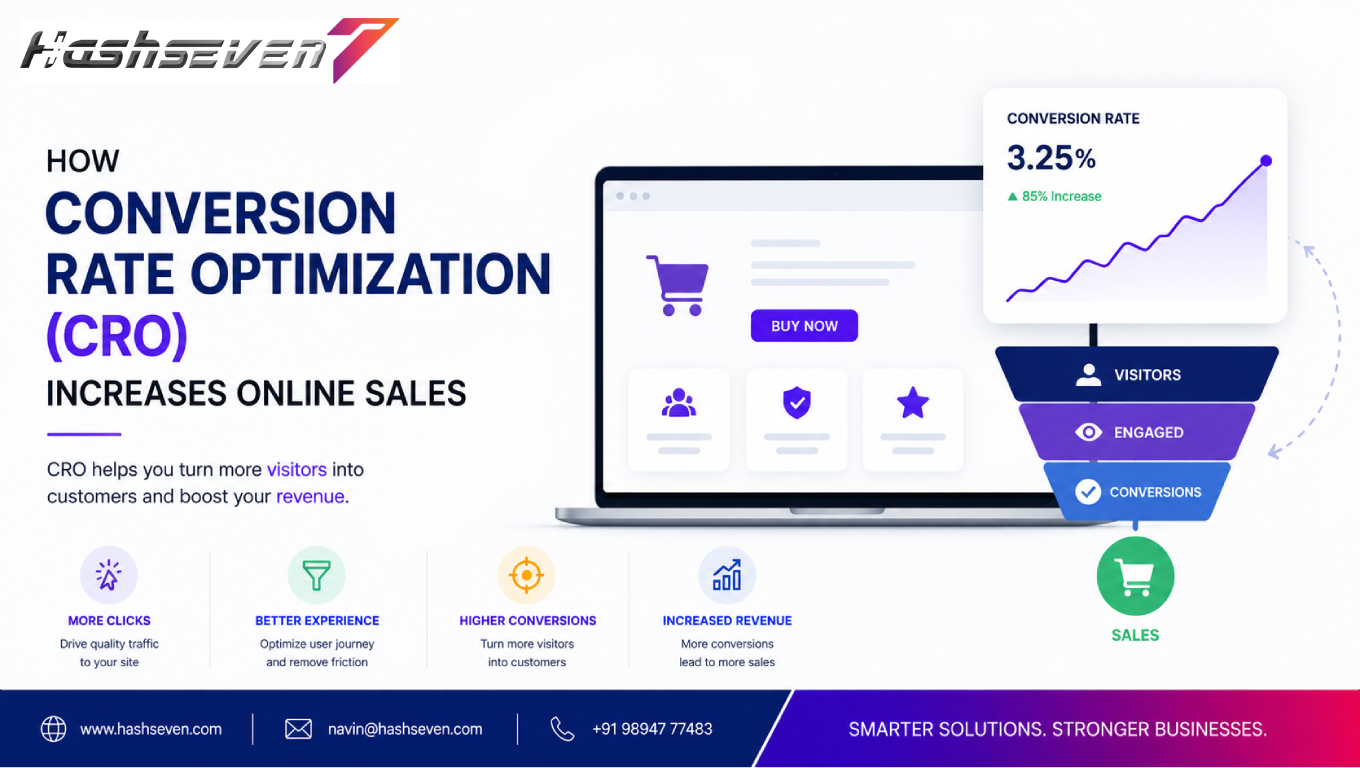
Conversion rate optimization, commonly called CRO, is the process of improving a website or digital experience so that a higher percentage of visitors complete a desired action. That action could be purchasing a product, submitting a form, booking an appointment, requesting a quote, signing up for a service, or contacting a business.
Instead of focusing only on attracting more traffic, CRO focuses on getting more value from the traffic a business already receives.
For example, if 1,000 people visit an online store and 20 purchase a product, the business has generated 20 sales from that traffic. By improving the website experience and increasing the percentage of visitors who purchase, the business can potentially generate more sales without increasing traffic by the same amount.
In this guide, we will explain what conversion rate optimization means, why it matters, how it increases online sales, the most effective CRO strategies, common mistakes, testing methods, and how businesses can build a successful CRO strategy.
What Is Conversion Rate Optimization?
Conversion rate optimization is the systematic process of improving a website, landing page, checkout process, or digital experience to encourage more visitors to complete a desired action.
A conversion can be different for every business.
Examples include:
- Purchasing a product
- Submitting a contact form
- Requesting a quotation
- Booking a consultation
- Signing up for an account
- Downloading a resource
- Starting a free trial
- Calling a business
- Subscribing to a newsletter
CRO uses data, user behavior, testing, design improvements, and persuasive content to identify barriers that prevent visitors from converting.
The goal is not simply to make a website look attractive. The goal is to make the customer journey clearer, easier, and more persuasive.
Why Conversion Rate Optimization Matters
Businesses often assume that increasing website traffic is the primary way to increase sales.
Traffic is important, but it is only one part of the equation.
A website can receive thousands of visitors and still generate poor results if:
- Navigation is confusing
- Product information is unclear
- Pages load slowly
- Forms are difficult to complete
- Checkout is complicated
- Calls to action are weak
- Visitors do not trust the business
- The website is difficult to use on mobile devices
Conversion rate optimization addresses these barriers.
Rather than constantly spending more money to attract additional visitors, businesses can improve the performance of the traffic they already have.
Build a Website That Grows Your Business
A professionally developed website is the foundation of your online success. If you’re planning to create a responsive, fast, and SEO-friendly business website, explore our Website Development Services to see how Hashseven can help transform your ideas into a powerful digital presence.
How Conversion Rate Optimization Increases Online Sales
1. Creates a Better User Experience
A smooth user experience can make it easier for visitors to complete their goals.
Visitors should be able to quickly:
- Find products
- Understand services
- Compare options
- Find pricing
- Contact the business
- Complete purchases
When unnecessary friction is removed, visitors have fewer reasons to abandon the website.
Good UX therefore becomes an important foundation for CRO.
2. Makes Calls to Action More Effective
A call to action tells visitors what they should do next.
Examples include:
- Buy Now
- Get Started
- Request a Quote
- Book a Consultation
- Contact Us
- Start Free Trial
- Download Guide
Weak or unclear calls to action can create uncertainty.
Effective CTAs should be:
- Clear
- Specific
- Relevant
- Easy to find
- Action-oriented
Instead of making visitors guess what to do next, a strong CTA provides a clear path forward.
3. Builds Customer Trust
Trust is essential for online purchases.
Visitors may hesitate when a website does not clearly communicate:
- Who operates the business
- What the product provides
- How payments work
- Whether returns are available
- How customer information is handled
- Whether other customers had positive experiences
Businesses can strengthen trust through:
- Customer reviews
- Testimonials
- Case studies
- Security information
- Clear contact details
- Transparent policies
- Professional design
- Recognized certifications where applicable
Trust signals can reduce hesitation and help customers feel more confident.
4. Improves Landing Pages
Landing pages are often created for specific marketing campaigns.
A landing page may promote:
- A product
- A service
- A limited-time offer
- A webinar
- A downloadable resource
- A consultation
- A campaign
A good landing page should have a clear objective.
If a page tries to accomplish too many things at once, visitors may become distracted.
A CRO-focused landing page can emphasize:
- One primary goal
- Strong headline
- Relevant benefits
- Supporting information
- Social proof
- Clear CTA
5. Simplifies Website Navigation
Visitors should not have to search through multiple pages to find important information.
Clear navigation can help users quickly discover:
- Products
- Services
- Pricing
- Contact information
- About the company
- Support
- FAQs
Simple navigation reduces friction and helps visitors move through the buying journey more efficiently.
6. Optimizes Product Pages
For e-commerce businesses, product pages can directly influence purchasing decisions.
A strong product page can include:
- High-quality images
- Clear product descriptions
- Benefits
- Pricing
- Product specifications
- Availability
- Reviews
- Shipping information
- Return information
- Clear CTA
Visitors should have enough information to make a confident decision.
7. Makes Checkout Easier
Checkout abandonment is a major challenge for e-commerce businesses.
A complicated checkout process may include:
- Too many fields
- Unexpected costs
- Forced account creation
- Limited payment methods
- Confusing navigation
- Technical errors
Businesses can improve checkout experiences by:
- Reducing unnecessary fields
- Providing clear pricing
- Offering suitable payment options
- Displaying security information
- Showing progress indicators
- Allowing guest checkout where appropriate
The easier the checkout process is, the fewer unnecessary barriers customers face.
8. Improves Mobile Conversion Rates
Many customers interact with businesses using smartphones.
A website that looks good on desktop but performs poorly on mobile can lose potential customers.
Mobile CRO should consider:
- Responsive layouts
- Readable text
- Touch-friendly buttons
- Simple navigation
- Fast loading
- Easy forms
- Mobile-friendly checkout
Businesses should test important conversion journeys on different screen sizes.
9. Uses Social Proof
Customers often look for evidence that other people trust a business.
Social proof can include:
- Reviews
- Ratings
- Testimonials
- Case studies
- Customer logos
- User-generated content
- Success stories
Social proof can help reduce uncertainty, especially when customers are unfamiliar with a brand.
However, businesses should use genuine and verifiable customer feedback rather than fabricated testimonials.
10. Improves Website Speed
Website performance can influence the user experience.
Slow pages can frustrate visitors and increase the likelihood that they leave before completing an action.
Businesses should monitor:
- Page loading
- Image sizes
- JavaScript
- CSS
- Server response
- Caching
- Mobile performance
Improving performance can make the conversion journey smoother.
11. Uses Clear and Persuasive Content
Website content should answer the questions visitors have before making a decision.
Effective sales content explains:
- What the product or service is
- Who it is for
- What problem it solves
- What benefits it provides
- Why customers should trust the business
- What action visitors should take next
Instead of focusing only on features, businesses should communicate customer benefits.
For example:
Feature: Automated reporting
Benefit: Save time by generating business reports automatically.
The second statement explains why the feature matters.
12. Removes Unnecessary Distractions
Too many elements can make a website difficult to understand.
Examples include:
- Excessive popups
- Too many CTAs
- Distracting animations
- Unnecessary banners
- Cluttered layouts
- Too many menu options
A CRO strategy should identify what helps visitors convert and what creates unnecessary friction.
13. Personalizes the Customer Experience
Different visitors may have different needs.
Personalization can include:
- Location-based content
- Returning customer experiences
- Relevant product recommendations
- Personalized offers
- Industry-specific landing pages
Personalization should be useful rather than intrusive.
Businesses should also respect privacy requirements and clearly communicate how customer information is used.
14. Uses Urgency Carefully
Urgency can encourage customers to take action when there is a genuine reason to act now.
Examples include:
- Limited availability
- Genuine sale deadlines
- Registration closing dates
- Seasonal offers
However, businesses should avoid misleading countdown timers or false scarcity.
Authentic urgency is more trustworthy and sustainable.
15. Improves Website Forms
Forms are important for lead generation.
A long or confusing form can discourage visitors from submitting their information.
Businesses should consider:
- Asking only necessary questions
- Using clear labels
- Providing helpful instructions
- Showing understandable errors
- Making forms mobile-friendly
- Clearly explaining what happens after submission
For lead-generation websites, improving forms can directly increase the number of qualified inquiries.
16. Uses A/B Testing
A/B testing compares two versions of an element to determine which performs better.
For example:
Version A: “Get Started”
Version B: “Request Your Free Consultation”
The business can measure which version generates more conversions under an appropriate test design.
A/B testing can be used for:
- Headlines
- CTAs
- Images
- Forms
- Product descriptions
- Page layouts
- Pricing presentation
Testing should be based on a clear hypothesis rather than random changes.
17. Understands Customer Behavior
CRO works best when businesses understand what visitors actually do on their websites.
Useful information can include:
- Most visited pages
- Exit pages
- Conversion paths
- Device usage
- Traffic sources
- Search terms
- Form abandonment
- Checkout abandonment
Analytics can help identify areas that require investigation.
18. Uses Heatmaps and Session Analysis
Behavioral tools can help businesses understand how visitors interact with pages.
Depending on the tool, businesses may analyze:
- Click patterns
- Scroll depth
- Navigation behavior
- Interaction with page elements
These insights can help identify areas where users may become confused or disengaged.
However, session recordings and behavioral analytics should be implemented with appropriate privacy protections.
19. Addresses Customer Objections
Visitors often have unanswered questions before making a purchase.
Common objections may involve:
- Price
- Quality
- Delivery
- Support
- Returns
- Security
- Compatibility
- Results
A strong website addresses these questions before they become reasons for abandonment.
FAQ sections, product information, guarantees where appropriate, reviews, and clear policies can help reduce uncertainty.
20. Makes Pricing Easier to Understand
Unclear pricing can create friction.
Businesses should make important pricing information easy to understand.
Depending on the business model, this may include:
- Product price
- Subscription cost
- Setup fees
- Shipping costs
- Taxes where applicable
- Included features
- Renewal terms
Unexpected costs appearing late in the customer journey can reduce trust.
Conversion Rate Optimization for Different Businesses
CRO strategies should match the business model.
E-Commerce Businesses
Focus on:
- Product pages
- Search
- Cart
- Checkout
- Payment
- Reviews
Service Businesses
Focus on:
- Service pages
- Trust signals
- Contact forms
- Booking systems
- Calls to action
B2B Businesses
Focus on:
- Lead forms
- Case studies
- Product information
- Demonstrations
- Consultation requests
SaaS Businesses
Focus on:
- Free trials
- Sign-ups
- Product demonstrations
- Pricing pages
- Onboarding
There is no universal CRO strategy.
The best approach depends on the audience, product, buying journey, and business objectives.
Common Conversion Rate Optimization Mistakes
1. Making Changes Without Data
Changing a website simply because someone prefers a different design does not guarantee better performance.
2. Testing Too Many Things at Once
If several major elements change simultaneously, it can become difficult to understand what caused the result.
3. Focusing Only on Design
CRO is not just about colors, buttons, and layouts.
It also involves:
- Content
- User behavior
- Psychology
- Performance
- Analytics
- Customer needs
4. Ignoring Mobile Users
A desktop-only approach can miss a large portion of website visitors.
5. Using False Urgency
Fake scarcity may damage customer trust.
6. Ignoring Existing Customers
CRO can also improve experiences for returning customers, not just first-time visitors.
7. Stopping After One Test
CRO is an ongoing process.
A successful improvement can create a new opportunity for further testing.
How to Build a Conversion Rate Optimization Strategy
Businesses can follow a structured process.
Step 1: Define the Conversion Goal
Decide what action matters most.
For example:
- Purchase
- Lead
- Registration
- Booking
Step 2: Collect Data
Use analytics and customer feedback to understand current performance.
Step 3: Identify Friction
Find where users struggle or abandon the process.
Step 4: Develop a Hypothesis
Create a specific reason for making a change.
For example:
“Adding clearer shipping information near the purchase button may reduce uncertainty and increase completed purchases.”
Step 5: Create the Test
Develop the alternative version.
Step 6: Run the Test
Collect sufficient data before making a conclusion.
Step 7: Analyze the Results
Determine whether the change produced a meaningful improvement.
Step 8: Implement Successful Changes
Apply validated improvements where appropriate.
Step 9: Continue Testing
CRO should be treated as an ongoing optimization process.
How Conversion Rate Optimization Supports SEO
CRO and SEO have different primary objectives.
SEO focuses on attracting relevant organic traffic, while CRO focuses on improving the percentage of visitors who complete desired actions.
However, they can work together.
SEO can bring qualified visitors to a website.
CRO can help those visitors:
- Find information
- Understand offers
- Navigate pages
- Submit forms
- Make purchases
Businesses should avoid making CRO changes that harm search visibility.
For example, removing useful content simply to make a page shorter may not always be beneficial.
The strongest strategy balances search visibility with user experience.
Conversion Rate Optimization and Paid Advertising
Paid advertising can generate targeted traffic quickly.
However, sending visitors to a poorly optimized landing page can reduce advertising efficiency.
CRO can help businesses improve landing pages by making them:
- More relevant to the advertisement
- Easier to understand
- Faster
- More trustworthy
- More focused
Better conversion performance can potentially improve the return from existing advertising traffic.
Measuring CRO Success
Businesses should track metrics that align with their objectives.
Important metrics may include:
- Conversion rate
- Revenue
- Average order value
- Lead volume
- Cost per acquisition
- Checkout completion
- Cart abandonment
- Form completion
- Customer acquisition
- Revenue per visitor
The most important metric depends on the business model.
A higher conversion rate is not automatically better if it produces low-quality leads or unprofitable customers.
Businesses should therefore evaluate both conversion quantity and conversion quality.
Conversion Rate Optimization Checklist
Use this checklist when reviewing a website:
- Conversion goals are clearly defined
- Primary CTAs are visible
- Navigation is simple
- Website works well on mobile
- Pages load quickly
- Forms are easy to complete
- Product information is clear
- Pricing is transparent
- Customer reviews are visible
- Trust signals are included
- Checkout is simple
- Important objections are addressed
- Content communicates benefits
- Analytics are configured
- User behavior is analyzed
- A/B tests are based on hypotheses
- Changes are measured
- Privacy is considered
- Successful tests are documented
- CRO is reviewed continuously
The Future of Conversion Rate Optimization
The future of CRO will increasingly involve data, personalization, automation, and artificial intelligence.
Businesses can use technology to better understand:
- Customer intent
- Website behavior
- Product preferences
- Content engagement
- Conversion barriers
AI can also help businesses generate testing ideas, analyze large datasets, personalize experiences, and identify potential friction points.
However, technology should support human decision-making rather than replace customer understanding.
Businesses still need to understand their audience, brand, products, and customer expectations.
Frequently Asked Questions
1. What is conversion rate optimization?
Conversion rate optimization is the process of improving a website or digital experience to increase the percentage of visitors who complete a desired action, such as purchasing a product, submitting a form, or booking a service.
2. How does conversion rate optimization increase online sales?
CRO can increase online sales by improving user experience, simplifying checkout, strengthening calls to action, building trust, improving product pages, reducing friction, and addressing customer objections.
3. What are the most important CRO strategies?
Important strategies include improving website usability, optimizing landing pages, simplifying forms and checkout, strengthening CTAs, improving page speed, using social proof, analyzing user behavior, and conducting controlled tests.
4. Does CRO replace SEO?
No. SEO and CRO have different purposes. SEO focuses on attracting relevant visitors, while CRO focuses on helping those visitors complete valuable actions. Businesses can use both strategies together.
5. How long does conversion rate optimization take?
CRO is an ongoing process rather than a one-time project. The time required depends on website traffic, business goals, testing methods, and the number of changes being evaluated.
Conclusion
Conversion rate optimization helps businesses get more value from the website traffic they already have.
Instead of focusing exclusively on attracting more visitors, CRO examines what happens after visitors arrive. It identifies barriers, improves user experience, strengthens trust, simplifies purchasing journeys, and tests changes that can encourage more visitors to take meaningful actions.
From optimizing landing pages and product pages to improving checkout experiences, forms, CTAs, website speed, and mobile usability, CRO can influence many stages of the customer journey.
The most effective CRO strategies are based on data and customer behavior rather than assumptions. Businesses should define clear goals, identify friction, develop hypotheses, test improvements, analyze results, and continue optimizing.
CRO should also work alongside SEO, paid advertising, content marketing, and other digital strategies. When businesses attract relevant traffic and provide a smooth conversion experience, they can create stronger opportunities for sustainable online growth.
Ready to Build a Professional Website for Your Business?
Turn your business into a powerful online brand with Hashseven.
Since 2017, we’ve helped businesses grow through professional website development, mobile apps, custom software, SEO, digital marketing, CRM, POS solutions, and Meta-approved WhatsApp automation. Let’s create a fast, secure, and conversion-focused website that attracts more customers and drives real business growth.