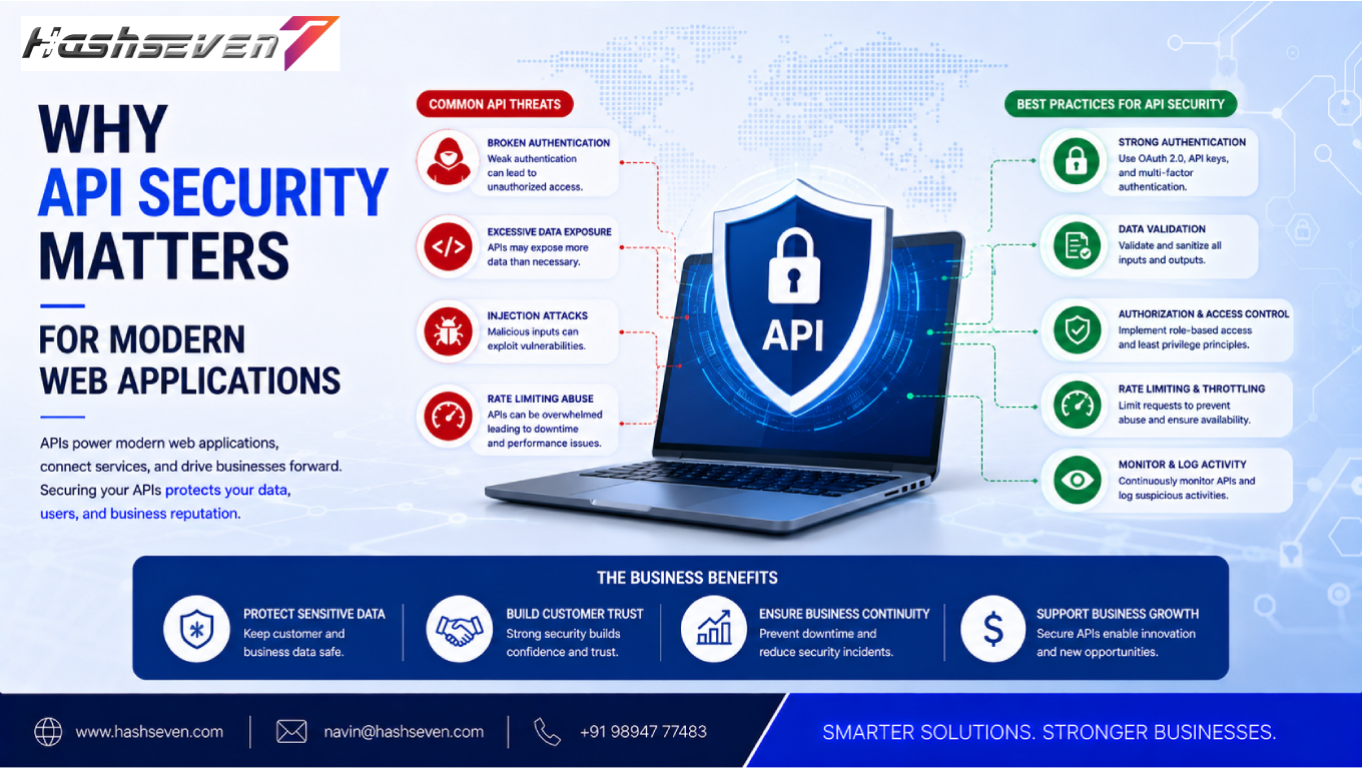

Modern web applications depend heavily on APIs to connect websites, mobile applications, databases, payment systems, cloud platforms, CRM systems, and third-party services. APIs make digital systems more flexible and connected, but they also create potential security risks when they are poorly designed or protected.
This makes API security an essential part of modern web application development.
An API, or Application Programming Interface, allows different software systems to communicate with one another. For example, when a customer logs into a website, checks an order, makes a payment, or submits a support request, APIs may transfer information between the front end and back-end systems.
Because APIs can provide access to sensitive information and important business functions, attackers may target them to steal data, bypass authentication, manipulate transactions, or disrupt services.
A strong API security strategy helps businesses protect their applications, customer information, business data, and connected systems.
In this guide, we will explain what API security means, why it matters, common API security risks, authentication methods, authorization, encryption, rate limiting, API monitoring, security testing, best practices, and how businesses can build more secure web applications.
What Is API Security?
API security refers to the practices, technologies, and processes used to protect APIs from unauthorized access, misuse, attacks, data exposure, and other security threats.
API security protects several important areas, including:
- Authentication
- Authorization
- Data protection
- Access control
- API endpoints
- Input validation
- Traffic management
- Monitoring
- Error handling
- Security testing
The objective is to ensure that only authorized users and systems can access the appropriate API resources.
For example, a customer should be able to view their own order information but should not be able to access another customer’s orders.
Effective API security helps enforce these boundaries.
Why API Security Matters
APIs are often the connection point between different parts of a digital ecosystem.
A single business application may connect:
Website → API → Database
and also:
Mobile App → API → CRM
or:
Website → Payment API → Payment Provider
If an API is compromised, attackers may potentially gain access to systems or information behind it.
Strong API security therefore helps businesses:
- Protect sensitive information
- Prevent unauthorized access
- Reduce security vulnerabilities
- Protect customer accounts
- Secure transactions
- Maintain application availability
- Support regulatory compliance
- Protect business reputation
API security should be considered from the beginning of application development rather than added after the application is completed.
Build a Website That Grows Your Business
A professionally developed website is the foundation of your online success. If you’re planning to create a responsive, fast, and SEO-friendly business website, explore our Website Development Services to see how Hashseven can help transform your ideas into a powerful digital presence.
How APIs Work in Modern Web Applications
A typical modern web application may have several components.
For example:
User → Front End → API → Application Server → Database
The user interacts with the website.
The front end sends a request to an API.
The API processes the request.
The application server performs the required business logic.
The database provides or stores the required information.
This architecture provides flexibility, but every communication point must be protected.
An insecure API can become an entry point for attackers.
Common API Security Risks
Broken Authentication
Authentication verifies who is making an API request.
Weak authentication can allow attackers to access accounts or protected resources.
Common problems include:
- Weak passwords
- Poor token management
- Exposed credentials
- Insecure authentication flows
- Long-lived access tokens
- Improper session handling
Businesses should use strong authentication mechanisms and securely manage credentials.
Broken Authorization
Authentication answers:
Who are you?
Authorization answers:
What are you allowed to access?
An authenticated user should not automatically have access to every resource.
For example, a customer may be authorized to access:
/customers/123/orders
but should not be able to access another customer’s information simply by changing the identifier.
Strong authorization checks should be applied to every sensitive resource.
Excessive Data Exposure
An API may return more information than the application actually needs.
For example, a customer profile API might return internal fields that should never be exposed to the browser.
Businesses should follow the principle of data minimization and return only the information required for the specific operation.
Injection Attacks
Attackers may attempt to insert malicious input into API requests.
Potential targets include:
- Databases
- Search systems
- Operating systems
- Application logic
Input validation, parameterized queries, safe data handling, and secure coding practices can reduce injection risks.
Lack of Rate Limiting
Without rate limiting, attackers may send huge numbers of requests to an API.
This can contribute to:
- Brute-force attacks
- Credential attacks
- Resource exhaustion
- Abuse
- Denial-of-service conditions
Rate limiting helps control how frequently clients can interact with API endpoints.
Improper Error Handling
Detailed error messages can accidentally reveal sensitive information.
For example, an API should not expose:
- Database details
- Internal file paths
- Authentication secrets
- Stack traces
- Internal system architecture
Error messages should provide enough information for legitimate users while avoiding unnecessary technical details.
Insecure API Keys
API keys are commonly used to identify applications or services.
If API keys are exposed in:
- Public repositories
- Client-side code
- Screenshots
- Logs
- Public documentation
attackers may misuse them.
Businesses should securely store and rotate API credentials.
Unprotected Sensitive Endpoints
Not every API endpoint should be publicly accessible.
Sensitive operations such as:
- Account deletion
- Password changes
- Payment actions
- Administrative functions
- Data exports
should require appropriate authentication and authorization.
Authentication in API Security
Authentication is one of the fundamental components of API security.
Common authentication approaches include:
- API keys
- Session-based authentication
- OAuth 2.0
- OpenID Connect
- JSON Web Tokens
- Mutual TLS
The appropriate approach depends on the application architecture and requirements.
For example, OAuth 2.0 can be useful when applications need delegated access between different systems.
Businesses should avoid creating custom authentication mechanisms unless there is a strong technical reason and sufficient security expertise.
Authorization and Access Control
Authorization determines which resources a user or application can access.
A secure API should verify permissions for every protected operation.
For example:
Customer A → Customer A’s data → Allowed
Customer A → Customer B’s data → Denied
Access controls should be enforced on the server side.
Client-side restrictions alone are not sufficient because attackers can bypass front-end controls and send API requests directly.
Role-Based Access Control
Role-Based Access Control, or RBAC, assigns permissions according to user roles.
For example:
| Role | Example Permissions |
|---|---|
| Customer | View own account and orders |
| Employee | Access assigned business functions |
| Manager | View broader operational data |
| Administrator | Manage system settings |
RBAC can simplify permission management when a business has clearly defined roles.
Encryption and API Security
Sensitive API communication should be protected using secure transport encryption.
HTTPS helps protect information while it travels between clients and servers.
Sensitive information that may require protection includes:
- Login credentials
- Customer information
- Payment-related data
- Authentication tokens
- Business information
- Personal information
Businesses should also consider encryption for sensitive data stored in databases and other systems.
HTTPS for API Communication
APIs should generally use HTTPS rather than unencrypted HTTP.
HTTPS helps protect against attackers intercepting network traffic.
It provides encryption and helps establish secure communication between clients and servers.
For businesses developing web applications, secure transport should be treated as a baseline security requirement.
API Keys and Secrets Management
API keys, passwords, tokens, and other secrets should never be hard-coded into public source code.
Instead, businesses should use appropriate secret-management mechanisms.
Important practices include:
- Store secrets securely
- Restrict access
- Rotate credentials
- Avoid exposing secrets in logs
- Remove unused credentials
- Monitor suspicious usage
Developers should also ensure that secrets are not accidentally committed to public repositories.
Rate Limiting
Rate limiting controls how many requests a client can make within a specific period.
For example:
100 requests per minute per user
could prevent excessive API usage.
Rate limiting can help reduce:
- Brute-force attacks
- API abuse
- Automated scraping
- Resource exhaustion
- Excessive traffic
Different endpoints may require different limits.
A login endpoint, for example, may need stricter controls than a public content endpoint.
Input Validation
Every API should treat incoming data as untrusted.
Input validation can help prevent malicious or unexpected data from reaching application logic.
Validation should check:
- Data type
- Length
- Format
- Range
- Required fields
- Allowed values
For example, an API expecting an integer should not blindly accept arbitrary strings.
Server-side validation is essential because attackers can bypass browser-based validation.
API Security and SQL Injection
APIs frequently interact with databases.
If user-provided input is inserted directly into database queries, attackers may attempt SQL injection attacks.
Businesses should use:
- Parameterized queries
- Prepared statements
- ORM safeguards
- Input validation
- Least-privilege database accounts
Secure database practices are an important part of overall API protection.
API Versioning
API versioning helps businesses manage changes without unexpectedly breaking existing clients.
Examples include:
/api/v1//api/v2/
When older API versions remain active, businesses should continue monitoring and securing them.
Unused or outdated API versions should be removed when they are no longer required.
An old API that remains accessible can become an unnecessary security risk.
API Security Monitoring
Security does not end after an API is deployed.
Businesses should continuously monitor API activity.
Useful information includes:
- Request volume
- Failed authentication attempts
- Unusual traffic
- Response errors
- Geographic anomalies
- Suspicious access patterns
- High-frequency requests
- Unexpected endpoint usage
Monitoring can help identify suspicious behavior earlier.
Logging for API Security
API logs can help development and security teams investigate incidents.
Useful logs may include:
- Timestamp
- Endpoint
- Request method
- Response status
- User or service identity
- Request origin
- Security events
However, logs should not contain sensitive information such as passwords, private keys, or authentication tokens.
Logging policies should balance security visibility with privacy and data protection.
API Security Testing
Security testing helps identify vulnerabilities before attackers discover them.
Common approaches include:
- Vulnerability scanning
- API penetration testing
- Authentication testing
- Authorization testing
- Input validation testing
- Automated security testing
- Dependency scanning
- Configuration reviews
Security testing should be integrated into the software development lifecycle.
For additional application-security guidance, businesses can refer to the OWASP API Security Top 10.
API Security in the Software Development Lifecycle
Security should be considered throughout development.
A secure development process can include:
Planning → Design → Development → Testing → Deployment → Monitoring
Security requirements should be defined during planning.
Developers should apply secure coding practices during development.
Security testing should happen before production.
Monitoring should continue after deployment.
This approach is more effective than waiting until a security incident occurs.
API Gateway and Security
An API gateway can provide a centralized entry point for API requests.
Depending on the architecture, an API gateway can help manage:
- Authentication
- Rate limiting
- Request routing
- Logging
- Traffic management
- API versioning
- Access policies
However, an API gateway should not be treated as the only security layer.
Individual services should still enforce appropriate authorization and security controls.
API Security for Microservices
Microservices architectures often depend heavily on APIs.
A typical system might contain:
User Service → Order Service → Payment Service → Notification Service
Each service may communicate through APIs.
This creates additional security considerations.
Businesses should protect:
- Service-to-service communication
- Service identities
- Internal APIs
- Authentication tokens
- Authorization policies
- Network access
Strong identity and access management becomes especially important in distributed systems.
API Security for Mobile Applications
Mobile applications frequently communicate with back-end systems through APIs.
This means the API should never assume that requests from a mobile application are automatically trustworthy.
Attackers can reverse engineer applications and send requests directly to APIs.
Therefore, security must be enforced at the API and server level.
Important controls include:
- Strong authentication
- Authorization
- Token security
- Rate limiting
- Input validation
- Secure transport
- Monitoring
API Security for E-Commerce Websites
E-commerce websites depend on APIs for:
- Product information
- Customer accounts
- Shopping carts
- Orders
- Payments
- Inventory
- Shipping
Security problems in these APIs can have serious business consequences.
Businesses should protect payment-related endpoints particularly carefully.
Sensitive operations should require appropriate authentication, authorization, validation, and monitoring.
API Security for Business Systems
Modern businesses often connect multiple systems through APIs.
Examples include:
- CRM
- ERP
- Accounting software
- Payment platforms
- Marketing automation
- Customer portals
- Mobile applications
- Analytics platforms
API security therefore protects not just one application but the broader digital ecosystem.
A vulnerable API can potentially affect multiple connected systems.
API Security and Third-Party Integrations
Third-party integrations introduce additional security considerations.
Before connecting an external service, businesses should evaluate:
- Authentication requirements
- Data exchanged
- API permissions
- Security documentation
- Token management
- Data retention
- Vendor security practices
Access should be limited to the minimum permissions required.
Least Privilege
The principle of least privilege means users, applications, and services should receive only the permissions they need.
For example:
A reporting service may need permission to read sales information but may not need permission to delete customer records.
Limiting permissions reduces the potential impact of compromised accounts or services.
Zero Trust and API Security
Modern application architectures increasingly follow zero-trust principles.
Instead of automatically trusting internal requests, systems verify:
- Identity
- Permissions
- Device or service context
- Request validity
This is especially useful in cloud and distributed environments where services may operate across multiple networks.
API security should therefore be designed around verification rather than assumptions of trust.
Common API Security Mistakes
1. Trusting Client-Side Validation
Attackers can bypass front-end controls.
2. Using Weak Authentication
Poor authentication can expose accounts and sensitive resources.
3. Missing Authorization Checks
Authenticated users should still have limited permissions.
4. Exposing Sensitive Data
APIs should return only necessary information.
5. Ignoring Old API Versions
Unused endpoints can become security liabilities.
6. Hard-Coding API Keys
Credentials should never be embedded carelessly in source code.
7. Not Using Rate Limits
Unlimited requests can enable abuse.
8. Logging Sensitive Information
Logs should not expose passwords, tokens, or private keys.
9. Ignoring Security Testing
Security vulnerabilities may remain hidden without regular testing.
10. Treating Internal APIs as Automatically Safe
Internal services can also be targeted or compromised.
API Security Best Practices
Businesses should consider the following API security best practices:
- Use HTTPS for API communication.
- Implement strong authentication.
- Enforce server-side authorization.
- Apply least-privilege access.
- Validate all incoming data.
- Use secure secret management.
- Apply rate limiting.
- Avoid excessive data exposure.
- Use secure error handling.
- Monitor API activity.
- Protect sensitive logs.
- Remove unused API endpoints.
- Keep API dependencies updated.
- Perform regular security testing.
- Maintain API documentation.
- Version APIs carefully.
- Secure third-party integrations.
- Establish incident-response procedures.
Step-by-Step API Security Strategy
Step 1: Identify Your APIs
Create an inventory of public, private, internal, and third-party APIs.
Step 2: Identify Sensitive Data
Determine what information each API can access or process.
Step 3: Review Authentication
Check how users, applications, and services prove their identities.
Step 4: Review Authorization
Verify that every sensitive operation has appropriate permission checks.
Step 5: Secure Data Transmission
Use HTTPS and appropriate encryption practices.
Step 6: Validate Requests
Implement server-side validation for incoming data.
Step 7: Add Rate Limits
Set reasonable limits according to API functionality and usage patterns.
Step 8: Secure Secrets
Protect API keys, passwords, tokens, and other credentials.
Step 9: Monitor API Activity
Create monitoring and alerting for suspicious behavior.
Step 10: Test Regularly
Perform security assessments and penetration testing where appropriate.
Step 11: Remove Unused APIs
Decommission unnecessary endpoints and outdated versions.
Step 12: Review Continuously
API security should evolve as applications, integrations, and threats change.
Benefits of Strong API Security
A strong API security strategy can provide several business benefits.
Protects Customer Data
Security controls help prevent unauthorized access to sensitive customer information.
Reduces Business Risk
Strong security can reduce the likelihood and potential impact of API-related incidents.
Improves Customer Trust
Customers expect businesses to protect their information and digital accounts.
Supports Reliable Applications
Security controls such as rate limiting and monitoring can help protect application availability.
Protects Business Integrations
Secure APIs help protect connections between internal and third-party systems.
Supports Compliance
Depending on the industry and location, businesses may have legal or regulatory obligations concerning data security and privacy.
Enables Safer Digital Growth
Secure APIs provide a stronger foundation for expanding applications, integrations, mobile apps, and digital services.
API Security for Small Businesses
Small businesses may assume API security is relevant only to large technology companies.
That is not true.
A small business may use APIs for:
- Payment processing
- CRM
- Email marketing
- Customer portals
- E-commerce
- Accounting
- Booking systems
- Analytics
Each integration creates a potential security consideration.
Small businesses should start with fundamental protections such as HTTPS, strong authentication, secure credentials, authorization, validation, monitoring, and regular updates.
API Security for Growing Businesses
As businesses grow, the number of applications and integrations often increases.
A growing organization may need:
- API gateways
- Centralized identity management
- Security monitoring
- Automated testing
- Secret management
- Access policies
- API inventories
- Security documentation
Building these capabilities gradually can help businesses maintain security as their digital ecosystem expands.
The Future of API Security
The API ecosystem will continue to evolve as businesses adopt:
- Cloud computing
- Microservices
- Mobile applications
- AI applications
- Serverless systems
- API-driven websites
- Connected platforms
- Automation
- Digital customer portals
Artificial intelligence may also be increasingly used to identify unusual API traffic and potential threats.
At the same time, attackers are likely to continue targeting APIs because they provide direct access to application functionality and data.
Businesses therefore need security strategies that evolve alongside their technology.
Conclusion
API security is a fundamental requirement for modern web applications.
APIs connect websites, mobile applications, databases, payment platforms, CRM systems, cloud services, and third-party tools. These connections create enormous business value, but they also introduce security risks.
Businesses can strengthen API protection by implementing strong authentication, authorization, encryption, input validation, rate limiting, secure secret management, monitoring, logging, and regular security testing.
The most important principle is to treat every API request as something that must be properly validated and authorized.
Security should also be built into the software development lifecycle instead of being treated as a final-stage activity.
Whether you operate a small business website, an e-commerce platform, a mobile application, or a large microservices ecosystem, investing in API security helps create a safer and more reliable digital foundation.
Frequently Asked Questions
1. What is API security?
API security is the practice of protecting APIs from unauthorized access, data exposure, misuse, attacks, and other security threats. It includes authentication, authorization, encryption, input validation, rate limiting, monitoring, and security testing.
2. Why is API security important for businesses?
API security helps businesses protect customer information, business data, transactions, applications, and connections with third-party systems. Strong API security also reduces security risks and helps maintain customer trust.
3. What are the most common API security risks?
Common API security risks include broken authentication, improper authorization, excessive data exposure, injection attacks, weak API keys, insufficient rate limiting, insecure endpoints, and poor error handling.
4. How can businesses improve API security?
Businesses can improve API security by using HTTPS, strong authentication, server-side authorization, input validation, rate limiting, secure secret management, monitoring, regular security testing, and least-privilege access controls.
5. Is API security necessary for small businesses?
Yes. Small businesses often use APIs for payments, CRM systems, e-commerce, booking platforms, marketing tools, and customer portals. Protecting these APIs helps prevent unauthorized access and protects important business and customer data.
Ready to Build a Professional Website for Your Business?
Turn your business into a powerful online brand with Hashseven.
Since 2017, we’ve helped businesses grow through professional website development, mobile apps, custom software, SEO, digital marketing, CRM, POS solutions, and Meta-approved WhatsApp automation. Let’s create a fast, secure, and conversion-focused website that attracts more customers and drives real business growth.