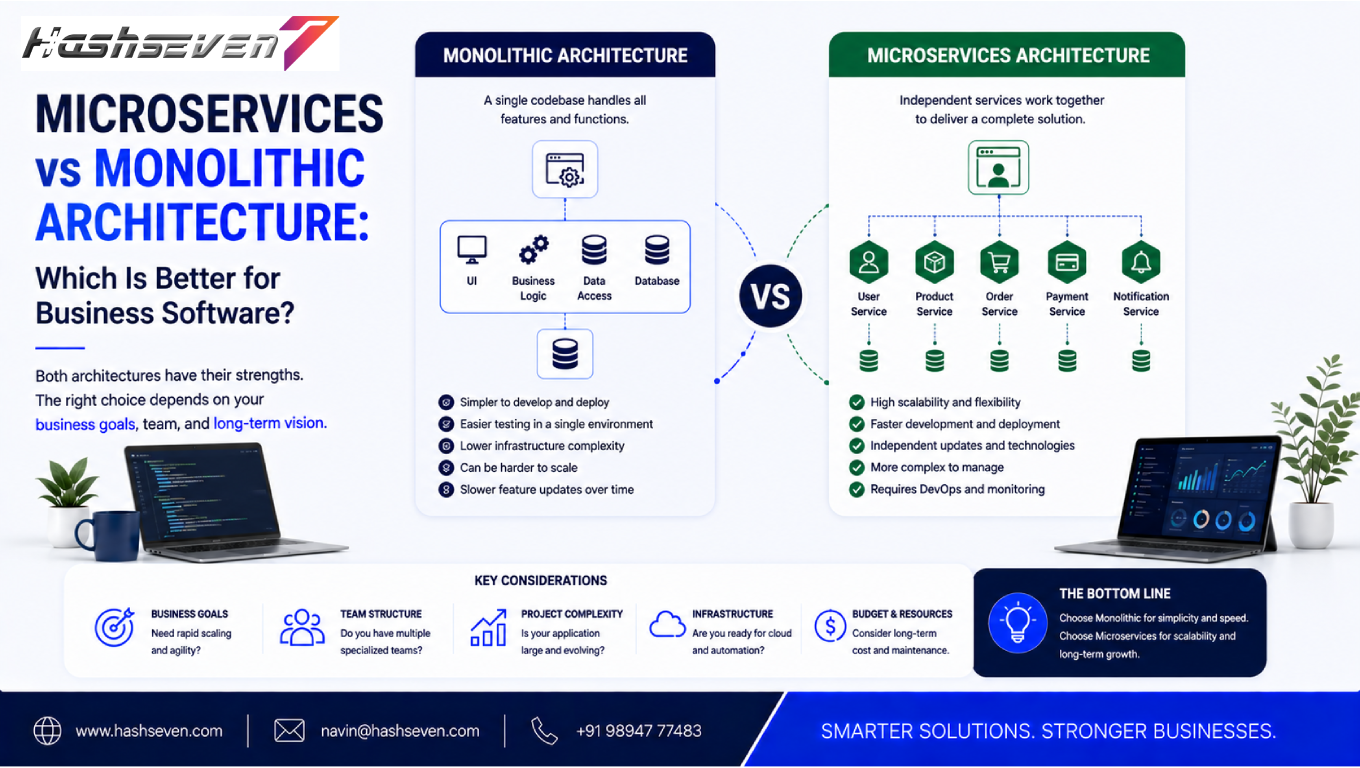

Modern businesses depend on software to manage customers, operations, payments, communication, analytics, and day-to-day workflows. As software requirements become more complex, choosing the right architecture becomes an important business decision.
One of the most common architecture decisions is microservices vs monolithic.
A monolithic architecture builds an application as a single, unified software system, while a microservices architecture divides an application into smaller, independently developed and deployable services. Both approaches have advantages and limitations.
Choosing between them should not be based simply on which architecture is newer or more popular. The right choice depends on application complexity, development team size, scalability requirements, budget, integrations, security, deployment needs, and long-term business goals.
For some businesses, a well-designed monolithic application can provide simplicity, faster development, and lower operational complexity. For larger or highly complex applications, microservices can provide greater flexibility, independent scalability, and deployment advantages.
In this guide, we will explain microservices vs monolithic architecture, their differences, benefits, limitations, costs, scalability, security considerations, use cases, and how businesses can choose the right approach for their software.
What Is Monolithic Architecture?
Monolithic architecture is a software architecture in which the major components of an application are developed and deployed as one integrated application.
A typical monolithic application may contain:
- User interface
- Business logic
- Authentication
- Database access
- Payment functionality
- Reporting
- Notifications
- Administrative features
These components may be logically separated within the codebase, but the application is generally built and deployed as one unit.
For example, an e-commerce application might contain product management, customer accounts, shopping carts, payments, orders, and reporting within the same application.
When the application is updated, the entire application may need to be built, tested, and deployed together.
What Are Microservices?
Microservices architecture divides an application into smaller, independently managed services.
Each service generally focuses on a specific business capability.
For example, an e-commerce platform could contain separate services for:
- Customer management
- Product catalog
- Orders
- Payments
- Inventory
- Notifications
- Authentication
These services can communicate with one another through APIs or messaging systems.
Each service can potentially be developed, tested, deployed, monitored, and scaled independently.
This approach can make large applications more flexible, but it also introduces additional technical and operational complexity.
Build a Website That Grows Your Business
A professionally developed website is the foundation of your online success. If you’re planning to create a responsive, fast, and SEO-friendly business website, explore our Website Development Services to see how Hashseven can help transform your ideas into a powerful digital presence.
Microservices vs Monolithic: The Basic Difference
The simplest way to understand microservices vs monolithic architecture is:
Monolithic architecture: One integrated application.
Microservices architecture: Multiple smaller services working together.
A monolithic application may be easier to develop and operate when the system is relatively simple.
Microservices may become more useful when the application has many independent business capabilities and requires separate scaling, deployment, or team ownership.
Microservices vs Monolithic Architecture Comparison
| Feature | Monolithic Architecture | Microservices Architecture |
|---|---|---|
| Application structure | Single application | Multiple services |
| Deployment | Usually as one unit | Services can deploy independently |
| Development | Simpler initially | More complex |
| Scalability | Usually application-level | Service-level |
| Infrastructure | Simpler | More distributed |
| Testing | Easier initially | More complex |
| Debugging | Generally simpler | Distributed tracing may be required |
| Deployment frequency | Often coordinated | Can be independent |
| Team requirements | Smaller teams can manage it | Often benefits from multiple specialized teams |
| Communication | Usually internal calls | APIs or messaging |
| Failure isolation | More limited | Better when designed correctly |
| Operational complexity | Lower | Higher |
| Best for | Small to medium applications | Complex, large-scale systems |
| Initial cost | Usually lower | Usually higher |
| Long-term flexibility | Good | High |
How Monolithic Architecture Works
In a monolithic application, different functions operate within the same application.
A simplified flow might look like:
User → Application → Business Logic → Database
When a customer places an order, the same application may handle:
- Customer authentication
- Product selection
- Order processing
- Payment processing
- Inventory updates
- Notifications
All of these functions may exist inside the same deployable application.
This structure can be straightforward to understand and maintain when the application is not excessively large.
How Microservices Architecture Works
In a microservices system, the same workflow can involve multiple services.
For example:
User → API Gateway → Order Service → Payment Service → Inventory Service → Notification Service
Each service manages a specific responsibility.
The Order Service handles orders.
The Payment Service handles payments.
The Inventory Service manages stock.
The Notification Service sends messages.
These services communicate through APIs or messaging infrastructure.
This separation can allow individual services to evolve independently.
Advantages of Monolithic Architecture
Simpler Development
A monolithic application can be easier for developers to understand because the application logic exists within one primary codebase.
Developers can often trace a feature from the user interface through business logic to the database without crossing multiple network boundaries.
Faster Initial Development
For smaller applications, a monolithic architecture can allow teams to build features quickly.
Developers do not necessarily need to configure:
- Multiple services
- Service discovery
- Distributed monitoring
- Message brokers
- Container orchestration
- Complex deployment pipelines
This can reduce the amount of infrastructure required during the early stages.
Easier Testing
Testing a monolithic application can be simpler because components operate within the same application environment.
Developers can perform:
- Unit testing
- Integration testing
- End-to-end testing
without managing a large distributed environment.
Lower Infrastructure Complexity
A monolithic application may require fewer infrastructure components.
This can reduce:
- Hosting complexity
- Monitoring requirements
- Deployment management
- Operational overhead
Easier Debugging
When something goes wrong, developers may have fewer components to investigate.
Logs, application behavior, and database interactions can often be analyzed within one system.
Lower Initial Cost
For smaller businesses, monolithic architecture can reduce initial development and infrastructure costs.
This can make it an attractive option for:
- Startups
- Small businesses
- Internal applications
- MVPs
- Small SaaS products
Limitations of Monolithic Architecture
Scaling the Entire Application
If one part of the application experiences heavy traffic, businesses may need to scale the entire application instead of only the component under pressure.
For example, if the product search functionality requires additional resources, the entire application may need additional instances.
Larger Codebase
As applications grow, the codebase can become increasingly difficult to understand.
Developers may find it harder to identify dependencies and safely modify existing functionality.
Deployment Dependencies
A small change to one component may require deployment of the entire application.
This can increase deployment risk and coordination requirements.
Technology Limitations
A large monolithic application may become tied to a particular programming language, framework, or technology stack.
Changing one part of the application may require significant changes across the system.
Maintenance Challenges
As more features are added, the application can become increasingly complex.
Without proper architecture and code organization, development speed can decline over time.
Advantages of Microservices Architecture
Independent Scalability
One of the major benefits of microservices is the ability to scale individual services.
For example, if the payment service receives significantly more traffic, the business can potentially scale the payment service without scaling unrelated services.
Independent Deployment
Teams can deploy individual services without necessarily deploying the entire application.
This can enable faster release cycles when the architecture and deployment processes are designed properly.
Better Team Independence
Different teams can own different services.
For example:
- Team A → Customer Service
- Team B → Payment Service
- Team C → Inventory Service
- Team D → Notification Service
This can help larger organizations divide development responsibilities.
Technology Flexibility
Different services can potentially use different technologies when there is a legitimate technical reason.
One service might use one programming language while another uses a different technology.
However, excessive technology diversity can increase operational complexity.
Fault Isolation
A properly designed microservices system can isolate failures.
If the notification service fails, the rest of the application may continue operating.
The actual behavior depends heavily on system design and failure-handling mechanisms.
Easier Evolution of Large Systems
Businesses can modify or replace individual services without rebuilding the entire application.
This can provide greater flexibility for complex systems.
Limitations of Microservices Architecture
Increased Complexity
Microservices introduce distributed-system challenges.
Businesses may need to manage:
- Service communication
- Authentication
- Network failures
- API versioning
- Distributed transactions
- Monitoring
- Logging
- Service discovery
- Deployment pipelines
Higher Infrastructure Requirements
A microservices system may require additional technologies for:
- Containers
- Orchestration
- Monitoring
- Logging
- API gateways
- Message queues
- Service discovery
This can increase infrastructure costs.
Distributed Debugging
When a customer request passes through multiple services, identifying the source of a problem can become more difficult.
Businesses may require centralized logging and distributed tracing.
Data Management Complexity
Each service may have its own data requirements.
Maintaining consistency across multiple services can be more complicated than managing one centralized database.
Higher Skill Requirements
Microservices often require developers and operations teams with experience in:
- Distributed systems
- Cloud infrastructure
- APIs
- Containers
- DevOps
- Observability
- Security
Without sufficient expertise, microservices can create unnecessary technical problems.
Microservices vs Monolithic for Scalability
Scalability is one of the most important factors in the microservices vs monolithic discussion.
A monolithic application can scale successfully.
For many businesses, horizontal scaling of a well-designed monolith is completely sufficient.
However, microservices allow businesses to scale specific services independently.
For example:
Product Search: High traffic
Reporting: Low traffic
Customer Accounts: Medium traffic
With microservices, each service can potentially receive different resource allocations.
This can improve resource efficiency for large and complex applications.
However, independent scaling does not automatically make microservices better.
A poorly designed microservices system can consume more resources and create additional bottlenecks.
Microservices vs Monolithic for Performance
Performance depends on application design, infrastructure, database architecture, caching, network conditions, and implementation quality.
A monolithic application can sometimes perform very efficiently because internal communication occurs within the same application.
Microservices introduce network communication between services.
This can create additional:
- Network latency
- Serialization overhead
- API calls
- Failure points
However, microservices can improve performance in certain scenarios by allowing high-demand services to scale independently.
Therefore, businesses should evaluate actual workload requirements rather than assuming one architecture will always be faster.
Microservices vs Monolithic for Security
Security is important for both architectures.
A monolithic application provides a centralized application environment, which can simplify certain security controls.
However, a vulnerability in one area may potentially affect the wider application.
Microservices can provide stronger service boundaries.
For example, sensitive payment functionality can be isolated from other application components.
However, microservices introduce additional security concerns around:
- Service-to-service authentication
- API security
- Network communication
- Secrets management
- Identity management
- Access control
- Service permissions
A secure architecture requires security to be designed into the system rather than relying solely on the architecture style.
For application security guidance, businesses can refer to the OWASP Foundation.
Microservices vs Monolithic for Deployment
Monolithic applications are generally deployed as one application.
This can make deployment straightforward.
However, a small change may require a complete application deployment.
Microservices can allow individual services to be deployed independently.
For example, a business may update the Notification Service without redeploying the Payment Service.
This can improve deployment flexibility.
However, independent deployments require strong:
- CI/CD pipelines
- Automated testing
- Monitoring
- Version management
- Rollback procedures
Without these capabilities, microservices can become difficult to operate.
Microservices vs Monolithic for Development Teams
Team structure should influence architecture decisions.
A small team may find microservices unnecessarily complex.
For example, a five-person development team managing ten services could spend significant time maintaining infrastructure instead of building business features.
A larger organization with multiple development teams may benefit from service ownership.
Each team can manage specific business capabilities independently.
Therefore:
Small team + simple application → Monolithic may be practical
Multiple teams + complex application → Microservices may provide advantages
This is not a strict rule, but it is a useful starting point.
Microservices vs Monolithic for Cost
Cost includes more than development.
Businesses should consider:
- Development
- Hosting
- Infrastructure
- Monitoring
- Security
- Maintenance
- Testing
- DevOps
- Training
- Support
A monolithic application generally has lower operational complexity.
Microservices can require additional infrastructure and engineering expertise.
However, microservices can provide long-term efficiency for businesses that need independent scaling and frequent deployments.
The best approach is to compare total cost of ownership, not just initial development cost.
When Should a Business Choose Monolithic Architecture?
A monolithic architecture may be appropriate when:
- The application is relatively simple.
- The development team is small.
- The business needs rapid initial development.
- The expected traffic is manageable.
- Infrastructure should remain simple.
- The product is still being validated.
- Independent service scaling is unnecessary.
- The organization has limited DevOps resources.
For many small and medium-sized businesses, a well-designed modular monolith can be an excellent starting point.
When Should a Business Choose Microservices?
Microservices may be appropriate when:
- The application is highly complex.
- Different components require independent scaling.
- Multiple teams work on different business capabilities.
- Frequent independent deployments are required.
- Different services have different performance requirements.
- Strong service boundaries provide business value.
- The organization has mature DevOps capabilities.
- The software operates at significant scale.
Microservices should solve a real business or technical problem.
They should not be adopted simply because they are considered modern.
What Is a Modular Monolith?
A modular monolith provides an interesting middle ground.
Instead of creating multiple independently deployed services, developers organize the monolithic application into clearly separated modules.
For example:
- Customer Module
- Product Module
- Order Module
- Payment Module
- Reporting Module
The application remains one deployable unit, but internal boundaries are clearly defined.
This approach can provide many benefits of good architectural separation without immediately introducing the complexity of distributed systems.
For businesses that are uncertain about microservices, a modular monolith can be a practical strategy.
Can a Monolith Be Converted Into Microservices?
Yes.
Businesses can gradually migrate a monolithic application toward microservices.
However, migration should be planned carefully.
A typical approach may involve:
Monolith → Identify Boundaries → Extract One Service → Test → Monitor → Scale → Repeat
Businesses should identify functionality that has a clear boundary and business value.
For example, a large application might first extract its notification functionality into an independent service.
Later, it could separate:
- Search
- Payments
- Inventory
- Customer management
The migration should be gradual rather than attempting to rebuild the entire application at once.
How to Choose the Right Architecture
Step 1: Understand Business Requirements
Start with business requirements rather than technology trends.
Ask:
- How complex is the application?
- How many users are expected?
- What growth is anticipated?
- Which functions are business-critical?
Step 2: Evaluate Team Size
Consider how many developers and operations professionals will maintain the system.
Step 3: Estimate Scalability Requirements
Determine whether individual components need to scale independently.
Step 4: Review Deployment Requirements
Ask how frequently the business needs to release updates.
Step 5: Evaluate Infrastructure Capabilities
Determine whether the organization has experience with:
- Cloud infrastructure
- Containers
- CI/CD
- Monitoring
- Distributed systems
Step 6: Compare Total Cost
Evaluate development and long-term operational expenses.
Step 7: Consider Future Growth
Choose an architecture that supports realistic future requirements without introducing unnecessary complexity today.
Microservices vs Monolithic Decision Framework
| Business Situation | Recommended Approach |
|---|---|
| Small website application | Monolithic |
| Simple internal software | Monolithic |
| Startup MVP | Monolithic |
| Small development team | Monolithic |
| Moderate business application | Modular monolith |
| Large application | Evaluate both |
| Multiple development teams | Microservices may fit |
| Independent service scaling | Microservices |
| Highly complex platform | Microservices may fit |
| Frequent independent releases | Microservices |
| Limited DevOps expertise | Monolithic |
| Highly distributed system | Microservices |
| Uncertain requirements | Start simpler |
Common Mistakes Businesses Should Avoid
Choosing Microservices Too Early
Microservices can introduce complexity before the business actually needs it.
Treating Monolithic as Outdated
Monolithic architecture is not automatically bad.
A well-designed monolith can be scalable, secure, maintainable, and reliable.
Ignoring Team Capabilities
Architecture should match the skills and resources available to the organization.
Splitting Services Without Clear Boundaries
Creating too many small services can produce unnecessary communication and management overhead.
Ignoring Database Design
Poor database architecture can become a major bottleneck regardless of application architecture.
Neglecting Monitoring
Distributed systems require strong observability.
Focusing Only on Technology
Architecture should support business objectives rather than become the objective itself.
Best Practices for Monolithic Applications
Businesses choosing monolithic architecture should still follow strong development practices.
Important practices include:
- Modular code organization
- Clear separation of responsibilities
- Automated testing
- Secure coding
- Database optimization
- Caching
- Continuous integration
- Automated deployment
- Monitoring
- Documentation
- Regular refactoring
A monolith should not mean an unstructured codebase.
Best Practices for Microservices
Businesses implementing microservices should focus on:
- Clearly defined service boundaries
- API-first design
- Automated testing
- Centralized logging
- Distributed tracing
- Service authentication
- Secure communication
- Automated deployment
- Failure handling
- Monitoring
- Documentation
- Infrastructure automation
The OpenTelemetry project provides open-source observability frameworks for generating and collecting telemetry such as traces, metrics, and logs.
Future of Software Architecture
Software architecture continues to evolve as businesses adopt:
- Cloud computing
- Serverless technologies
- Container platforms
- AI applications
- API-driven systems
- Event-driven architecture
- Edge computing
- Distributed databases
Microservices will continue to be useful for many large-scale applications, but simpler architectural approaches will remain valuable.
Businesses should avoid assuming that every application needs a distributed architecture.
The future is likely to involve more context-driven architecture, where teams select the appropriate combination of monolithic, modular, microservices, serverless, and managed cloud technologies according to actual requirements.
Frequently Asked Questions
1. What is the main difference between microservices and monolithic architecture?
A monolithic application is generally built and deployed as one integrated unit, while microservices divide an application into smaller services that can be developed and deployed more independently.
2. Is microservices better than monolithic architecture?
Not always. Microservices can be better for complex applications requiring independent scaling and deployment, while monolithic architecture can be more practical for smaller applications and teams.
3. Is monolithic architecture suitable for small businesses?
Yes. A well-designed monolithic or modular monolithic application can provide simplicity, lower operational complexity, and cost-effective development for many small and medium-sized businesses.
4. Can a monolithic application be converted into microservices?
Yes. Businesses can gradually extract specific modules or capabilities from a monolithic application and turn them into independent services when there is a clear technical or business reason.
5. Which architecture is cheaper: microservices or monolithic?
Monolithic architecture is generally cheaper to start and operate because it requires less infrastructure and operational complexity. Microservices can become cost-effective at scale when independent deployment and service-level scaling provide significant business value.
Conclusion
The microservices vs monolithic decision is not about choosing the newest or most advanced technology.
It is about choosing an architecture that matches your business requirements.
Monolithic architecture can provide simplicity, faster initial development, easier testing, lower infrastructure complexity, and lower operational costs. These advantages make it a strong option for many small and medium-sized applications.
Microservices can provide independent deployment, service-level scalability, team autonomy, technology flexibility, and stronger separation for complex applications. These advantages can become increasingly valuable as software systems and organizations grow.
For businesses that are still developing their product or have relatively simple requirements, starting with a well-structured modular monolith can often be a practical choice. As the application grows, individual components can be separated when there is a clear reason to do so.
The best architecture is therefore the one that provides the right balance of performance, scalability, security, maintainability, development speed, and cost.
Ready to Build a Professional Website for Your Business?
Turn your business into a powerful online brand with Hashseven.
Since 2017, we’ve helped businesses grow through professional website development, mobile apps, custom software, SEO, digital marketing, CRM, POS solutions, and Meta-approved WhatsApp automation. Let’s create a fast, secure, and conversion-focused website that attracts more customers and drives real business growth.