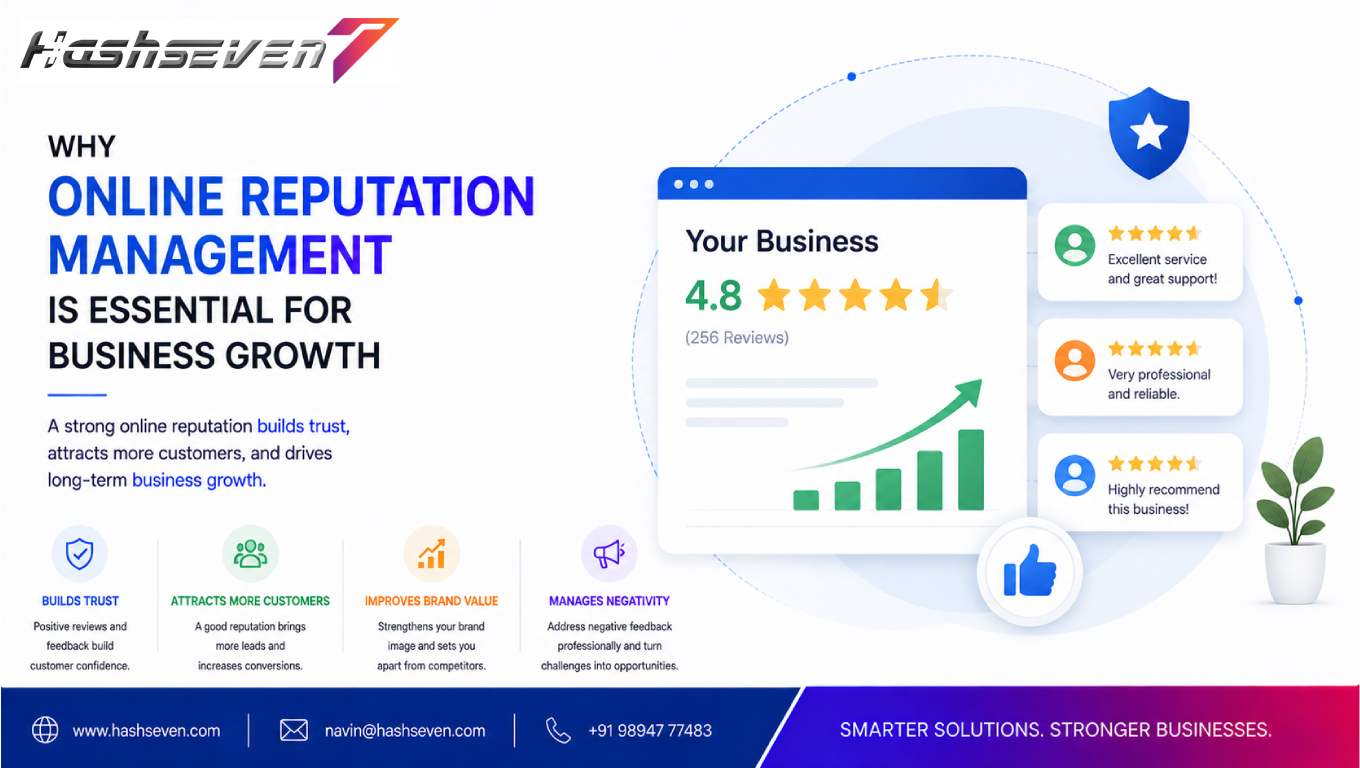

In today’s digital-first marketplace, customers can research a business before making almost any purchasing decision. They may read online reviews, check social media profiles, search for customer experiences, compare competitors, and look at what appears in search results.
This makes online reputation management an important part of modern business growth.
A strong online reputation can help a business build trust, attract new customers, generate leads, and encourage repeat purchases. On the other hand, negative reviews, inaccurate information, unresolved complaints, or inconsistent online communication can make potential customers hesitate.
Online reputation management is not simply about removing negative reviews. It involves monitoring how a business appears online, responding professionally to feedback, encouraging genuine customer reviews, maintaining accurate business information, and building positive digital experiences.
This complete guide explains why online reputation management matters, how it affects business growth, the strategies businesses can use, common mistakes to avoid, and how to create a sustainable reputation management strategy.
What Is Online Reputation Management?
Online reputation management is the process of monitoring, managing, and improving how a business, brand, product, or organization is perceived across digital channels.
These channels can include:
- Google Business Profile
- Search engine results
- Review websites
- Social media
- Business directories
- Industry websites
- Forums
- News websites
- Company websites
- Online marketplaces
Reputation management combines monitoring, customer communication, review management, content creation, and problem resolution.
The goal is not to create a perfect online image.
The goal is to build an accurate, trustworthy, and positive digital presence.
Build a Website That Grows Your Business
A professionally developed website is the foundation of your online success. If you’re planning to create a responsive, fast, and SEO-friendly business website, explore our Website Development Services to see how Hashseven can help transform your ideas into a powerful digital presence.
Why Online Reputation Management Matters
Customers increasingly use online information to evaluate businesses.
Before contacting a company, a customer might search for:
Business name + reviews
or:
Business name + complaints
They may also compare ratings, testimonials, social media activity, and website information.
A strong reputation can reduce uncertainty.
When potential customers see:
- Positive reviews
- Professional responses
- Accurate information
- Helpful content
- Real customer experiences
- Consistent branding
they may feel more confident about choosing the business.
1. Builds Customer Trust
Trust is one of the most important factors in purchasing decisions.
Customers want to know that a business:
- Delivers what it promises
- Treats customers professionally
- Responds to problems
- Provides quality service
- Communicates clearly
A well-managed online reputation provides evidence of these qualities.
For example, a business with numerous genuine reviews and thoughtful responses can appear more trustworthy than a business with little online information.
2. Influences Purchasing Decisions
Customers often compare multiple businesses before making a decision.
Imagine a customer has three local service providers to choose from.
Business A
- 4.7-star rating
- Recent reviews
- Professional responses
- Updated website
Business B
- 3.1-star rating
- Several unresolved complaints
- Outdated information
Business C
- Almost no reviews
- Limited online presence
The customer may naturally feel more comfortable with Business A.
This demonstrates why reputation can directly influence customer decisions.
3. Improves Local Business Visibility
For businesses that depend on local customers, reputation can be particularly important.
Local customers may search for:
- Restaurants
- Clinics
- Salons
- Repair services
- Agencies
- Retail stores
- Home services
Google Business Profile can display information such as reviews, business hours, photos, services, and contact information.
Maintaining accurate information and responding to customer feedback can help create a stronger local presence.
4. Helps Generate More Leads
A positive reputation can increase the likelihood that visitors will take action.
Depending on the business, conversions may include:
- Phone calls
- Contact forms
- Quote requests
- Appointment bookings
- Store visits
- Product purchases
- Consultation requests
When customers trust a business, they may be more willing to move from research to action.
5. Supports Higher Conversion Rates
Traffic alone does not guarantee business growth.
A website may receive thousands of visitors but generate relatively few inquiries if visitors lack trust.
Reputation signals such as:
- Reviews
- Testimonials
- Case studies
- Awards
- Certifications
- Customer stories
can help reduce uncertainty.
Businesses should place relevant trust signals near important conversion points.
6. Strengthens Brand Credibility
Brand credibility develops through consistent customer experiences and communication.
A business can strengthen credibility by:
- Providing accurate information
- Responding to feedback
- Publishing useful content
- Demonstrating expertise
- Maintaining consistent branding
- Delivering quality products and services
Online reputation management helps ensure that the digital representation of the business reflects its actual values and customer experience.
7. Helps Businesses Respond to Negative Reviews
Negative feedback is inevitable for many businesses.
Even excellent companies can receive complaints.
The important question is how the business responds.
A professional response should:
- Acknowledge the customer’s concern.
- Avoid becoming defensive.
- Provide relevant clarification.
- Offer a reasonable resolution where appropriate.
- Move sensitive discussions to a private channel when necessary.
The goal is not to argue with the customer.
The goal is to demonstrate professionalism.
8. Negative Reviews Can Provide Valuable Feedback
Not every negative review should be treated as an attack.
Some complaints reveal genuine problems.
For example:
“The website contact form did not work.”
or:
“The delivery information was unclear.”
These complaints can identify areas for improvement.
Businesses can use recurring feedback to improve:
- Products
- Services
- Customer support
- Website usability
- Communication
- Delivery processes
Reputation management can therefore become a source of business intelligence.
9. Encourages Genuine Customer Reviews
Businesses should make it easy for satisfied customers to provide honest feedback.
After completing a successful transaction, businesses can politely ask customers to share their experience.
Useful approaches include:
- Sending a follow-up email
- Providing a review request after service completion
- Sharing a review link
- Asking customers in person
- Including review instructions in customer communication
Businesses should never pressure customers to leave only positive reviews.
Authenticity is more valuable than artificially perfect ratings.
10. Helps Manage Reviews Across Multiple Platforms
Customers may leave feedback on different platforms.
Depending on the industry, these may include:
- Yelp
- TripAdvisor
- Industry directories
- E-commerce marketplaces
Businesses should monitor the platforms that are relevant to their customers.
A centralized reputation process can make it easier to identify new feedback and respond consistently.
11. Protects Your Brand From Inaccurate Information
Incorrect online information can create customer confusion.
Examples include:
- Wrong phone number
- Incorrect address
- Outdated business hours
- Old service information
- Incorrect pricing
- Outdated website pages
Businesses should regularly review important online profiles.
Accurate information improves customer experience and reduces unnecessary frustration.
12. Helps Control Search Results
When customers search for a business name, they may encounter different types of content.
Search results can include:
- Company website
- Social profiles
- Reviews
- News articles
- Directory listings
- Blog posts
- Customer discussions
Businesses cannot completely control what other people publish.
However, they can build a stronger digital presence by consistently publishing useful, accurate, and authoritative content.
This can help customers find reliable information about the company.
13. Strengthens Social Media Reputation
Social media is another important part of reputation management.
Customers may judge a business based on:
- Posts
- Comments
- Replies
- Customer complaints
- Visual content
- Response speed
- Brand tone
Businesses should monitor relevant mentions and respond professionally.
Avoid engaging in public arguments with customers.
14. Creates Better Customer Relationships
Reputation management is closely connected to customer experience.
When businesses respond to feedback, acknowledge customers, and resolve problems, customers can feel heard.
This can strengthen relationships and encourage:
- Repeat purchases
- Recommendations
- Positive reviews
- Referrals
- Long-term loyalty
15. Increases Customer Retention
Acquiring a new customer can require significant marketing effort.
Retaining existing customers can create long-term value.
A business that actively listens to customers can identify problems before they become reasons for customers to leave.
For example:
Complaint → Response → Resolution → Follow-up
This process can turn a negative experience into an opportunity to rebuild trust.
16. Supports Word-of-Mouth Marketing
Positive customer experiences often lead to recommendations.
Customers may recommend a business through:
- Google reviews
- Social media
- Personal conversations
- Community groups
- Online forums
A strong reputation can therefore create a cycle:
Good Experience → Positive Feedback → More Trust → More Customers
17. Improves Customer Experience
Reputation management should not be treated only as a marketing activity.
It can also improve operations.
Businesses can analyze feedback to identify recurring problems.
For example:
If multiple customers complain about slow responses, the business may need to improve its support process.
If customers repeatedly praise a particular service, the business can highlight that strength in its marketing.
18. Builds Social Proof
Social proof helps customers feel more confident about making a decision.
Examples include:
- Customer reviews
- Testimonials
- Case studies
- Ratings
- Customer photos
- Video testimonials
- Success stories
Businesses should use authentic social proof throughout their websites and marketing materials.
19. Supports SEO and Online Visibility
Reputation management and SEO are different disciplines, but they can work together.
Positive customer experiences can lead to:
- More branded searches
- More reviews
- More mentions
- More website visits
- More customer-generated content
Businesses should never attempt to manipulate reviews or search results.
Instead, focus on providing genuine value and building a strong digital presence.
Google provides useful guidance through its SEO Starter Guide.
20. Helps Businesses Compete With Larger Brands
Small businesses may not have the advertising budgets of large companies.
However, they can compete through:
- Excellent customer service
- Strong reviews
- Local reputation
- Personalized communication
- Customer relationships
- Community involvement
A smaller business with an excellent reputation can outperform a larger competitor in specific local markets.
21. Online Reputation Management for Small Businesses
Small businesses should focus on a few important areas rather than trying to monitor everything.
A practical starting point is:
Google Business Profile
Maintain accurate information and monitor reviews.
Website
Ensure that your website communicates trust and professionalism.
Social Media
Monitor comments and customer questions.
Reviews
Encourage genuine customer feedback.
Search Results
Search your business name regularly to understand what customers see.
22. Online Reputation Management for E-Commerce Businesses
E-commerce businesses often depend heavily on reviews.
Customers may evaluate:
- Product ratings
- Customer comments
- Delivery experiences
- Return policies
- Seller responses
Businesses should monitor product feedback and address recurring problems.
Negative feedback can reveal issues with:
- Product quality
- Packaging
- Delivery
- Product descriptions
- Customer support
23. Online Reputation Management for B2B Companies
B2B customers often conduct extensive research before choosing a service provider.
They may review:
- Company websites
- LinkedIn profiles
- Case studies
- Client testimonials
- Industry publications
- Reviews
- Company leadership
B2B businesses should build authority through useful content and genuine customer success stories.
24. Monitor Your Brand Mentions
Businesses should know where their brand is being discussed.
Monitor:
- Business name
- Product names
- Key executives where appropriate
- Major services
- Brand variations
Depending on your business size, monitoring can be performed manually or through specialized monitoring tools.
The goal is to identify relevant conversations early.
25. Create a Reputation Monitoring Process
A simple reputation management process can look like this:
Monitor → Identify → Evaluate → Respond → Resolve → Learn
Monitor
Find new reviews and mentions.
Identify
Determine whether the feedback is positive, negative, neutral, or potentially inaccurate.
Evaluate
Understand the context.
Respond
Provide a professional response.
Resolve
Take appropriate action.
Learn
Use recurring feedback to improve the business.
26. Respond Quickly but Thoughtfully
Speed matters, but accuracy matters too.
Do not respond emotionally immediately after receiving a negative comment.
Instead:
- Read the complaint carefully.
- Verify the facts.
- Discuss internally if necessary.
- Write a professional response.
- Offer an appropriate next step.
A thoughtful response is usually better than a rushed response.
27. Use a Consistent Brand Voice
Your reputation can be affected by how your business communicates.
Choose a brand voice that is:
- Professional
- Helpful
- Respectful
- Clear
- Human
Avoid:
- Insults
- Sarcasm
- Aggressive responses
- Blaming customers
- Arguments
Consistency makes your business appear more reliable.
28. Turn Positive Reviews Into Marketing Assets
With appropriate customer permission, businesses can use positive feedback in marketing.
Examples include:
- Website testimonials
- Social media posts
- Case studies
- Email campaigns
- Landing pages
For example:
Customer testimonial → Website case study → Social media content
This allows one positive customer experience to support multiple marketing activities.
29. Create a Crisis Reputation Plan
Businesses should prepare for serious reputation issues before they happen.
A crisis may involve:
- Product complaints
- Service failures
- Data incidents
- Viral negative posts
- Misleading information
- Public misunderstandings
A crisis plan should define:
- Who responds
- Who approves statements
- Which channels are used
- How customers are updated
- How facts are verified
Preparation can reduce confusion during a crisis.
30. Avoid Fake Reputation Management
Businesses should never attempt to manipulate their reputation using dishonest methods.
Avoid:
- Fake reviews
- Fake testimonials
- Buying ratings
- Creating fake customer accounts
- Posting fake comments
- Attacking competitors
- Misleading claims
These practices can damage trust and create long-term problems.
31. Use Customer Feedback to Improve Products
Reputation management should connect with product development.
Businesses can categorize feedback into:
- Product requests
- Service complaints
- Usability problems
- Pricing concerns
- Support issues
- Feature requests
This information can help product and management teams prioritize improvements.
32. Use Customer Feedback to Improve Marketing
Reviews can reveal the language customers naturally use when describing your business.
For example, customers may repeatedly mention:
- Fast delivery
- Friendly service
- Easy process
- Affordable pricing
- Professional support
These genuine customer phrases can provide useful insights for marketing messaging.
33. Build a Strong Review Response Strategy
A simple response framework can help.
Positive Review
Thank → Appreciate → Reinforce
Neutral Review
Thank → Clarify → Invite further communication
Negative Review
Acknowledge → Apologize where appropriate → Resolve → Follow up
Keep responses professional and avoid revealing private customer information.
34. Measure Online Reputation Performance
Businesses should track reputation-related metrics.
Useful indicators include:
- Review volume
- Average rating
- Review response rate
- Response time
- Sentiment trends
- Brand mentions
- Customer complaints
- Customer retention
- Referral volume
The objective is not simply to increase the number of positive reviews.
The objective is to improve customer trust and business performance.
35. Build a Long-Term Reputation Strategy
Online reputation management is not a one-time activity.
It should become part of ongoing business operations.
A long-term strategy can include:
Weekly
- Monitor reviews
- Respond to customer questions
Monthly
- Review reputation trends
- Check business listings
- Analyze customer feedback
Quarterly
- Review customer sentiment
- Identify recurring complaints
- Update reputation strategy
This consistent approach is more effective than reacting only when a problem appears.
Online Reputation Management Checklist
Use this checklist to evaluate your current reputation strategy:
- Google Business Profile is accurate
- Business information is consistent
- Customer reviews are monitored
- Reviews receive professional responses
- Genuine reviews are encouraged
- Website contains trust signals
- Testimonials are updated
- Social media mentions are monitored
- Customer complaints are documented
- Negative feedback is handled professionally
- Brand mentions are monitored
- Search results are reviewed regularly
- Customer feedback reaches the right internal team
- Crisis communication procedures exist
- Reputation metrics are tracked
Common Online Reputation Management Mistakes
Ignoring Negative Reviews
Ignoring legitimate complaints can make customers feel that the business does not care.
Responding Emotionally
Public arguments can make a small problem much bigger.
Buying Fake Reviews
Fake reviews can destroy credibility.
Only Monitoring One Platform
Customers may discuss your business across multiple channels.
Not Updating Business Information
Incorrect information can frustrate customers.
Deleting Legitimate Criticism
Removing genuine negative feedback does not solve the underlying problem.
Making False Claims
Reputation should be built on real customer experiences.
How Online Reputation Management Supports Business Growth
The relationship can be summarized as:
Better Customer Experience
↓
More Positive Feedback
↓
Stronger Online Reputation
↓
Greater Customer Trust
↓
Higher Conversion Potential
↓
More Customers
↓
Business Growth
This is why reputation management should be connected to customer service, marketing, sales, and business operations.
Frequently Asked Questions
1. What is online reputation management?
Online reputation management is the process of monitoring, managing, and improving how a business is perceived across search engines, review platforms, social media, websites, directories, and other online channels.
2. Why is online reputation management important for businesses?
It helps businesses build trust, respond to customer feedback, manage inaccurate information, strengthen credibility, improve customer relationships, and support lead generation and conversions.
3. How can a business improve its online reputation?
Businesses can improve their reputation by providing excellent customer experiences, encouraging genuine reviews, responding professionally to feedback, maintaining accurate online information, publishing useful content, and resolving legitimate complaints.
4. Should businesses respond to negative reviews?
Yes. Businesses should generally respond professionally to legitimate negative reviews. The response should acknowledge the concern, avoid arguments, protect customer privacy, and provide an appropriate path toward resolution.
5. How long does online reputation management take?
Reputation management is an ongoing process. Improvements can take time because businesses need to consistently deliver good experiences, collect genuine feedback, resolve problems, and build positive digital visibility.
Conclusion
Online reputation management is an essential part of modern business growth because customers increasingly research businesses before making purchasing decisions.
A strong online reputation can improve trust, credibility, customer confidence, lead generation, conversions, and retention. However, reputation cannot be created through reviews alone.
Businesses need to focus on the complete customer experience.
That means delivering quality products and services, maintaining accurate information, responding professionally to feedback, encouraging genuine reviews, monitoring important online channels, and using customer feedback to improve operations.
The most effective reputation strategy is proactive rather than reactive.
Instead of waiting for a negative review or public complaint, businesses should continuously monitor their online presence and build positive customer experiences.
When reputation management becomes part of everyday business operations, it can transform customer feedback into an opportunity for improvement and help create a stronger foundation for sustainable growth.
Ready to Build a Professional Website for Your Business?
Turn your business into a powerful online brand with Hashseven.
Since 2017, we’ve helped businesses grow through professional website development, mobile apps, custom software, SEO, digital marketing, CRM, POS solutions, and Meta-approved WhatsApp automation. Let’s create a fast, secure, and conversion-focused website that attracts more customers and drives real business growth.